

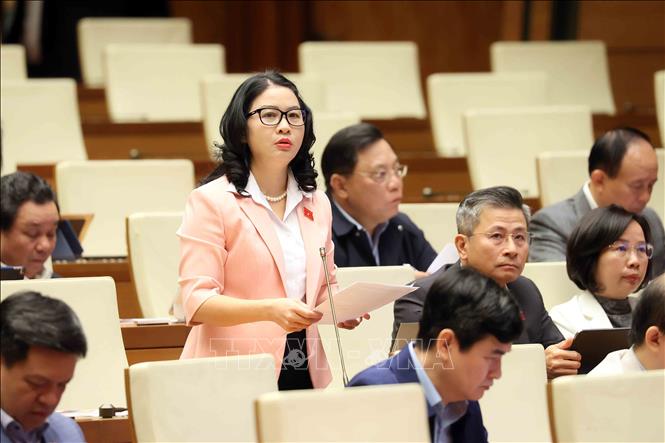
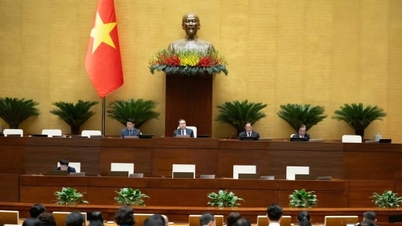
According to delegate Nguyen Thi Lan (Hanoi delegation), agriculture, farmers and rural areas continue to play an important fundamental role in stabilizing the economy and society, ensuring food security and adapting to climate change. In the context of low income and large regional differences, the development of a new phase of integrated national target program is extremely necessary. The program's objectives are clear, especially the goal of increasing people's income by 2.5-3 times and strongly improving the quality of rural life, moving from "meeting standards" to "sustainable and modern development".
Giving comments to complete the draft, delegate Nguyen Thi Lan said that the vocational training content is still general, while the requirements of modern agriculture require digital skills, automation and production management.
Delegates suggested adding a new generation of rural human resource training program, focusing on digital skills, modern machinery operation, and agricultural management and business skills. At the same time, increasing the role of universities and research institutes in transferring technology directly to farmers, avoiding too many intermediary levels. Or the agricultural extension team also needs to be focused on because this is the core force supporting production innovation at the grassroots level.
Regarding science, technology and innovation, according to delegate Nguyen Thi Lan, the draft has not yet specified the budget ratio specifically for scientific and technological research and innovation, and there is no mechanism for ordering research or attracting technology enterprises to participate.
Delegate Nguyen Thi Lan proposed establishing a Rural Innovation Fund. With this fund, localities will be more proactive in placing research orders. At the same time, funding will be prioritized for areas such as biotechnology, seeds, digital transformation, and artificial intelligence.
Regarding environmental economics and climate adaptation, delegate Nguyen Thi Lan said that the draft still lacks a set of indicators for land and water assessment and has not fully mentioned the low-carbon agricultural model or regional climate solutions. Adding these criteria is not only a requirement for sustainable development but also a mandatory condition to meet the standards of markets importing Vietnamese agricultural products.
Regarding the mechanism for monitoring, decentralization and measurement of results, delegate Nguyen Thi Lan said that the draft still lacks a digital monitoring system; a set of indicators for evaluating output results; and a clear accountability mechanism for each level and each investor. Accordingly, the delegate proposed adding criteria for monitoring income, livelihood, environment, and actual poverty reduction; at the same time, building an electronic monitoring system, clearly defining accountability for each level and each investor to ensure transparency and effective program implementation.
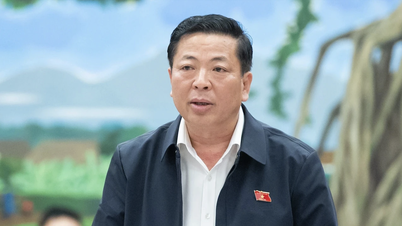
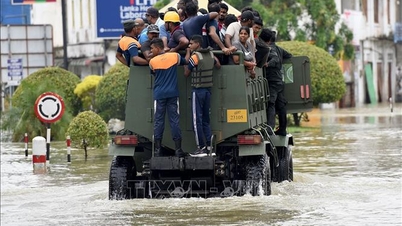
Commenting on the draft, delegate Hoang Van Cuong (Hanoi Delegation) said that the development of rural infrastructure should be given special priority in building and developing safe, stable and sustainable residential clusters, villages and hamlets. In recent times, reality has shown that people in mountainous areas are often heavily affected by flash floods, landslides and heavy rains due to living in unsafe areas.
Therefore, it is necessary to have a roadmap for population arrangement and reorganization. Not to relocate the entire population, but to form safe residential clusters so that synchronous infrastructure investment can be made. Only when households from high-risk areas are concentrated in safer locations, will investment in infrastructure, essential services and stabilizing people's lives be effective.
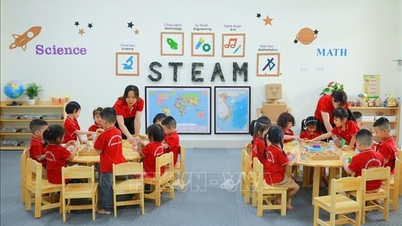
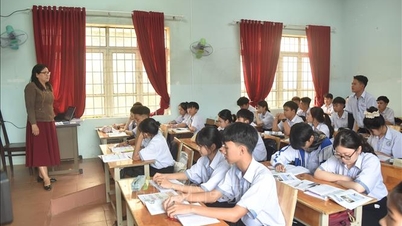
Delegate Hoang Van Cuong noted that the program mentioned the construction of preschools and kindergartens, however, there were no targets on the proportion of children in mountainous areas who had access to education, especially those who studied two sessions a day, or who had access to semi-boarding and boarding schools. Semi-boarding and boarding schools play a very important role in ensuring safety and improving the quality of children in mountainous areas.
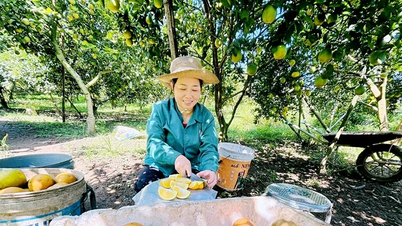
Regarding the transition to commodity production, delegates suggested not to repeat the livelihood support model as in the old program. To produce commodities, there must be a leader, that is, there must be a capable enterprise or investor to link with farmers, purchase products, provide technical support and access the market. Therefore, there should be incentive and preferential policies for leaders in this commodity production.
According to delegate Leo Thi Lich (Bac Ninh delegation), although the New Rural Development Program and the Poverty Reduction Program have achieved relatively high results, the Socio-Economic Development Program for Ethnic Minority Areas in the 2021-2025 period still has very low disbursement, reaching only 45.9%, with more than 54,000 billion VND undisbursed. The proposal to transfer resources to the next phase requires a careful assessment of the causes and actual effectiveness.
Delegate Leo Thi Lich was also very concerned about the counterpart capital requirement in the draft of the new program. In the 2021-2025 period, many localities still have difficulty completing the 10% counterpart fund, while the new draft requires 33% counterpart capital - which is very difficult for provinces that still depend heavily on the central budget.
Regarding the issue of capital, delegate Le Nhat Thanh (Hanoi delegation) agreed with the Government's view that it is necessary to create a development push, starting from ethnic minority and mountainous areas. Therefore, it is necessary to prioritize resources for this area; in which the central budget plays a key role in the conditions where localities have difficulty balancing their budgets and have low counterpart capacity. The delegate suggested that the central budget allocated for component two be at least equal to the level of the 2021-2025 period.
Source: https://baotintuc.vn/thoi-su/tich-hop-ba-chuong-trinh-muc-tieu-quoc-gia-quan-tam-den-nguon-von-20251203190223188.htm


![[Photo] Cat Ba - Green island paradise](/_next/image?url=https%3A%2F%2Fvphoto.vietnam.vn%2Fthumb%2F1200x675%2Fvietnam%2Fresource%2FIMAGE%2F2025%2F12%2F04%2F1764821844074_ndo_br_1-dcbthienduongxanh638-jpg.webp&w=3840&q=75)






























![[VIMC 40 days of lightning speed] Da Nang Port: Unity - Lightning speed - Breakthrough to the finish line](https://vphoto.vietnam.vn/thumb/402x226/vietnam/resource/IMAGE/2025/12/04/1764833540882_cdn_4-12-25.jpeg)

































Comment (0)