

Credit decreased across all economic sectors except for real estate.
Speaking at the Conference on the Implementation of Monetary Policy Management Tasks in 2024 on the morning of March 14th, Mr. Nguyen Quoc Hung - General Secretary of the Vietnam Banking Association - stated that the State Bank of Vietnam has implemented a comprehensive set of solutions, executing monetary policy flexibly, in line with the market economy and the Prime Minister 's directives, creating conditions for businesses to access credit capital and supporting economic growth.
As of February 28, 2024, credit to the economy decreased by 0.72% compared to 2023. Specifically, the agricultural sector saw a decrease of 0.17%, the industrial and construction sector a decrease of 0.13%, and the trade and services sector a decrease of 0.91%. Notably, real estate credit increased by 0.23%, while consumer lending decreased by 1.77%. It can be seen that most economic sectors experienced a decline, except for the real estate sector.
"However, low growth in the first few months of the year is a common phenomenon. The average credit growth in the first two months of the year during the period 2013-2023 was 0.56%. In 2014-2018 and 2024, the credit growth rate in the first two months of the year was negative," he said.
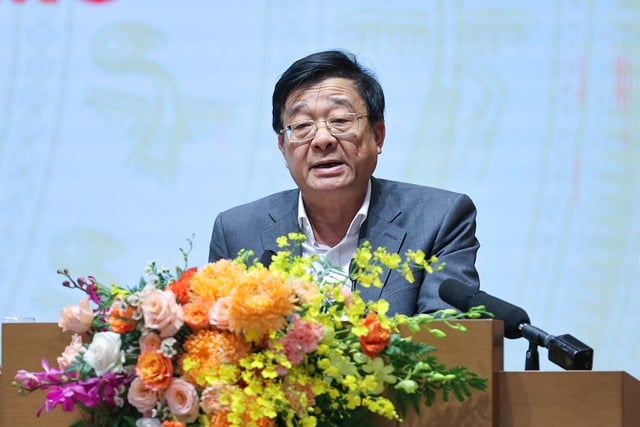
Mr. Nguyen Quoc Hung - General Secretary of the Vietnam Banking Association, speaking at the Conference (Photo: VGP).
Regarding the reasons, Mr. Hung pointed out that the capital market faced many difficulties, leading to pressure on medium and long-term capital, including short-term capital shifting to bank credit, while businesses struggled to cope with the impact of the Covid-19 pandemic.
The economy, plagued by global geopolitical conflicts that disrupt supply chains and lead to declining orders, has resulted in depleted resources and assets. Furthermore, the immense pressure to repay restructured loans under Circular 02 has led to companies failing to meet loan eligibility requirements.
Secondly, the banking sector faces existing pressure from bad debts in the context of Resolution 42 expiring and a sluggish real estate market, leading to difficulties in handling collateral assets and recovering bad debts.
Thirdly, consumer lending by finance companies continues to face difficulties as many borrowers intentionally default on their loans, with some even forming groups to openly default on debts on social media, leading credit institutions to narrow the scope and target of lending.
Fourth, high-tech fraud and money laundering are becoming increasingly audacious and sophisticated. Fifth, the implementation of some programs and policies directed by the Government and the Prime Minister faces many difficulties and obstacles related to legal regulations concerning social housing, with some conditions for homebuyers not matching the resources, income, and repayment capacity of customers.
Bank financing is not the main source of funding helping businesses overcome difficulties.
Regarding recommendations and proposals, the Banking Association believes that: Bank credit flows are only supplementary capital, not the primary source of funding to help businesses overcome difficulties and promote economic growth. Therefore, it requires the joint efforts of ministries, sectors, and localities in continuing to support and resolve difficulties for the business community and credit institutions.
Based on this, the Banking Association proposes that the Government direct relevant ministries, sectors, and local authorities to coordinate with the banking sector to implement comprehensive solutions to restore the economy and alleviate difficulties for businesses.
Specifically, this includes trade promotion, VAT refunds, and other programs, while also boosting public investment and stimulating consumer demand.
Next, it is necessary to remove legal obstacles, especially regarding land, to create favorable conditions for businesses to make new investments and expand production and business activities according to schedule, simplify investment processes and administrative procedures, and create favorable conditions for the business activities of people and enterprises.
"I propose that the Government allow state-owned banks to increase their charter capital, profits, and retained earnings to help credit institutions increase their capacity to provide credit to the economy," Mr. Hung stated.
He also suggested reviewing regulations related to the sustainable development of the capital market to amend and supplement them to suit practical realities and international practices, thereby building confidence among investors. He also proposed considering the issuance, amendment, and supplementation of Decree 101 on cashless payments to accelerate the comprehensive digital transformation of the banking sector.
Regarding the State Bank of Vietnam, he proposed allowing credit institutions to restructure debt, maintaining the same debt classification for principal incurred from 2023, extending the deadline to December 31, 2024, instead of June 30, 2024 .
Source
![[Photo] Closing Ceremony of the 10th Session of the 15th National Assembly](/_next/image?url=https%3A%2F%2Fvphoto.vietnam.vn%2Fthumb%2F1200x675%2Fvietnam%2Fresource%2FIMAGE%2F2025%2F12%2F11%2F1765448959967_image-1437-jpg.webp&w=3840&q=75)

![[Photo] Prime Minister Pham Minh Chinh holds a phone call with the CEO of Russia's Rosatom Corporation.](/_next/image?url=https%3A%2F%2Fvphoto.vietnam.vn%2Fthumb%2F1200x675%2Fvietnam%2Fresource%2FIMAGE%2F2025%2F12%2F11%2F1765464552365_dsc-5295-jpg.webp&w=3840&q=75)











































![[OFFICIAL] MISA GROUP ANNOUNCES ITS PIONEERING BRAND POSITIONING IN BUILDING AGENTIC AI FOR BUSINESSES, HOUSEHOLDS, AND THE GOVERNMENT](https://vphoto.vietnam.vn/thumb/402x226/vietnam/resource/IMAGE/2025/12/11/1765444754256_agentic-ai_postfb-scaled.png)



















































Comment (0)