

After unifying the North and South, King Gia Long modeled the Northern Citadel system of the Tay Son dynasty, establishing two major citadels in the two regions. These were the Northern Citadel, centered in Thang Long, and the Gia Dinh Citadel, centered in Gia Dinh.
TWO TIMES AS GOVERNOR-GENERAL OF GIA DINH CITY
Gia Định Thành was established in 1808, headed by a Governor-General, a Deputy Governor-General, and later a Vice-Governor-General. Gia Định Thành controlled the affairs of the five provinces of Phan Yên, Biên Hòa, Định Tường, Vĩnh Thanh, and Hà Tiên (military, civilian, and public services), and also had the authority to command the army of Bình Thuận province. Assisting the Governor-General was a complete administrative apparatus with two offices (Tả Thừa and Hữu Thừa, comprising six departments: Personnel, Rites, Military, Household, Justice, and Public Works) and a Medical Office.
In 1813, when the Protectorate of Cambodia was established, the Governor-General of Gia Dinh Citadel also took charge of direct relations with Cambodia. In 1814, additional positions such as Governor-General, Registrar, and Deputy Governor were created to manage foreign trade with foreign ships. The citadel was entrusted with the full duties of a small royal court, to the point that the Governor-General was sometimes referred to as a viceroy by European writers.
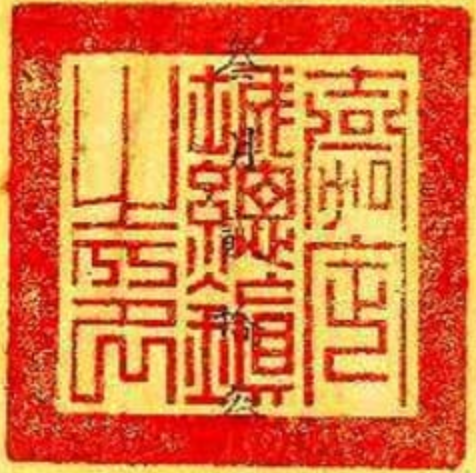
Seal of the Governor-General of Gia Dinh Citadel - PHOTO: AUTHOR'S ARCHIVE
From the establishment of Gia Dinh Citadel until its dissolution, three people were appointed Governor-General: Nguyen Van Nhan (twice, 1808-1812; 1819-1820), Nguyen Huynh Duc (1816-1819), and Le Van Duyet (twice, 1812-1816; 1820-1832). However, only Le Van Duyet left a profound mark on the consciousness of the people of Southern Vietnam.
Of the three Governors-General, Le Van Duyet held the position for the longest time. Notably, during the reign of Minh Mang, he served as Governor-General for over 10 years. King Minh Mang ceased appointing the Deputy Governor-General in 1820. By 1824, the position of Deputy Governor-General of Gia Dinh Citadel was also left vacant. The system of power separation was abolished. Political power, both civil and military, was concentrated in the hands of the Governor-General of Gia Dinh Citadel. King Minh Mang even allowed him to "dismiss or promote officials, promote benefits and eliminate harm, and handle all matters of the citadel and border regions at his discretion." These extensive powers made Le Van Duyet the most powerful Governor-General in the history of the Nguyen Dynasty.
CRUSH THEFT AND ROBBERY
The Mekong Delta, with its intricate network of rivers and wild nature, is a complex region. Since the time of the Nguyen lords, there have been gangs of kidnappers, known as the "Little Bao" bandits. There were also those who threw out ominous papers, calling themselves the "Invincible General of Thanh Son" or the "Great General of Luc Lam," intimidating people to extort their belongings.
The memoir "Retreating Home" by Truong Quoc Dung recounts the story of a governor-general from Vinh An district. One day, the governor-general returned to his hometown, with few attendants. A gang of thugs then ambushed and robbed him. The governor-general had to plead with them before they would release him. Although Truong Quoc Dung doesn't explicitly name the governor-general, the fact that he was from Vinh An district means he was Nguyen Van Nhan.
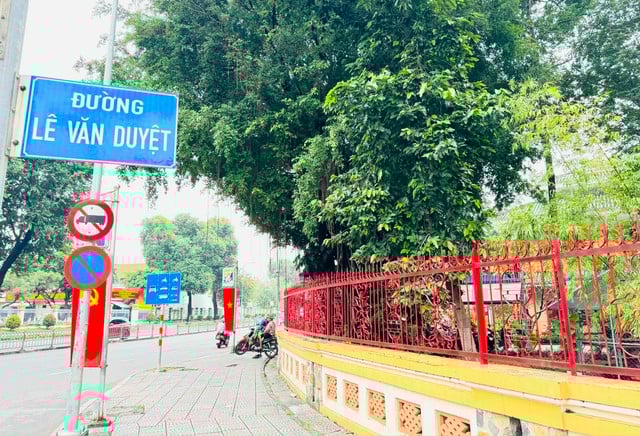
Le Van Duyet Street, right next to the Mausoleum of Ông in Ho Chi Minh City - PHOTO: QUYNH TRAN
Upon first assuming the position of Governor-General of Gia Dinh Citadel, after resolving the issue of bringing the Cambodian king back home, Le Van Duyet focused on dealing with the rampant theft and robbery.
The Đại Nam Liệt Truyện Chính Biên Sơ Tập, Volume 22, records: "Many vagrants lived in Gia Định, some seeking refuge in the homes of powerful families, registering in the military register, and often sneaking back to the villages to gather and commit robbery." Governor-General Lê Văn Duyệt "established clear prohibitions." Local people secretly reported information about the robbers, and the local officials had to immediately arrest and punish them. A contemporary witness, Gibson, in 1823 personally saw in Gia Định Thành "three or four thieves being executed each week." Lê Văn Duyệt also allowed robbers to surrender, with the effect of atonement. Thanks to this, "the bandits gradually ceased, and the people enjoyed security."
Enticing bandits to surrender and rebuild their lives was one of Le Van Duyet's important policies. In 1819, while suppressing rebellions in Thanh Hoa and Nghe An , Le Van Duyet also called on more than 900 people to surrender, forming them into the Thanh Thuan and An Thuan branches and units.
In 1820, when appointed Governor-General of Gia Dinh for the second time, Le Van Duyet also requested to bring this force with him. In Gia Dinh, there were quite a few prisoners who were conscripted into the army to rebuild their lives. Besides the Thanh Thuan and An Thuan units, there were also the Hoi Luong and Bac Thuan units. They still retained their rebellious and audacious nature, so the people also called the Bac Thuan army "the Northern Rebels." Many of them returned to normal civilian life.
After the Le Van Duyet affair broke out, they responded to Le Van Khoi's call to revolt and kill Bach Xuan Nguyen to avenge Le Van Duyet. That event ultimately resulted in a devastating tragedy for the people of Southern Vietnam. (to be continued)
Source: https://thanhnien.vn/tong-tran-quyen-luc-nhat-trong-lich-su-nha-nguyen-185251027233047685.htm




















































































Comment (0)