

Ukraine has officially opened its gas pipeline network to domestic biogas producers, aiming to allow exports to Europe.
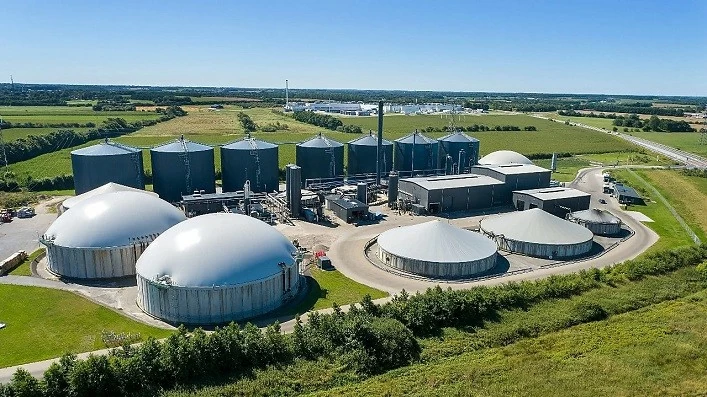 |
| Ukraine decides to cut ties with Russian gas, discarding $800 million, as it has its own plans with the EU. (Source: ubn.news) |
Ukraine could launch its biogas export "campaign" to Europe this November, after accumulating sufficient quantities in storage facilities, providing proper personnel training, and amending legislation to pave the way for exports. The first trial transactions are expected to take place as early as this September.
This statement was made by Georgii Geletukha, Chairman of the Board of Directors of the Ukrainian Bioenergy Association, through an analysis sent to Ukrainian media.
Paving the way for a "new campaign"
According to information from the State Gas Transmission Operator of Ukraine (GTSOU), the government has officially formalized procedures for exporting biogas. However, they still maintain the ban on exporting domestically produced natural gas, imposed shortly after Russia launched its military operation in Ukraine, even though independent producers argue that this ban restricts new investments in the energy sector.
Biogas—also known as biomethane—is produced when bacteria break down organic matter into methane, carbon dioxide, and other gases.
European analysts believe that Ukraine, with its approximately 33 million hectares of agricultural land, could become a major fuel supplier for Germany and other European Union (EU) countries, replacing imports of Russian natural gas via the pipeline system that the EU has committed to phasing out by 2027.
According to DW , the Zukunft Gas industry lobbying group estimates that Ukraine could produce 22 billion cubic meters of biogas annually from corn silage, an organic byproduct of corn harvesting.
Georgii Geletukha, Chairman of the Board of Directors of the Ukrainian Bioenergy Association, stated that Ukraine currently has seven biogas plants, expected to be operational before the end of 2024. Two of these produce liquefied biogas and do not require connection to the gas transmission system. Meanwhile, five plants will be connected to the gas network: one to GTSOU and four to the distribution network.
Mr. Geletukha added, "Two of the plants that will be connected to the distribution network are the best-prepared, and these businesses have already signed connection contracts." Furthermore, the law on biogas exports stipulates that the gas must be pumped into storage facilities a month in advance. For this reason, Ukrainian biogas producers must learn how to work with the GTSOU platform, as well as study the gas market mechanisms for their own export operations.
“I think it will take some more time. Then, the biogas producers will pump gas for a month. By November, some of the plants will have accumulated the necessary biogas batches and will be ready for export,” Geletukha, Chairman of the Board of Directors of the Ukrainian Bioenergy Association, expects.
According to estimates by Georgii Geletukh, when all seven biogas plants are expected to be fully operational, Ukraine could produce 111 million cubic meters of gas per year. The two plants ready to begin operations earliest could produce a total of 6 million cubic meters of biogas per year.
However, the expert stated that it is still too early to make predictions for 2025 regarding the development of Ukraine's biogas production industry, as potential investors will have to wait for the results of these initial export activities.
Previously, the DiXi Group research team from Ukraine estimated that the country could produce approximately 21.8 billion cubic meters of biogas and/or bio-gas per year.
To officially "pave the way" for biogas exports, in March, the Ukrainian Parliament passed draft law No. 9456 on "Customs control and clearance of biogas transported via pipelines across the borders of Ukraine".
Ready to remove Moscow from the network.
Most recently, on September 9th, the Ukrainian Ministry of Finance officially announced Decree 380 dated August 1st, 2024, which introduces significant changes to the regulations on customs clearance procedures for biogas via pipelines. The ban on biogas exports has been completely lifted; from now on, Ukrainian biogas producers will be able to export biogas to the EU via Ukraine's gas transmission system, through federal connection points with four EU countries.
Furthermore, Ukrainian biogas producers will not have to worry about direct links between their biogas plants and transmission systems, but can connect directly to distribution networks.
According to the adopted amendments, the terms and tariff schedule for the connection, transport and export of Ukraine's gas transmission system for biogas producers are similar to those for natural gas producers.
According to analysts at the global legal information platform Lexology, pure biogas is comparable to natural gas in properties and can be used in the same areas as heating fuel, power generation, and transportation. Importantly, it can be integrated into existing gas infrastructure without incurring additional costs for new networks, making this resource not only profitable but also widely applicable.
According to Lexology experts, Ukraine's potential for exporting biogas to the EU has several advantages. Firstly, with its abundant agricultural resources, Ukraine is well-positioned to meet a significant portion of Europe's renewable energy needs through biogas production.
A second advantage worth mentioning is the Ukraine-EU Strategic Partnership, established in February 2023, which strengthens cooperation in the renewable gas sector and contributes to Ukraine's deeper integration into the EU energy market. This relationship also contributes to sustainable economic development in Ukraine's vast rural areas by creating sustainable income opportunities.
Furthermore, biogas can replace natural gas, strengthening Ukraine's and the EU's energy independence by reducing reliance on imports from Russia.
Prior to Russia's military campaign in Ukraine, nearly 150 billion cubic meters of Moscow's natural gas flowed annually through thousands of kilometers of underground pipelines built by the Soviet Union in Ukraine to reach Europe.
Following the outbreak of the Russia-Ukraine conflict in February 2022, EU countries gradually reduced their dependence on Russian fossil fuels. To date, natural gas imports from Russia to Europe have decreased by more than 90%.
At the end of this year, the five-year gas transit agreement between Ukraine and Russia, signed in 2019, will expire. This is the only remaining commercial and political agreement between Moscow and Kyiv. Calculations show that Russia could lose $6.5 billion per year at current prices. This is a strong incentive for Russian gas exporters to negotiate an extension of the agreement.
However, when Russian gas exporters were ready to extend the transit agreement, Kyiv declared firmly that it was ready to exclude Moscow from its gas transit network, refusing to renew the agreement in order to cut off the flow of money to the Kremlin.
Of course, the revenue loss for Russia is significant, especially given its increasingly difficult economic situation due to Western sanctions. But for Kyiv, not renewing the agreement not only affects its position as a reliable gas pipeline but also costs it approximately $800 million per year in transit fees, while revenue is already limited due to the prolonged military conflict.
Professor Margarita Balmaceda, an international relations professor at Seton Hall University (USA), argues that the Ukrainian economy could suffer the most. Kyiv could lose the funds needed to maintain its energy infrastructure and its position as a channel for affordable energy to its Western allies. But Kyiv seems to have made new calculations, prepared to face the losses upfront, in order to implement a longer-term plan.
Source: https://baoquocte.vn/ukraine-quyet-tuyet-tinh-khi-dot-nga-vut-bo-800-trieu-usd-vi-da-co-ke-hoach-rieng-voi-eu-287037.html
























































































Comment (0)