

Initiatives stemming from practical experience.
Along the O Giang River section passing through Van Tri village, Nam Hai Lang commune, these days it's easy to spot dozens of cages for raising eels and climbing perch neatly arranged on the water's surface. All share a special design: the front of the cage is pointed like a boat's bow, and the body is made of durable aluminum with ventilation holes around it to increase water circulation. Compared to traditional net cages or wooden rafts, this is a significant improvement, stemming from the local people's years of experience dealing with floods.
Mr. Pham Van Thien, one of the households with a long history of cage fish farming in Van Tri village, shared that eels have high economic value but require a long farming period, from stocking to harvesting, which takes 1.5-2 years. Such a long farming cycle requires cages that can withstand the effects of weather, especially during the rainy season and floods.
Previously, eel cages were mainly rectangular and made of lightweight materials, so during the rainy season and floods, they were often swept away or damaged by strong currents, causing significant losses for farmers. After research and learning, eel farmers in the village have studied and improved the cages by beveling one side like the bow of a boat to reduce water resistance.
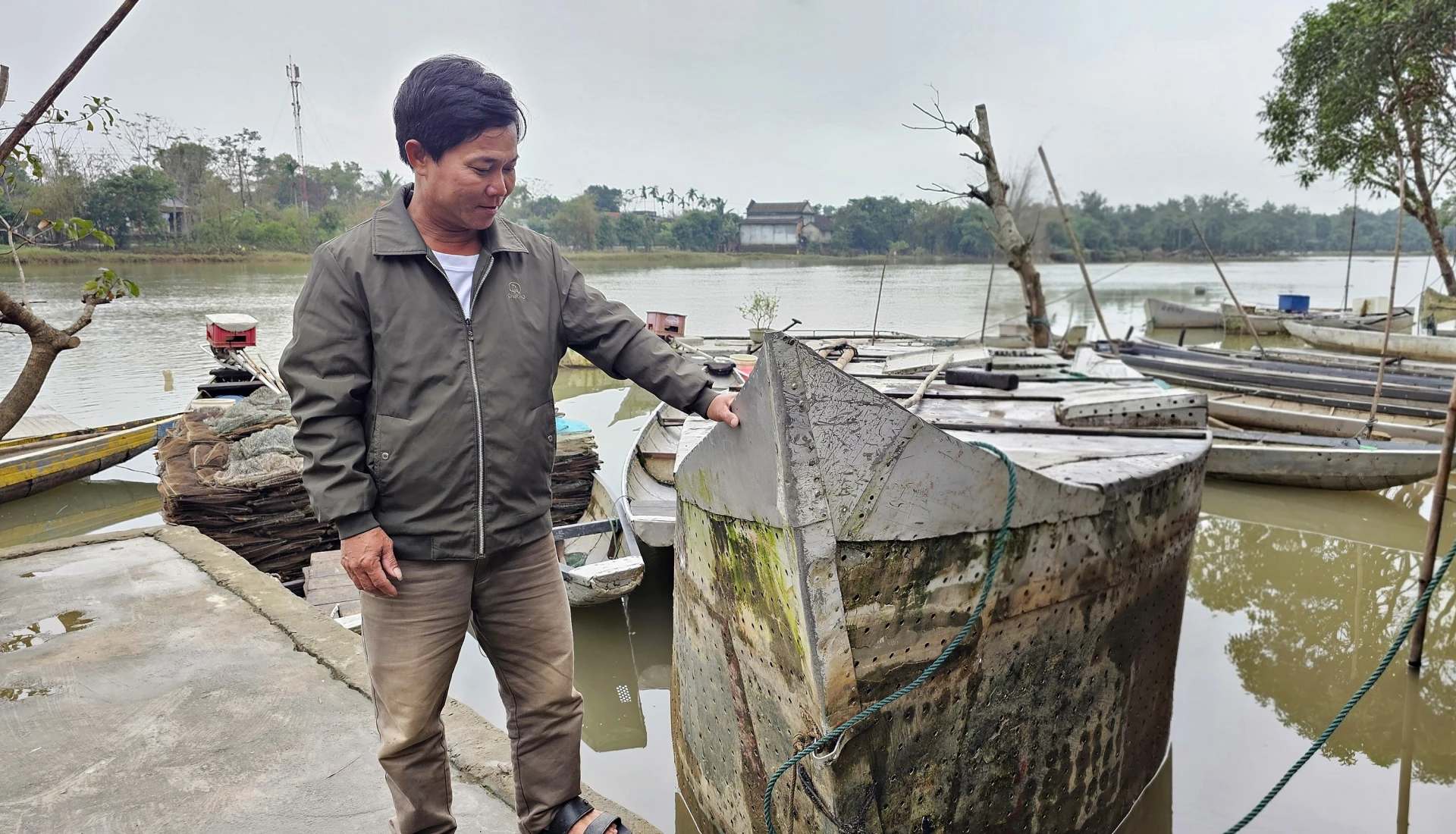 |
| Mr. Pham Van Thien next to his boat-shaped eel cage - Photo: LA |
According to Mr. Thien, the fish cages have a volume of 12-14 m³, a length of about 5 m, a width of 2 m, and a height of about 1.5 m. They are made of aluminum sheets 2 mm or thicker, preferably the type of aluminum used for refrigerated truck bodies or large boats. This type of aluminum is very strong, durable, and impact-resistant. The cage walls are drilled with small holes with a diameter of 0.8-1.4 cm. The cages are kept afloat on the water surface by 4-6 plastic barrels installed securely inside.
When put into operation, the cages are positioned facing upstream and securely fixed in the middle of the river with mooring ropes 25-30 meters long. Additionally, the cages have mooring ropes connecting them to the shore, allowing for easy movement closer to the bank when needed.
Mr. Thien explained that the advantage of this design lies in its ability to "steer the current." When floodwaters arrive, the strong current will slide along the two edges of the boat's bow, significantly reducing the direct impact force on the cages. The lightweight yet sturdy aluminum frame, combined with internal floats, helps the cages float well even when the water rises rapidly. In fact, for many years, major floods in the area have not caused any damage to households applying this model.
“The boat's bow design is highly effective during flood season. With wave-cutting channels on both sides and a supporting ridge underneath, the cage floats on its own when the water flows strongly, significantly reducing the impact force. During the rainy season, we just need to pull the cage closer to the shore; we can pull it in as high as the water level rises. We don't have to worry about even the biggest floods,” Thiện explained.
Nguyen Khanh Tang, Head of the Economic Department of the People's Committee of Nam Hai Lang Commune, affirmed that the boat-shaped cage is a reasonable choice, suitable for the short, steep, and fast-flowing rivers during the rainy season such as the O Lau and O Giang rivers. Not only does it ensure safety and reduce risks, this model also helps farmers reduce the cost of repairing and maintaining the cages each year. It also increases their ability to move and anchor the cages during bad weather.
“The boat-shaped cage design allows farmers to be completely in control of the weather. During hot weather, they can move the cages to the middle of the river, and when the water level rises, they can move them closer to the shore. In particular, besides the boat-shaped design which prevents water resistance, the cages are also securely connected to each other, ensuring safety,” Mr. Tang said.
Provides a stable income.
Not only is it safe from natural disasters, the boat-shaped cage fish farming model also helps the people of Nam Hai Lang generate a stable and long-term source of income.
According to Mr. Pham Van Thien, he currently has two cages for raising eels, each containing 200-300 juvenile eels. In addition, he also raises 500 juvenile catfish in one cage to generate income in the short term. Eels, after about 1.5-2 years, reach a size of 3-4 kg/fish and are ready for harvest, yielding an average profit of 100-120 million VND per cage. Catfish, on the other hand, have a shorter rearing time of only 3-3.5 months and yield a profit of 15-20 million VND per batch.
"The income from climbing perch is used to cover daily expenses, while the eel cages are the main, stable source of income," Thien shared.
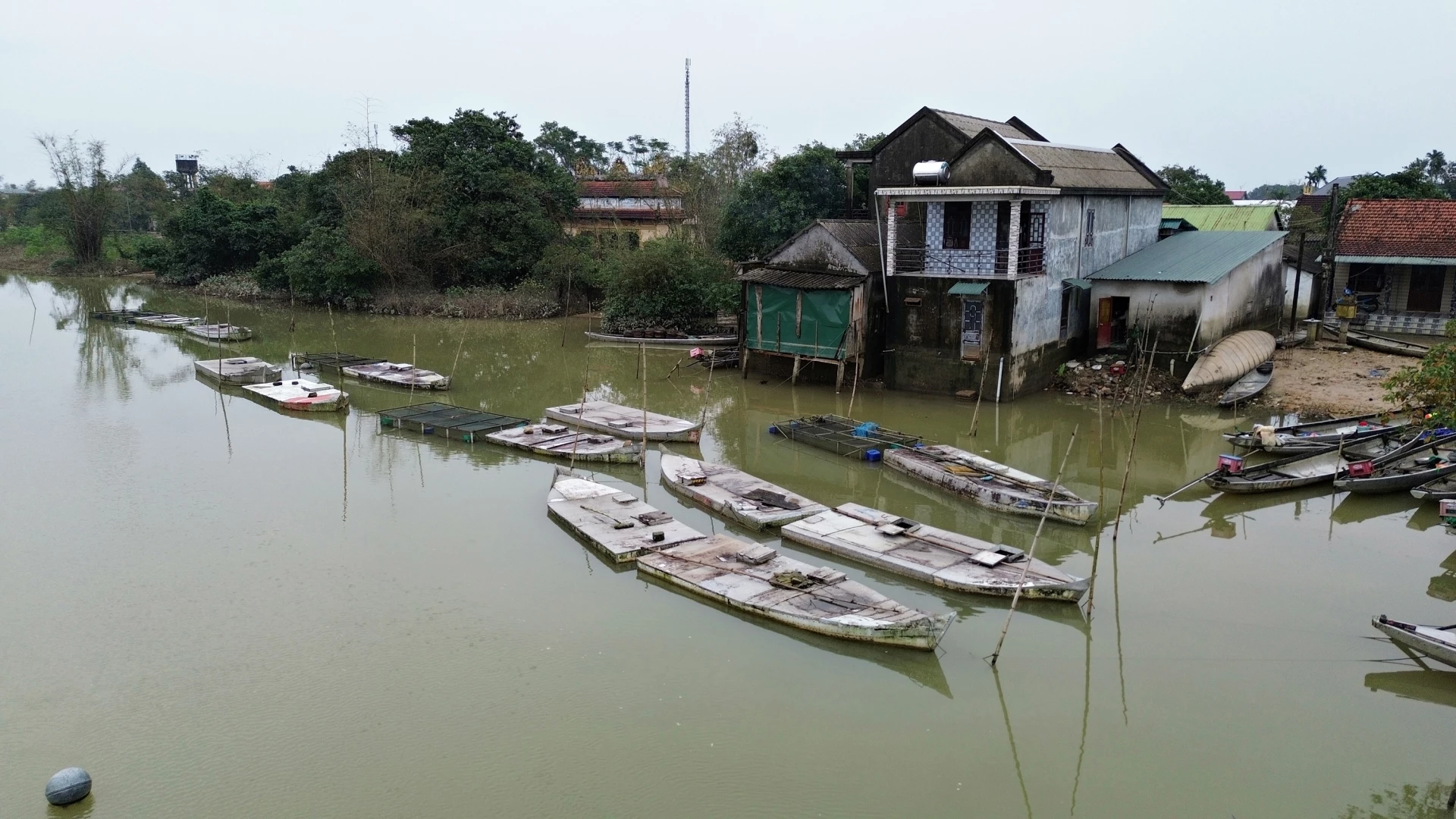 |
| During the rainy season, the fish cages are moved closer to the shore and securely connected to each other - Photo: LA |
As for Mr. Pham Van Ty, another fish cage farmer in Van Tri village, in addition to his stable job at VJTOM Textile and Garment Company, he and his wife also raise 200 eels in a cage to supplement their income. Thanks to the year-round water flow and clean farming environment, the fish thrive and rarely get sick.
"After about two years of raising them, the fish reached an average weight of 2-3 kg/each. With a selling price of about 500,000 VND/kg, after deducting expenses, I made a profit of about 80 million VND," Mr. Ty happily stated.
According to Mr. Nguyen Khanh Tang, the reality of recent years shows that the weather is becoming increasingly erratic, with many early or prolonged periods of rain and floods causing significant damage to fish cage farmers. In this context, the people's self-improvement of fish cages towards greater safety is not only a personal need but also a requirement for sustainable production development.
This is also a prime example of the people's creativity in adapting to climate change. By using durable materials and a scientific design, the model helps reduce risks, save costs, and ensure long-term income. As a result, the entire Nam Hai Lang commune now has about 70 fish cages, of which about two-thirds are used for raising eels, and the rest for climbing perch.
“Thanks to the sturdy and movable cages, for many years, even during major floods, local fish cage farmers have not suffered any losses. This safety has helped make cage fish farming a sustainable livelihood for people in the face of climate change impacts. This model is also perfectly suited to the conditions of short rivers with strong currents like in Quang Tri , and it needs to be considered and replicated,” Mr. Tang affirmed.
Le An
Source: https://baoquangtri.vn/kinh-te/202512/nuoi-ca-long-thich-ung-voi-bien-doi-khi-hau-ae87710/







































































Comment (0)