

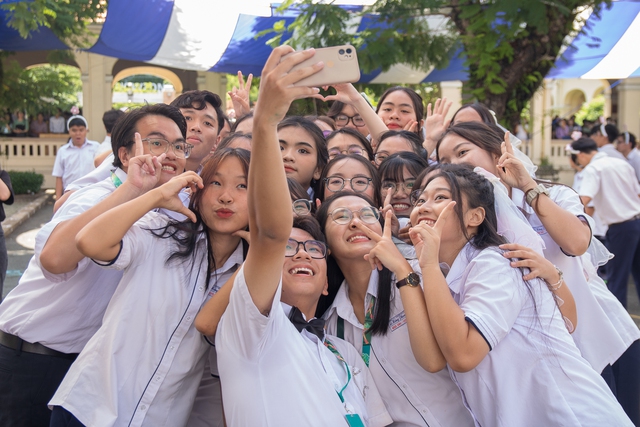
Vietnamese education has many bright spots that have been recognized by UNESCO.
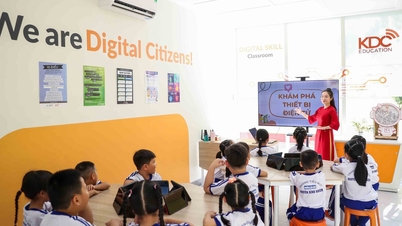
ILLUSTRATIVE PHOTO: NGOC LONG
UNESCO released its 2023 Global Education Monitoring Report on July 26th. With the theme of technology in education, the report highlighted the lack of appropriate governance and regulation, encouraged the establishment of individual standards for the design and use of technology in education, and reflected on some key data points from various countries.
A bright spot for Vietnam
Accordingly, current UNESCO data shows that students in middle- and low-income countries are far from reaching minimum proficiency levels in academic skills.
Specifically, among the 31 low- and lower-middle-income countries for which data was recorded in 2019, only Vietnam had most children achieving at least or higher levels of proficiency in reading comprehension and mathematics by the end of primary school. Conversely, 18 out of 31 countries had less than 10% of children achieving minimum proficiency in reading comprehension and/or mathematics.
According to UNESCO, at least 31% of students, or nearly half a billion students worldwide from preschool to high school, did not have access to distance learning during the Covid-19 pandemic. This is attributed to a lack of access to necessary technologies and policies that address their needs.
In Vietnam alone, students from the poorest 20% are 34% less likely to pursue distance learning than students from the wealthiest 20%. Similarly, students from lower-educated households are 21% less likely to pursue distance learning than students from higher-educated households.
However, UNESCO also acknowledged the resilience of Vietnamese students amidst the pandemic. The organization stated that it conducted a field survey at Bat Xat Ethnic Boarding Secondary and High School ( Lao Cai province) and visited the families of Nong Van Duong (15 years old) and Nong Van Thanh (13 years old), two outstanding students at the school.
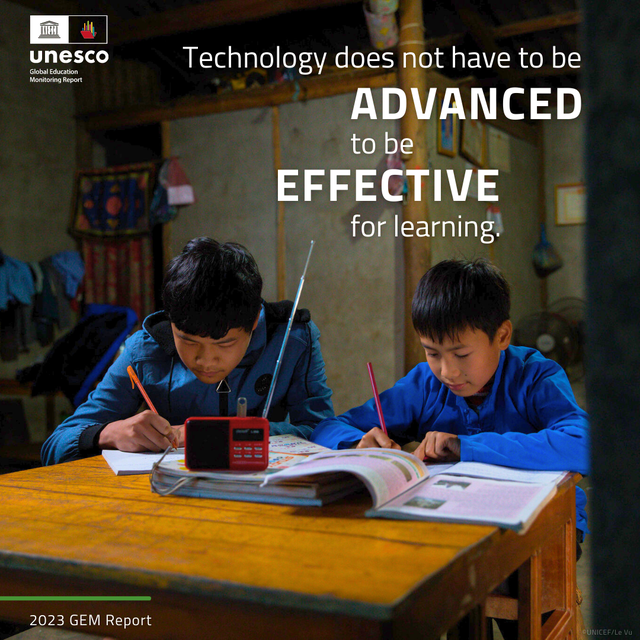
The image of Nong Van Duong and Nong Van Thanh was recognized by UNESCO with the message: "Technology doesn't necessarily have to be cutting-edge to be effective for learning."
UNICEF/UN0610392/LE VU
"Duong and Thanh faced many difficulties due to Covid-19. While other students used smartphones or laptops to attend classes, they tried to transcribe recordings of online lessons to play on an old red radio. However, Duong and Thanh studied diligently and received many commendations from Bat Xat school," UNESCO wrote in its report.
Furthermore, data cited by UNESCO also shows that in India and Vietnam, first-generation students (i.e., the first in their family to attend a particular level of education) are at a higher risk of dropping out of lower secondary school. This is also a higher level of education than their parents achieved.
Focus on technology training.
Training in information and communication technology (ICT) for teachers and students is also an issue addressed by UNESCO.
Accordingly, globally, 72% of education systems have policies, plans, or strategies for technology training for student teachers, and 84% of education systems have policies, plans, or strategies for professional development for teachers.
Meanwhile, the 2018 international survey on teaching and learning indicated that an average of 56% of secondary school teachers in 48 education systems had received ICT training during their formal education or training, ranging from 37% in Sweden to 97% in Vietnam. For teachers, the average figure was 60%. Vietnam continued to lead with a rate of 93%, while Belgium was at the lowest at 40%.
However, school closures during the Covid-19 pandemic and the shift of many education systems to online learning have spurred efforts to train teachers in ICT. By 2022, more than 80% of low- and middle-income countries reported having implemented professional development activities for teachers in digital skills, from primary to high school levels.
Vietnam has also been recognized by UNESCO for making technology an independent subject, alongside developed countries such as the UK, Switzerland, and South Korea. Accordingly, the 2018 reform of the general education curriculum made ICT a compulsory subject for students from grades 3 to 9. Here, students are taught the fundamentals of digital technology and computer science.
Source: https://thanhnien.vn/unesco-hau-het-tre-em-viet-nam-thong-thao-doc-hieu-lam-toan-185230801181504769.htm


![[Photo] Prime Minister Pham Minh Chinh attends the Conference summarizing and implementing tasks of the judicial sector.](/_next/image?url=https%3A%2F%2Fvphoto.vietnam.vn%2Fthumb%2F1200x675%2Fvietnam%2Fresource%2FIMAGE%2F2025%2F12%2F13%2F1765616082148_dsc-5565-jpg.webp&w=3840&q=75)
























































































Comment (0)