

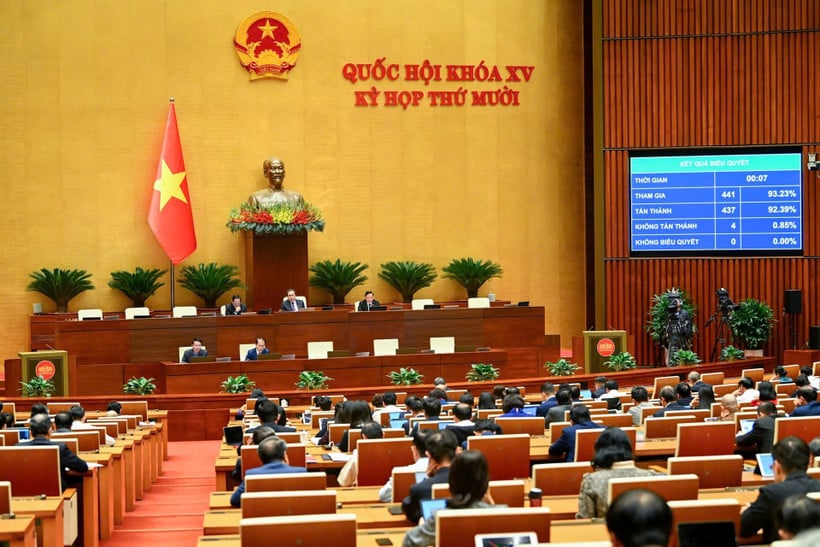
The National Assembly voted to pass the Law amending and supplementing a number of articles of the Law on Judicial Records. (Photo: DUY LINH)
Building a reasonable capital structure and focused investment
According to the Government 's Submission, the total capital demand for the 2026-2030 period is expected to be 500,000 billion VND, of which the central budget capital accounts for 100,000 billion VND (20%), and the local budget capital accounts for 400,000 billion VND (80%).
Many delegates said that the above capital structure is unreasonable, does not demonstrate the leading role of the central budget, and also puts a financial burden on the beneficiary localities - where life is still difficult and there is a high rate of poor households. Delegate Mai Van Hai ( Thanh Hoa Delegation) said that many mountainous provinces and communes do not have enough revenue to cover expenses, the main source of investment is based on land use rights fees, but now localities only receive 80 to 85% of land use fees, causing difficulties for counterpart funds.
Many opinions suggested increasing the proportion of the central budget in the total state budget to a reasonable level to ensure leading resources, consistent with the principle of prioritizing central budget investment capital for core poor areas, ethnic minority and mountainous areas, contributing to thoroughly solving key and urgent tasks, creating breakthroughs for these areas.
Delegate Ha Sy Huan (Thai Nguyen Delegation) and many delegates said that the program does not have quantitative criteria, so it is difficult to avoid spreading and leveling capital sources when organizing implementation. Localities need to be more proactive in defining tasks, beneficiaries and focusing resources for implementation. In addition, capital allocation criteria need to be based on the level of difficulty, poverty rate, progress and number of criteria, thereby giving more priority to particularly difficult areas, ensuring investment in the right core poor areas, right focus. The government needs to have solutions to mobilize capital sources from enterprises, cooperatives, and people to share the burden with the budget.
National data connection on citizen reception, complaints and denunciations
Discussing in the hall about the draft Law amending and supplementing a number of articles of the Law on Citizen Reception, the Law on Complaints, and the Law on Denunciation on the afternoon of December 5, the majority of opinions assessed this as an important step in perfecting the law.
Agreeing with the form of online citizen reception, delegate Nguyen Tam Hung (Ho Chi Minh City Delegation) proposed to clearly stipulate the principle of recognizing the legal value of online citizen reception as equivalent to direct citizen reception. The delegate also suggested establishing a mechanism to bind the personal responsibility of the head in case of delay or avoidance of citizen reception, prolonging the time limit for settlement or transferring the petition in a roundabout way. Along with that, develop a mechanism to connect national data on citizen reception, complaints and denunciations to reduce the situation of both correct and incorrect complaints, avoiding wasting State resources.
Regarding the protection of whistleblowers, delegate Hoang Anh Cong (Thai Nguyen Delegation) proposed reviewing the provisions in the Law on Denunciation, closely following the results of amending and supplementing related laws such as the Law on Anti-Corruption, the Law on Thrift and Anti-Waste to study and adjust accordingly, ensuring consistency between the Party's regulations and the State's regulations, and consistency in legal provisions.
Regarding the regulations on protecting whistleblowers, Government Inspector General Doan Hong Phong said that the review showed that the scope of protected subjects in Article 47 of the Law on Denunciation is consistent with Regulation 231 of the Politburo, so it is proposed to keep it as it is currently.
Commenting on the draft Law on Specialized Courts at the International Financial Center, the majority of opinions agreed on the need to attract high-quality human resources and foreign judges with experience in handling international disputes, while creating opportunities for domestic judges to study and access international experience.
Delegate Le Thu Ha (Lao Cai Delegation) said that for this model to truly attract investors, the law needs to ensure three core criteria: international competition, fast and transparent procedures, friendly language with global trade standards; protection of judicial sovereignty, openness without sacrificing legal security and public interests; effective enforcement, judgments must be enforceable, both domestically and internationally. The delegate also suggested that it is necessary to clarify the legal position and relationship of the Court in the people's court system, especially the scope of jurisdiction over disputes arising at the International Financial Center.
Explaining to the National Assembly, Chief Justice of the Supreme People's Court Nguyen Van Quang said that there was great pressure when drafting the law in a condition of no experience, but it had to ensure superiority, at least equal to the current courts of the International Financial Centers. The drafting committee will continue to make appropriate adjustments, in the spirit of approaching the most modern issues of the legal system and in accordance with international practices.
With a high consensus rate, the National Assembly voted to pass the Law on Judicial Expertise (amended); the Law on Civil Judgment Enforcement (amended), and the Law on amending and supplementing a number of articles of the Law on Judicial Records.
The Law on Judicial Expertise (amended) stipulates in the direction of expanding the scope of establishing Judicial Expertise Offices in a number of fields and specialties, in which the specialty of DNA, document, digital and electronic, trace and fingerprint expertise is only performed for civil and administrative proceedings.
With the Law on Civil Judgment Enforcement (amended), the Civil Judgment Enforcement Office has not been given full enforcement power. The enforcement officer only has the right to request the competent authority to freeze accounts, assets, and suspend transactions to prevent the dissipation of assets.
The Law amends and supplements a number of articles of the Law on Judicial Records, continuing to maintain Judicial Records Form No. 1 and No. 2. The form is issued in electronic or paper form with equal legal value. Agencies and organizations are not allowed to request individuals to provide information on judicial records or Judicial Records Forms, and are only allowed to request Form No. 1 in certain cases as prescribed by law.
The previous national target program for sustainable poverty reduction, which aimed to reduce risks, prevent natural disasters, and respond to climate change, is still valuable and necessary. It is recommended to add this content to the general objectives of the program; adding beneficiaries to communes, villages, and hamlets in coastal areas, islands, and communes with high rates of multidimensional poverty.
Delegate VU XUAN HUNG (Thanh Hoa Delegation)
It is necessary to clearly define what constitutes a force majeure event or objective obstacle in handling complaints; and to add specific provisions on the maximum suspension period. If not clearly defined, it will lead to abuse in handling complaints, not handling them or prolonging them, pushing them away, avoiding handling them, and causing disadvantages and frustration to citizens.
Delegate TRAN VAN TUAN (Bac Ninh Delegation)
Source: https://nhandan.vn/uu-tien-von-dau-tu-ngan-sach-trung-uong-cho-vung-loi-ngheo-post928360.html


![[Photo] 60th Anniversary of the Founding of the Vietnam Association of Photographic Artists](/_next/image?url=https%3A%2F%2Fvphoto.vietnam.vn%2Fthumb%2F1200x675%2Fvietnam%2Fresource%2FIMAGE%2F2025%2F12%2F05%2F1764935864512_a1-bnd-0841-9740-jpg.webp&w=3840&q=75)
![[Photo] National Assembly Chairman Tran Thanh Man attends the VinFuture 2025 Award Ceremony](/_next/image?url=https%3A%2F%2Fvphoto.vietnam.vn%2Fthumb%2F1200x675%2Fvietnam%2Fresource%2FIMAGE%2F2025%2F12%2F05%2F1764951162416_2628509768338816493-6995-jpg.webp&w=3840&q=75)









































































Comment (0)