

To the naked eye, the night sky appears to have over 9,000 points of light, but this observable portion is only a small corner of the universe.
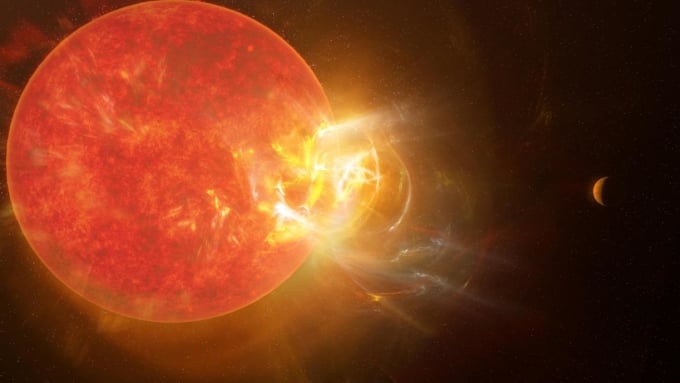
Simulation of a flash of light erupting from the star Proxima Centauri. Image: NRAO/S. Dagnello
The nearest visible star system is Alpha Centauri, located about 4.25 light-years from Earth. The closest star in this three-star system is Proxima Centauri, but because it is a red dwarf, it is too faint to observe without a telescope.
The farthest star visible to the naked eye is V762 Cas, a variable star located 16,000 light-years from Earth. Although it may be 100,000 times brighter than the Sun, its vast distance means it is only just visible to the naked eye under ideal night vision conditions.
All stars visible to the naked eye have masses far greater than the Sun. Stars comparable to or smaller than the Sun are not bright enough to overcome the light-year distance between them and Earth, and therefore become invisible.
V762 Cas is the most distant star visible to the naked eye, but not the most distant object observable without a telescope. That title belongs to the Andromeda galaxy. Containing over a trillion stars, this galaxy appears to the human eye as a large, fist-sized, blurry expanse. When looking at Andromeda, the observer is receiving light that has been traveling for 2.5 million years.
In addition, there are some flashes and bursts of light that temporarily increase in brightness to astonishing levels, making them visible for short periods even from extremely long distances. For example, in 2008, the gamma-ray burst GRB 080319B was visible to the naked eye for about 30 seconds, even though it was more than 7.5 billion light-years away. This means that when the light from the burst began to travel, the solar system hadn't even formed yet.
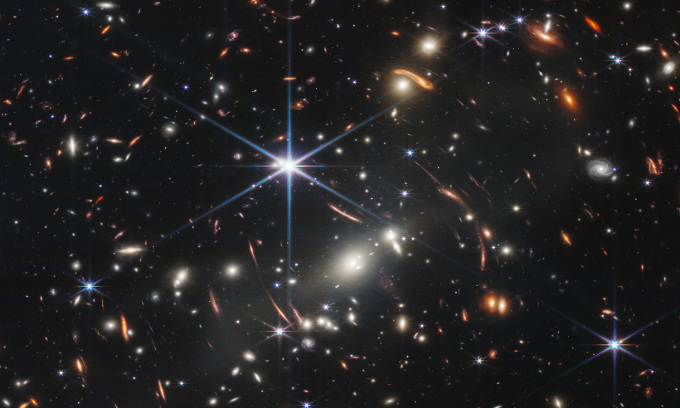
A distant region of the galaxy captured by the James Webb Space Telescope. Image: NASA/ESA/CSA/STScI
Telescopes allow humans to observe fainter objects because they collect more light, and to observe more distant objects because they magnify images. However, even with the most advanced ground-based and space telescopes, conducting the most extensive surveys, scientists have only mapped less than 3% of the stars in the Milky Way and less than 1% of the galaxies in the observable universe.
To observe more distant objects, experts take advantage of a unique natural phenomenon: When light from a distant star or galaxy passes through a massive cluster of celestial bodies, the cluster's gravitational pull can magnify the image, sometimes by more than 10,000 times.
This phenomenon is called gravitational lensing. Thanks to it, astronomers were able to detect the most distant single star ever recorded, Erendel. Erendel appeared only about 900 million years after the Big Bang, belonging to the first generation of stars in the universe. Although light from Erendel takes 12.9 years to reach Earth, the star is now more than 28 billion light-years away from Earth due to the increasingly rapid expansion of the universe since the Big Bang.
Using gravitational lensing, astronomers employed the James Webb Space Telescope to precisely measure the distance to JADES-GS-z13-0, the most distant galaxy ever recorded. JADES-GS-z13-0 is currently more than 33.6 billion light-years from Earth and formed when the universe was only 400 million years old. Experts believe that humans may still be able to see even more distant celestial objects in the future.
Thu Thao (According to Space )
Source link



![[Photo] Closing Ceremony of the 10th Session of the 15th National Assembly](/_next/image?url=https%3A%2F%2Fvphoto.vietnam.vn%2Fthumb%2F1200x675%2Fvietnam%2Fresource%2FIMAGE%2F2025%2F12%2F11%2F1765448959967_image-1437-jpg.webp&w=3840&q=75)












































![[OFFICIAL] MISA GROUP ANNOUNCES ITS PIONEERING BRAND POSITIONING IN BUILDING AGENTIC AI FOR BUSINESSES, HOUSEHOLDS, AND THE GOVERNMENT](https://vphoto.vietnam.vn/thumb/402x226/vietnam/resource/IMAGE/2025/12/11/1765444754256_agentic-ai_postfb-scaled.png)
















































Comment (0)