

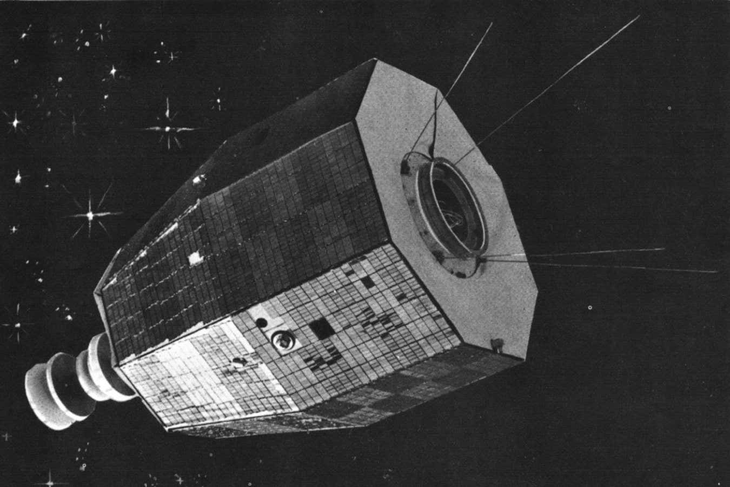
Illustration of NASA's Relay 1 satellite, the predecessor of Relay 2 - Photo: NASA
The incident occurred last summer but was only recently published in the scientific journal New Scientist . A research team from Curtin University in Australia accidentally detected a strange and very strong signal from NASA's Relay 2 satellite while using the ASKAP radio telescope system to observe the night sky.
According to astronomer Clancy James, the lead researcher, the signal was so strong and bright that it overshadowed all other objects for a brief moment lasting only a few billionths of a second.
In particular, the signal was emanating from a distance so close to Earth that the telescopes in the system could not all simultaneously focus precisely on it.
After extensive analysis, the scientific team unexpectedly identified the source of the signal as NASA's Relay 2 satellite, a communications satellite launched in 1964 and decommissioned in 1967.
This raises many questions. How could a device that had been "dormant" for nearly 60 years emit such a strong signal?
Two hypotheses have been put forward. One is that the satellite collided with some object in orbit. The other is that electrical charges had accumulated inside the satellite over decades and eventually released a very strong surge of energy, a phenomenon known as electrostatic discharge.
Dr. Karen Aplin, an astrophysicist at the University of Bristol in England, suggests that in the context of Earth's increasingly crowded orbit with space debris and inexpensive satellites with poor protection, phenomena like the Relay 2 incident could be clues to a better understanding of electrical impulses in space.
She shared that detecting signals using radio waves could become a new tool for monitoring and assessing the risks from electrical discharges in space.
Source: https://tuoitre.vn/ve-tinh-chet-cua-nasa-bat-ngo-phat-tin-hieu-la-sau-gan-60-nam-20250622230612397.htm


![[Image] Close-up of the newly discovered "sacred road" at My Son Sanctuary](/_next/image?url=https%3A%2F%2Fvphoto.vietnam.vn%2Fthumb%2F1200x675%2Fvietnam%2Fresource%2FIMAGE%2F2025%2F12%2F13%2F1765587881240_ndo_br_ms5-jpg.webp&w=3840&q=75)

















































































Comment (0)