

The 44th and 45th ASEAN Summits and related Summits recently concluded successfully in Vientiane, Laos, bringing to a close a memorable ASEAN Cooperation Year 2024 on “Connectivity and Resilience,” and accelerating the implementation of the ASEAN Community Building Master Plans 2025.
In 2025, ASEAN will adopt the ASEAN Community Vision 2045, along with four Strategic Plans on political-security, economic, socio-cultural, and connectivity, to be implemented from 2026. These plans promise to open up new aspirations with innovative thinking, strategic vision, and the impetus of digital, green, and rapid development to continue successfully fulfilling its mission for peace , security, cooperation, and sustainable development.
Standing at a new historical turning point for the country, beginning a new journey for ASEAN, and preparing for the 30th anniversary of Vietnam's accession to ASEAN, this is the time for all of us to look back and assess what ASEAN has done, is doing, and will do, in order to determine the direction of our participation and contribution to the future of ASEAN, which is also a contribution to the future of each member state and to ourselves.
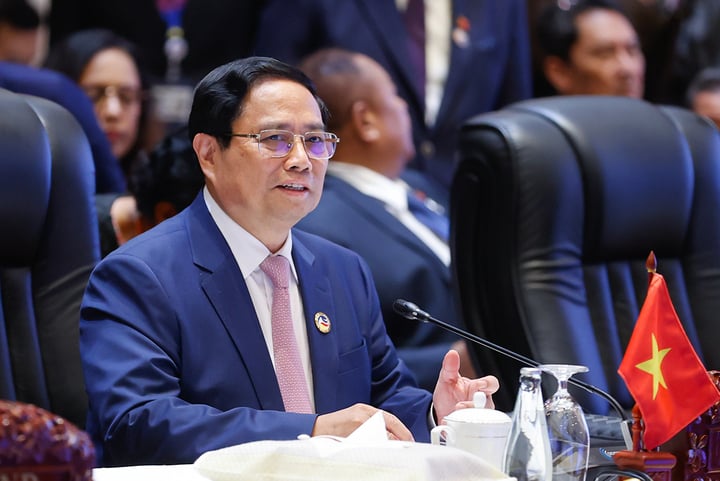
At the plenary sessions of the 44th and 45th ASEAN Summits, Prime Minister Pham Minh Chinh proposed that ASEAN should take self-reliance as the foundation for growth, connectivity as the focus for breakthroughs, and innovation as the driving force for pioneering leadership. (Photo: VGP/Nhat Bac)
ASEAN - a solid foundation, strong linkages, and sustainable development.
Founded nearly 60 years ago amidst regional instability, division, and mistrust, ASEAN has gradually united, expanded, and developed, giving the region a new face and fostering growing trust over the years. After almost three decades, ASEAN, from an organization with only five members, has now become the common home of all ten Southeast Asian nations, ushering in a new era of regional solidarity and cooperation.
The ASEAN Community was formed on December 31, 2015, marking a qualitative leap in ASEAN's development, further strengthening its integration foundation and affirming its indispensable role in peace, security, cooperation, and development in the region. ASEAN's journey to its current stature and position has not always been smooth sailing, but has been fraught with many ups and downs. The more hardships and challenges it faces, the more ASEAN is tempered and matures, developing its resilience, confidence, self-reliance, and strategic autonomy. This is clearly demonstrated through ASEAN's adaptability, response capabilities, and principles of conduct.
Firstly, ASEAN must be flexible, timely, and responsive to all changes in the regional and international situation. From global hotspots to the region, member states share a common understanding and responsibility in strengthening solidarity and promoting the common voice of ASEAN.
With a shared will to achieve unity in conduct and action, ASEAN has clearly demonstrated its ability to adapt to changing circumstances, based on its unchanging mission of maintaining a peaceful, secure, stable, and cooperative environment for development in the region.
Overcoming all challenges, the world has witnessed an ASEAN that has responded with unwavering confidence and resilience to international and regional issues, from the Five-Point Consensus supporting Myanmar in finding a long-term and sustainable solution, strengthening principled positions and a common voice on the South China Sea issue, to maintaining a balanced and consistent approach to conflicts in Ukraine, the Middle East, and the Korean Peninsula.
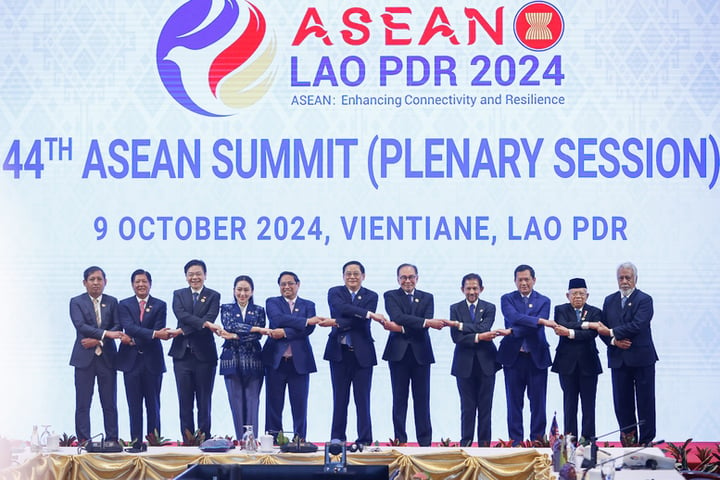
The theme for cooperation in 2024 is "ASEAN: Promoting Connectivity and Resilience". (Photo: VGP/Nhat Bac)
Understanding and sharing the current realities in the Middle East, Europe, and many other places, we appreciate even more the value of peace and stability in the region today. Peace is not something that is taken for granted, but stems from the determination and concerted efforts of member states to strive for peace, stability, cooperation, and development.
Secondly, we must respond flexibly, proactively, promptly, and effectively to non-traditional security challenges. A prime example is the COVID-19 pandemic; its consequences are still long-lasting, but the experience and lessons learned from responding to the pandemic remain valuable and relevant in the current period.
A series of initiatives such as the COVID-19 Response Fund, the Regional Emergency Medical Supplies Reserve, the ASEAN Standard Epidemic Response Procedure, the ASEAN Travel Corridor Framework, and the ASEAN Comprehensive Recovery Framework are vivid examples of ASEAN's solidarity and mutual support in times of difficulty, and its proactive approach in responding to issues of a nationwide, comprehensive, global, and Community-wide nature.
The coordinated implementation of these initiatives has laid the groundwork for ASEAN to mobilize resources for pandemic control, including over 900 million doses of vaccine and a large quantity of medical equipment and supplies. These initiatives have also shaped the framework for cooperation and coordinated action among countries in controlling and preventing the disease, contributing to ASEAN's impressive achievements in pandemic control and economic recovery.
The combined efforts of ASEAN in responding to the pandemic, along with other emerging challenges such as climate change, natural disasters, resource depletion, and population aging, clearly demonstrate the spirit of "Community Thinking, Acting Together" of a compassionate ASEAN, standing shoulder to shoulder, overcoming difficulties and challenges together.
Thirdly, maintaining a firm, independent, and balanced approach in the face of increasingly fierce strategic competition is crucial. The early decades of the 21st century witnessed significant geopolitical shifts. The Asia-Pacific region continues to be a convergence and intersection of strategic interests for all major powers; situated at the heart of this region, ASEAN attracts the attention, participation, and even involvement of major partners. Strategic competition and friction between major powers occur directly within ASEAN's mechanisms and forums, impacting the operation and effectiveness of cooperation.
In this context, ASEAN has demonstrated steadfastness and consistency in its independent, proactive role and principled conduct in its relations with partners. Guided by fundamental principles such as the Treaty of Friendship and Cooperation in Southeast Asia and the ASEAN Vision on the Indo-Pacific, ASEAN has successfully harmonized interests, reconciled differences, and balanced the concerns of participating countries in regional cooperation.
ASEAN mechanisms such as ASEAN+1, ASEAN+3, and the East Asia Summit continue to affirm their strategic value in promoting dialogue, building trust, and strengthening cooperation, creating a solid foundation for shaping a multi-process, multi-layered, and multi-sectoral regional architecture with ASEAN at its center.
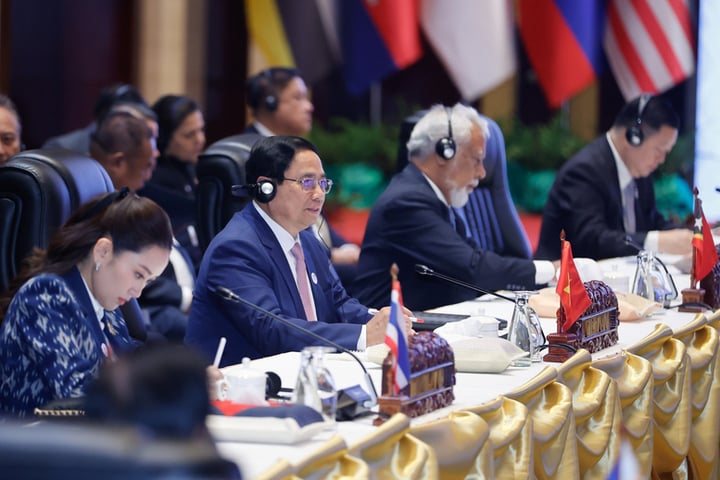
Prime Minister Pham Minh Chinh shared important directions for ASEAN in the coming period at the plenary session of the 44th and 45th ASEAN Summits. (Photo: VGP/Nhat Bac)
Seize opportunities, overcome challenges, and elevate the network.
The world is undergoing complex and far-reaching changes with conflicting trends and intertwined positive and negative impacts. Overall, there is peace, but localized wars; overall, there is détente, but localized tensions; overall, there is stability, but localized conflicts. New drivers of growth, especially science and technology, innovation, green transition, and energy transition, are creating epoch-making shifts, fundamentally changing production methods and all aspects of social life.
In this volatile landscape, ASEAN continues to emerge as a model of solidarity, a focal point of growth, a beacon of effort, and a prime example of adapting to new development trends.
With projected growth of 4.6% in 2024 and 4.8% in 2025, far exceeding the world average, ASEAN continues to record impressive economic development achievements and is expected to become the world's fourth-largest economy by 2030.
Strengthening connectivity among economies, ASEAN is accelerating the upgrading of the ASEAN Trade in Goods Agreement, essentially completing negotiations to upgrade the ASEAN-China Free Trade Agreement to version 3.0, and implementing the Regional Comprehensive Economic Partnership (RCEP)... New ASEAN cooperation frameworks on the digital economy, circular economy, and blue economy demonstrate a shift in ASEAN's thinking and actions, not only proactively seizing new growth drivers but also leading and shaping new cooperation contents in the region.
With the guiding principle of "placing people at the center of ASEAN community-building efforts," all ASEAN specialized agencies in education, labor, health, culture, etc., are deeply aware of the goal of building a people-centered community that serves the practical interests of the people, considering this as the highest goal in policy planning and implementation.
The cohesion, commitment, and trust of the people are the catalysts that strengthen the bonds between nations, and clearly reflect the nature of ASEAN as a harmonious, humane, and inclusive community, for equitable and fair development for all, leaving no one behind.
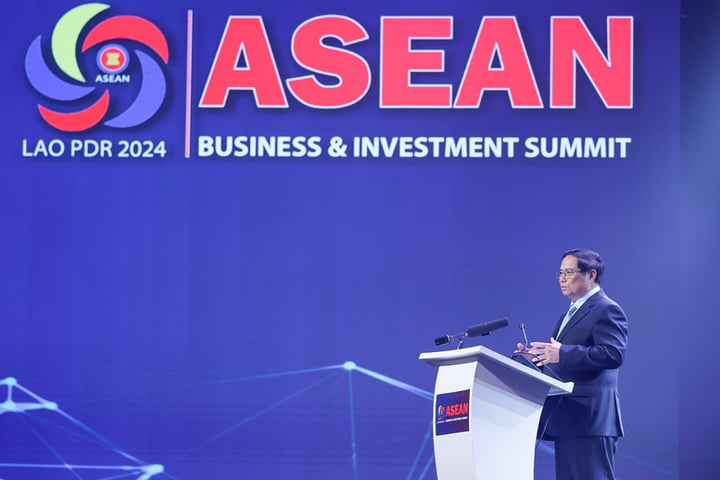
Speaking at the ASEAN Business and Investment Summit 2024, the Prime Minister emphasized that a resilient ASEAN cannot exist without a resilient team of entrepreneurs and businesses. (Photo: VGP/Nhat Bac)
Looking ahead, with numerous opportunities and challenges, ASEAN's task is to maintain its achievements and continue to elevate its linkages and cooperation in all three dimensions: scale, scope, and quality. How can ASEAN maintain its independence and strategic autonomy? How can ASEAN break through and become a hub of growth? How can ASEAN adapt increasingly better to external changes? These fundamental issues require fundamental solutions; accordingly, ASEAN needs to effectively manage the following relationships:
Firstly, there is a dialectical relationship between "ASEAN's strategic independence and autonomy" and "deeper integration into global processes." Strategic independence and autonomy are the foundation for ASEAN to steadfastly pursue its goals and principles, leverage its internal strengths, enhance its self-reliance, affirm its role and position, and lay the groundwork for ASEAN's deeper participation in global agendas.
In turn, ASEAN's effective role and contributions to global processes will help enhance its potential, strengthen its capacity, and mobilize resources, enabling ASEAN to consolidate its strategic self-reliance and autonomy, remaining steadfast in the face of any changes.
Secondly, there is the dialectical relationship between force, position, and timing. "Force" is the foundation of the linkages and the tradition of solidarity that ASEAN has diligently cultivated over the past 60 years. "Position" is the position and prestige that ASEAN has built upon its "force," clearly demonstrated through ASEAN's increasingly proactive and active role and participation in regional and global issues, as well as the attention and respect that partners have for ASEAN.
"The times" refers to the major trends currently unfolding, particularly the new growth drivers that ASEAN needs to grasp and effectively utilize. "Building momentum, establishing position, seizing opportunities" is the "art" of ASEAN's action in the current context, continuing to strengthen unity, unleash dynamic vitality, and create new impetus to move forward and reach new heights.
Thirdly, there is the dialectical relationship between economics, politics-security, and socio-culture. The ASEAN Community is built on a solid three-pronged foundation, comprising three mutually supportive and closely interconnected pillars: economics, politics-security, and socio-culture. In this framework, economic development is the central task, strengthening politics-security is crucial and ongoing, and socio-cultural cooperation is the spiritual foundation and endogenous resource.
Resolving this relationship harmoniously, comprehensively, and thoroughly is of paramount importance to ASEAN's success. For any issue, ASEAN needs a holistic and comprehensive approach, with multi-dimensional thinking and perspectives, to address all aspects thoroughly.
To achieve this, strengthening institutional capacity is a prerequisite, and this requires particular attention and investment in inter-sectoral and inter-pillar coordination, ensuring smooth and seamless operation.
Vietnam's participation in ASEAN is more proactive, flexible, positive, responsible, creative, and effective.
Nearly three decades of participation in ASEAN have demonstrated its immense importance to Vietnam. Since becoming an ASEAN member in 1995, participation has always been a strategic priority and a top choice for Vietnam. ASEAN is a "strategic space" that contributes to creating a favorable situation, maintaining a peaceful, secure, stable, and developing environment for the country. ASEAN is a "bridge" that allows us to expand cooperation and mobilize resources to support socio-economic development.
ASEAN serves as a "foundation" for Vietnam to enhance its role and strategic value in its relations with partners, and to confidently, independently, and self-reliantly participate in and integrate into broader mechanisms and forums.
Joining ASEAN has transformed Vietnam from a war-torn, besieged, and embargoed country into one that has gradually opened up and integrated, linking its development with the overall development trends of ASEAN, the region, and the world. Vietnam's various stages of ASEAN participation have always coincided with the country's ongoing renewal of its foreign policy thinking.
Over time, we have grown stronger and more stable, participating in ASEAN cooperation in particular and international integration in general, with increasingly significant contributions. Today, when we speak of Vietnam, we speak of a reputable and responsible member of ASEAN and the international community, striving wholeheartedly, cooperating sincerely and reliably, and making dedicated contributions.
Vietnam's most significant contributions include promoting and disseminating the fundamental values and principles of ASEAN, such as: the Treaty of Friendship and Cooperation in Southeast Asia (TAC), the Southeast Asia Nuclear Weapon-Free Zone Treaty (SEANWFZ), the Declaration on the Conduct of Parties in the South China Sea (DOC), and building an effective, substantive, and internationally compliant Code of Conduct in the South China Sea (COC), including the 1982 United Nations Convention on the Law of the Sea.
It initiated and shaped ASEAN's strategic decisions, particularly contributing to ASEAN's successful leadership in overcoming the COVID-19 pandemic during its ASEAN Chairmanship in 2020, and proactively guiding the Community's development with the process of building the ASEAN Vision after 2025.
That is, to strengthen ASEAN's extensive economic network, actively participate in negotiating, reviewing, and upgrading ASEAN agreements and treaties between ASEAN and its partners, and affirm ASEAN's leading role in the trend of rules-based trade liberalization.
That is, to further enhance the identity of the ASEAN Community is the principle of consensus and unity in diversity; of the people, by the people, and for the people, with an approach that is "people-centered, subject, goal, driving force, and resource" of the Community-building process.
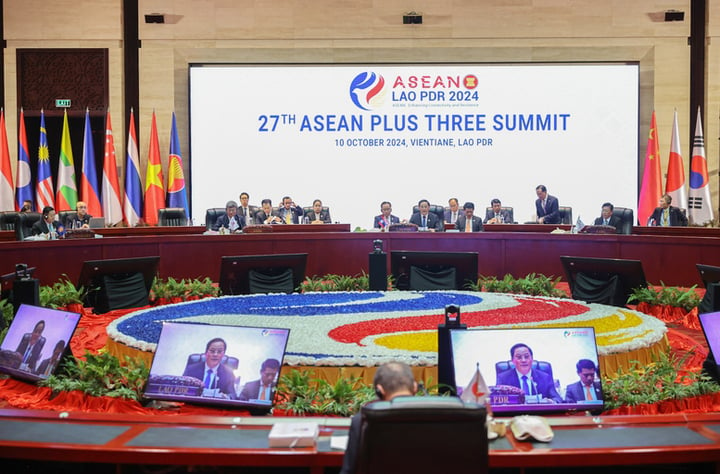
At the ASEAN+3 Summit, ASEAN leaders and leaders from China, Japan, and South Korea all emphasized the importance of the ASEAN+3 cooperation framework and highly appreciated the positive progress in ASEAN+3 cooperation in recent times. (Photo: VGP/Nhat Bac)
In the next stage of development, with new expectations placed upon ASEAN, we need to be more aware of our responsibility to actively participate and contribute more to the common good, guided by the principles of creative thinking, innovative approaches, flexible implementation, effective methods, and decisive action. To achieve this, from now on, Vietnam must identify, supplement, and develop new, specific values with the spirit of "resources stemming from thinking and vision; driving force stemming from innovation and creativity; strength stemming from the people and businesses," and six more:
Firstly, ASEAN needs to take greater responsibility in strengthening solidarity, not only by working with member states to build consensus based on reconciling differences, but also by improving the quality of consensus by increasing the level of intertwining and cooperation that aligns interests, aiming to gradually increase the common denominator of interests among member states.
Secondly, ASEAN needs to be more proactive in enhancing its self-reliance. It is necessary to improve ASEAN's capacity to respond to all challenges, from climate change, natural disasters, epidemics, resource depletion, and population aging, to financial and economic risks, supply chain disruptions, and effective governance of emerging technologies such as artificial intelligence, cybersecurity, and information security, in order to maintain internal strategic stability and respond promptly to external shocks and fluctuations.
Thirdly, we need to be more creative by proposing initiatives and ideas that effectively serve the community building effort. In particular, we need to focus on "connectivity" to create strategic breakthroughs, promoting intra-bloc connectivity combined with external connectivity, public-private connectivity, and multi-sectoral connectivity, with institutional, infrastructure, and human connectivity being the strategic breakthrough for ASEAN.
Fourth, be more proactive in maintaining the growth focus and unlocking new growth drivers. ASEAN needs to keep pace with, accurately grasp, catch up with, and surpass current trends, especially by completing the roadmap and promptly implementing the ASEAN Digital Economy Framework Agreement to optimize the potential and opportunities for the region's digital economy.
Fifth, we need to make greater efforts to promote ASEAN's participation and reach in broader spheres. With its rising strength and increasing importance, ASEAN has the foundation and conditions to expand its influence at both regional and global levels. The ASEAN Future Forum is a very timely initiative, contributing to regional cooperation and gradually bringing ASEAN into global processes, seeking solutions to contemporary issues.
Sixth, further promote institutional harmonization in the region and global progress; in accordance with the culture and political institutions of ASEAN and each member state. Institutional harmonization, strategic infrastructure connectivity, and linkages to improve the quality of human resources can be considered breakthroughs for ASEAN in the coming period.
The future belongs to those who prepare today. Contributing to building a strong and prosperous future for ASEAN is also a crucial contribution to realizing the aspirations of over 100 million Vietnamese people, leading the country into a new era, an era of national progress for Vietnam.
On ASEAN's new path of development, Vietnam is ready to further strengthen its role and responsibilities towards the ASEAN Community, contributing more and more effectively to the integration process, promoting regional growth and cooperation, for the common goal of peace, security, stability and sustainable development.
Source: https://vtcnews.vn/viet-nam-cung-asean-doi-moi-de-bay-cao-sang-tao-de-vuon-xa-hoi-nhap-phat-trien-ar907944.html

















![[Image] Close-up of the newly discovered "sacred road" at My Son Sanctuary](/_next/image?url=https%3A%2F%2Fvphoto.vietnam.vn%2Fthumb%2F1200x675%2Fvietnam%2Fresource%2FIMAGE%2F2025%2F12%2F13%2F1765587881240_ndo_br_ms5-jpg.webp&w=3840&q=75)

















































Comment (0)