Building optimal solutions towards sustainable development goals
Việt Nam•15/09/2023
Immediately following the Opening Session, continuing the 9th Global Young Parliamentarians Conference, delegates affirmed that the conference is an opportunity for young parliamentarians to work towards a common voice, to seek and build the best solutions towards the goal of a more sustainable, peaceful , prosperous, happy, and better world, one where no one is left behind.
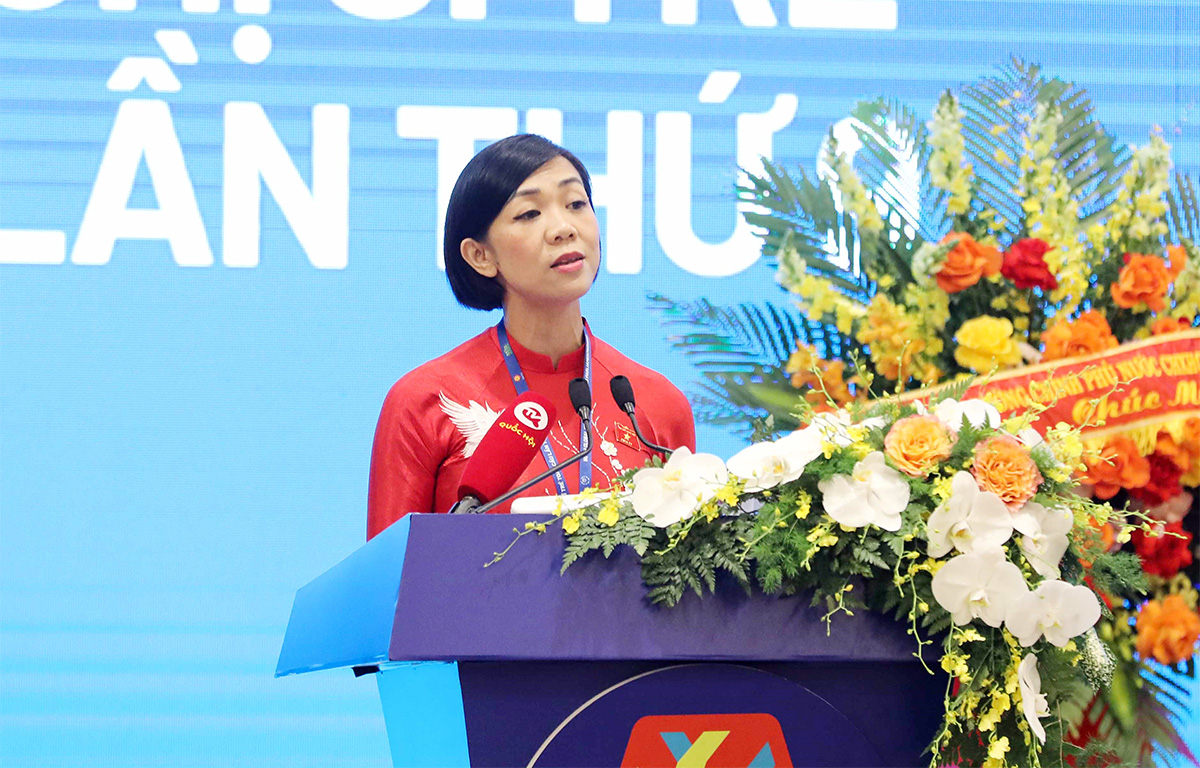
Reflecting the development trends and concerns of nations, continuing the conference program, in her opening remarks on the implementation of the Sustainable Development Goals (SDGs) and the role of digital transformation and innovation, National Assembly representative Trinh Thi Tu Anh (Lam Dong) stated that, with the theme "The role of youth in promoting the implementation of SDGs through digital transformation and innovation," this conference accurately reflects the current development trends and concerns of nations. Sustainable development, science and technology, innovation, and high-quality human resources have become among the most important factors determining the speed and quality of economic development, especially in the context of a world facing many difficulties and challenges. National Assembly representative Trinh Thi Tu Anh ( Lam Dong province ) delivers a speech. Photo: Ho Long The delegate stated, “This is an invaluable opportunity for young delegates and parliamentarians like us to meet, exchange ideas, share experiences, and learn from each other about what we have done, are doing, and will do, about the results achieved, the advantages, difficulties, causes, and lessons learned. At the same time, it is also an opportunity for us to work towards a common voice, to seek and build the best possible solutions to achieve the goal of a more sustainable, peaceful, prosperous, happy, and better world , one where no one is left behind.” Tomas Lamanauska, Deputy Secretary-General of the International Telecommunication Union (ITU), delivers a recorded speech to the conference. Photo: Ho Long In a recorded address to the Conference, the Deputy Secretary-General of the International Telecommunication Union (ITU), Tomas Lamanauska, emphasized that the Conference's theme is extremely important, especially as the world is facing a climate change crisis, with record-breaking temperatures during the past three summer months. We have also witnessed terrible wildfires and thick black smoke in many places over the past few months. The weather has been extremely harsh. Meanwhile, we are almost halfway through the 2030 Agenda for achieving the SDGs, but action to achieve these goals is still not decisive enough. This requires the international community to make even stronger efforts to achieve the goals by 2030. Ensuring the legal framework for the implementation of the SDGs: Sharing about Vietnam's achievements in implementing the SDGs, delegate Trinh Thi Tu Anh stated that throughout the years, despite facing numerous difficulties and challenges in the global situation, Vietnam has always been one of the leading countries in implementing and realizing international commitments in its development process. The Vietnamese economy, in general, has achieved commendable results by effectively responding to external risks and challenges, maintaining macroeconomic stability, controlling inflation, ensuring major balances, promoting growth, consolidating national defense and security, and creating a peaceful and stable environment for development. It has been recognized by the international community, notably for its achievements in implementing the SDGs and its impressive figures in digital transformation and innovation. Delegates attending the conference. Photo: Ho Long Delegates also highlighted Vietnam's achievements in implementing the SDGs. Specifically, Vietnam has made significant progress in ensuring social security. This includes a sharp reduction in the multidimensional poverty rate; an increase in coverage of essential health services, the rate of households with access to safe water, the rate of households with access to the national electricity grid, the rate of access to energy, and mobile phone coverage; forest cover has been maintained and gradually increased over the years. The percentage of female National Assembly deputies in the 2016-2021 and 2021-2026 terms reached 27.31% and 30.26% respectively, higher than the global average (23.4%) and the Asian average (18.6%). Vietnam continues to strongly implement its commitments on climate change through the development and implementation of national strategies and action plans on green growth and adaptation to climate change. Vietnam is also one of the countries committed to achieving net-zero emissions by 2050 at the COP 26 conference. Vietnam has established relations with 30 key partners, including 17 strategic partners and 13 comprehensive partners. Between 2016 and 2020, export growth averaged 10.5% per year. The size of Vietnam's economy exceeded US$400 billion for the first time, with a growth rate of 8.02% in 2022, the highest since 1997; it is a safe investment destination and, for the first time, has been included by UNCTAD in the list of the top 20 countries attracting FDI worldwide, with over 34,000 projects and a total registered capital of over US$430 billion. According to global rankings on SDG implementation, Vietnam has generally made good progress since 2015. In particular, its ranking in achieving the Sustainable Development Goals (SDGs) has improved, moving Vietnam from position 88 in 2016 to position 55 in 2022. Regarding digital transformation and innovation, in recent years, Vietnam has made significant strides in improving its global innovation indicators, ranking 48th out of 132 countries and economies in innovation and belonging to the group of countries that have achieved the greatest progress in the past decade (up more than 20 places). It is one of the top 5 countries with the most developed innovation ecosystems in the region and ranks 54th in the Global Startup Ecosystem Index. Delegates attending the conference. Photo: Tran Hiep Currently, Ho Chi Minh City is approaching the top 100 most dynamic innovation and startup cities globally, ranking 111th. Vietnam currently has four unicorns (startups valued at $1 billion or more) including VNG , VNLife, MoMo, and Sky Mavis, along with many potential startups that could become technology unicorns in the near future. Simultaneously, Vietnam has made significant efforts to improve its business and investment environment, promoting the development of the national innovation ecosystem. Numerous mechanisms, policies, strategies, and programs have been enacted, such as the 2020 Investment Law; the Law on Supporting Small and Medium-Sized Enterprises; and Government decrees stipulating preferential mechanisms and policies for national innovation, all of which have played a crucial role in promoting the development of the digital, green, and sustainable economy in Vietnam. The delegates further stated that the aforementioned outstanding achievements are the result of the strong efforts and determination of the entire political system, with the active and unified contributions and participation of the whole society in the process of implementing sustainable development goals, promoting digital transformation and innovation. In this process, the Vietnamese National Assembly plays a central role, as demonstrated in four prominent aspects. Firstly, the legislative role of the Vietnamese National Assembly has been strengthened and promoted to improve the legal system and policy mechanisms, ensuring a complete legal framework for implementing sustainable development goals and enhancing the effectiveness of state management in national sustainable development, while creating all necessary conditions to support and promote the digital transformation process and the national innovation network. Secondly, ensuring the efficient use of public resources through the allocation of medium-term and annual budgets, with a particular focus on vulnerable groups in society. Thirdly , implement annual thematic monitoring activities on the implementation of sustainable development goals in ministries, sectors, and localities, strengthening the representation of the people, conveying the voice of the people in monitoring state activities, and creating more conditions for people and communities to participate in the process of lawmaking and policy making. Fourthly, continuously innovate the organization and operation of the National Assembly with the goal of building a National Assembly that is increasingly professional and effective in all areas of activity, meeting the requirements and demands of the country's development in the coming period. Delegates expressed hope that young parliamentarians will join hands and make positive contributions to the implementation of the Sustainable Development Goals through digital transformation and innovation on a global scale. Promoting the development of digital technology and ensuring sustainable development: ITU Deputy Secretary-General Tomas Lamanauska stated that one of the key solutions to achieving the SDGs is harnessing the power of digital technology. He emphasized that digital technology has proven its strength, changing the lives of billions of people worldwide for the better. Digital technology creates changes in work, the economy, and the way healthcare and other public services are used. It also has enormous potential to help us address the consequences of the climate change crisis, through monitoring the Earth's climate via satellites and smart sensor networks, supporting industries, enhancing efficiency in transportation, smart agriculture , and early warning of natural disasters. Digital technology has become indispensable in modern life. Delegates attending the conference. Photo: Tran Hiep However, the ITU Deputy Secretary-General also noted that one-third of humanity still lacks internet connectivity, a mission for the United Nations Educational , Scientific and Cultural Organization (UNESCO) to promote safe and sustainable global access. This highlights the crucial role of young parliamentarians, the generations who will assume future leadership responsibilities. The ITU Deputy Secretary-General stated, “75% of people aged 25-24 use the internet, and many of them have been making positive changes with technology, but not all young people have the same opportunities, especially in less developed countries. A UNESCO report during the Covid-19 pandemic showed that the rapid shift to online learning caused at least half a billion students worldwide, mostly poor and rural, to miss out on education.” Furthermore, the development of emerging technologies such as artificial intelligence (AI) is impacting many aspects of life, making bridging the digital divide more necessary than ever. The ITU Deputy Secretary-General added that AI contributes to the implementation of the SDGs, moving towards digital infrastructure, ensuring secure and sustainable access with affordable devices and low costs. We encourage and support investment in sustainable development, increased use of digital skills, and digital startups. At the same time, we aim to address digital inequality, ensuring everyone can share opportunities from connectivity, regardless of location or age. Therefore, we have launched the Generation Connect initiative – an initiative that has quickly attracted participation from countries around the world. Of course, we cannot ignore and must also mention the risks of digital technology, such as the increasing energy demands of digital transformation for networks and data centers, the growing amount of waste – projected to double by 2025; and inequality in access to digital technology… These are issues that need continued attention and solutions. The digital world is evolving, and young parliamentarians in particular, and the younger generation in general, have a very important role to play in promoting the development of digital technology and ensuring sustainable development – the ITU Secretary-General emphasized.









![[Photo] Closing Ceremony of the 10th Session of the 15th National Assembly](/_next/image?url=https%3A%2F%2Fvphoto.vietnam.vn%2Fthumb%2F1200x675%2Fvietnam%2Fresource%2FIMAGE%2F2025%2F12%2F11%2F1765448959967_image-1437-jpg.webp&w=3840&q=75)










































![[OFFICIAL] MISA GROUP ANNOUNCES ITS PIONEERING BRAND POSITIONING IN BUILDING AGENTIC AI FOR BUSINESSES, HOUSEHOLDS, AND THE GOVERNMENT](https://vphoto.vietnam.vn/thumb/402x226/vietnam/resource/IMAGE/2025/12/11/1765444754256_agentic-ai_postfb-scaled.png)





































Comment (0)