

Building a legal corridor for school nutrition to improve Vietnamese people's stature
At the International Conference on Vietnamese Nutrition, school nutrition issues continued to be discussed with urgent perspectives and important solutions, including the need to build a legal corridor for school nutrition.
School nutrition is important to improve stature
The second Vietnamese Nutrition Conference, with the theme of School Nutrition, was recently co-organized by the Institute of Nutrition ( Ministry of Health ) and the Japan Nutrition Association, with the support of TH Group and TH Nutrition Institute.
The workshop brought together over 300 delegates, including leading nutrition experts and scientists from both domestic and international backgrounds, as well as representatives from regulatory agencies and international organizations. At the workshop, delegates and experts unanimously agreed that health is a precious asset in life, beginning in the first 1,000 days of life and continuing from the ages of 2-12.
In particular, science has proven that approximately 86% of a person's maximum height is achieved before the age of 12. This is the crucial period for the maximum development of a person's stature, physical strength, and intelligence. Therefore, the issue of caring for children's nutrition during this period - especially school nutrition - has become urgent and needs to be fully understood in order to have effective solutions implemented.
Speaking at the workshop, Associate Professor, Dr. Tran Thanh Duong, Director of the Institute of Nutrition, said that Vietnamese children are facing three nutritional burdens: malnutrition (especially stunting); overweight and obesity; and micronutrient deficiencies.
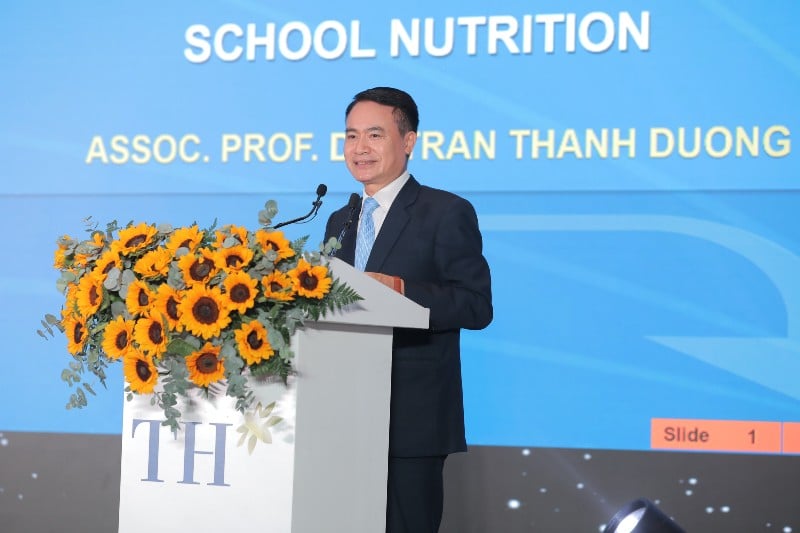 |
| Associate Professor, Dr. Tran Thanh Duong speaks at the Workshop |
According to the 2023 national survey, the rate of stunting in children under 5 years old in Vietnam is 18.2% (placing Vietnam among countries with a stunting rate below 20%, which is the average level according to the World Health Organization classification). However, this rate remains high in the Northern Midlands and Mountains (24.8%) and the Central Highlands (25.9%).
In addition, there is an increase in the rate of overweight and obesity in all subjects, in which the rate of overweight and obesity in children aged 5-19 increased from 8.5% in 2010 to 19.0% in 2020 (more than double after 10 years).
To address this situation, the Vietnamese Government has issued the National Nutrition Strategy for the 2021-2030 period, with specific goals to improve the nutritional status of the entire population, especially school-age children and adolescents.
Some of the basic objectives of the Strategy include: Reducing the rate of stunting in children under 5 years old to below 15% by 2030; Controlling the rate of overweight and obesity in children, especially in urban areas, with the goal of keeping this rate below 19% for children aged 5-18 by 2030; Strengthening nutrition education in schools, with the goal of 60% of schools in urban areas and 40% in rural areas organizing school meals with menus that meet recommended needs by 2025 and striving to reach 90% and 80% respectively by 2030.
“To achieve this goal, comprehensive, continuous, and interdisciplinary intervention solutions are required, including improving mechanisms and policies on nutrition to facilitate implementation; strengthening interdisciplinary coordination and social mobilization; enhancing the quality of human resources, international cooperation, and the application of information technology; and promoting scientific research and communication on nutrition education,” said Associate Professor Dr. Tran Thanh Duong.
In the field of school nutrition, according to Associate Professor, Dr. Tran Thanh Duong, to achieve the set goals, in addition to the efforts and initiative of schools and educational organizations, there needs to be participation from families, businesses and the entire community.
Parents need to be equipped with nutrition knowledge to help their children maintain healthy eating habits both at school and at home. Food businesses also play a particularly important role in providing healthy nutritional products and participating in nutrition support programs for children.
Point models and successful experiences
Speaking at the workshop, Associate Professor Dr. Nguyen Thanh De, Director of the Department of Physical Education, Ministry of Education and Training, said that one of the solutions to develop school nutrition suitable to the practical situation in Vietnam is to implement a model of school meals that ensure reasonable nutrition, combined with increased physical activity for Vietnamese children, students, and university students.
This model is deployed by the Ministry of Education and Training with the support of TH Group, carried out in 10 provinces and cities across the country, representing 5 ecological regions of Vietnam.
Accordingly, after assessing nutritional status and developing menus suitable for each locality, school meals in the pilot model are approached with a focus on using entirely natural foods, based on the agricultural advantages of the region, and fresh milk is scientifically incorporated into the meal composition.
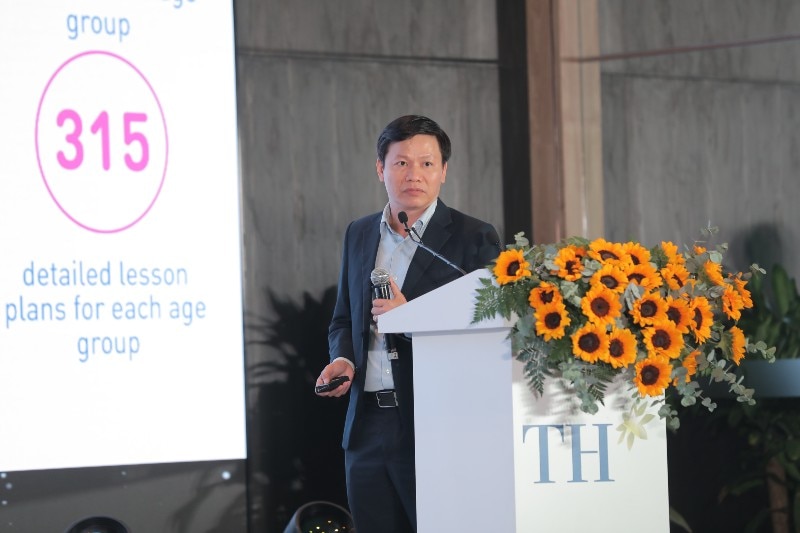 |
| Associate Professor, Dr. Nguyen Thanh De shares about the school meal model |
The main intervention of the model involves 400 diverse, balanced, and nutrient-rich school meal menus, an afternoon snack including a glass of fresh milk to improve calcium intake, and a combination of nutrition education and physical education (through 130 exercise routines and 60 age-appropriate movement games) to help students improve their health and physical development.
According to Associate Professor, Dr. Nguyen Thanh De, the research results show that the pilot model has had a positive effect on the height and weight development of children, while contributing to improving knowledge about proper nutrition and strengthening the physical strength of all three groups: students, schools and parents.
“It is necessary to replicate the model; develop policies and move towards legalizing school nutrition – this will be the legal basis for management agencies, schools, and businesses to participate in preparing and complying with the conditions regarding facilities, human resources, procedures, and expertise in serving school meals. In addition, it is necessary to ensure a workforce with expertise in nutrition in schools,” Associate Professor Dr. Nguyen Thanh De expressed.
Meanwhile, regarding international experience, Prof. Nakamura Teiji, President of the Japan Nutrition Association, shared the successes of the school meal program in Japan, a prominent successful model in the world.
After World War II, Japan faced a severe nutritional deficit. In this challenging national context, Japan prioritized and emphasized school lunches. In 1954, Japan enacted the School Lunch Act. In 2005, the Japanese government enacted the "Basic Act on Food and Nutrition Education (Shokuiku Basic Act)."
 |
| TH Group is one of the pioneering enterprises piloting school nutrition models. |
Thus, it can be seen that the law on school nutrition in Japan was established early and has changed over time to suit the actual situation regarding nutritional status, economic conditions, and social conditions. The law both standardizes school meals and emphasizes the development of nutrition education. To date, 99% of elementary schools and 91.5% of junior high schools in Japan have implemented this program. As a result, malnutrition has decreased significantly, and Japanese youth are increasingly developing physically and intellectually, with average height and stature growing remarkably compared to 50 years ago.
According to the latest survey results from Japan's Ministry of Health, Labour and Welfare, published in 2023, the average height of Japanese people is impressive: 1.72 meters for men and 1.58 meters for women. Fifty years ago, these figures were only 1.50 meters and 1.49 meters respectively. Currently, the average height of Japanese people is among the highest in the world.
Japan has become a prime example of how a nation can use nutrition, regulated by a standardized "legal framework," as a powerful tool to improve the health, stature, and quality of life of its younger generation. In this context, school nutrition is not only a solution to improve student health, but also a solid foundation for building a healthy and sustainably developing society.
Need to build a legal corridor for school nutrition
The proposal to build a legal corridor for school nutrition is not the first time it has been mentioned, and was once again emphasized at the Workshop.
Not only Associate Professor, Dr. Nguyen Thanh De proposed to develop policies and move towards legalizing school nutrition, but Professor, Dr., Doctor Le Thi Hop, President of the Vietnam Women Intellectuals Association, Former Director of the Institute of Nutrition (Ministry of Health), Former President of the Vietnam Nutrition Association, also proposed that legalizing regulations on school nutrition is an urgent issue, in order to have sustainable and synchronous solutions.
According to Ms. Le Thi Hop, school nutrition activities help standardize meals for students, standardize processing procedures, increase awareness of healthy nutrition to help children develop comprehensively, and reduce the risk of chronic diseases related to nutrition later on.
The law is also the basis for stipulating that school nutrition workers must be properly trained; nutrition knowledge must be included in formal lessons for students; and coordination between families and schools must be strengthened in providing nutritional care for students.
Meanwhile, Labor Hero Thai Huong, Founder and Chairwoman of TH Group's Strategy Council, once again proposed the need to build a legal corridor for school nutrition.
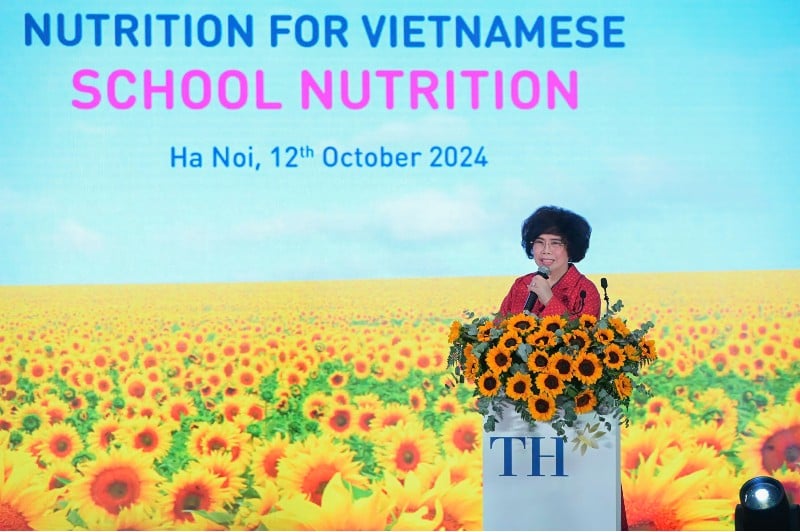 |
| Businesswoman Thai Huong proposed the need to build a legal corridor on school nutrition. |
Previously, at the Government Standing Committee Conference with large enterprises, Ms. Thai Huong proposed this. In particular, at the meeting with General Secretary and President To Lam on October 13, she emphasized that entrepreneurs must have vision, intelligence and talent, and enough courage to grasp and shoulder the responsibility with the country to enter a new era - the era of national growth.
“In addition to growing in economy and civilization, we must grow in stature, physical strength, and height. In addition to legal policies, food businesses must consider the mission of raising the stature of the nation as their own and shoulder this responsibility,” said businesswoman Thai Huong.
According to her, Vietnam ranks 15th from the bottom in the world in terms of average height. Meanwhile, science has proven that 86% of a person's height development occurs during the golden age of 0-12, and 14% occurs up to the age of 25. Therefore, children need adequate care, and to achieve this, comprehensive and broad legal regulations are necessary. A Law on School Nutrition should be enacted, encompassing regulations on physical activity, human resources, nutrition education, and more.
"I hope to inspire people to promote the establishment of a legal framework for school nutrition. I will be steadfast and persistent in this journey. I also have a dream and aspiration to become a producer of quality food, first for the Vietnamese people themselves, and then to expand internationally," businesswoman Thai Huong emphasized.
Source: https://baodautu.vn/xay-hanh-lang-phap-ly-cho-dinh-duong-hoc-duong-de-nang-cao-tam-voc-nguoi-viet-d227334.html


![[Photo] Closing Ceremony of the 10th Session of the 15th National Assembly](/_next/image?url=https%3A%2F%2Fvphoto.vietnam.vn%2Fthumb%2F1200x675%2Fvietnam%2Fresource%2FIMAGE%2F2025%2F12%2F11%2F1765448959967_image-1437-jpg.webp&w=3840&q=75)

















































![[OFFICIAL] MISA GROUP ANNOUNCES ITS PIONEERING BRAND POSITIONING IN BUILDING AGENTIC AI FOR BUSINESSES, HOUSEHOLDS, AND THE GOVERNMENT](https://vphoto.vietnam.vn/thumb/402x226/vietnam/resource/IMAGE/2025/12/11/1765444754256_agentic-ai_postfb-scaled.png)













































Comment (0)