


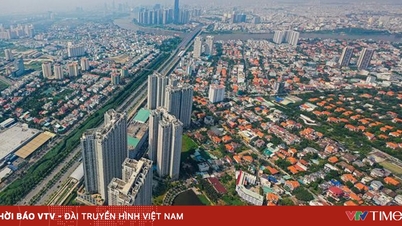
(Illustrative image)
Lawyer Nguyen Van Dinh ( Hanoi Bar Association) - a real estate legal expert - has compiled a list of 17 outstanding new points of the Resolution (effective from January 1, 2026) compared to the current Land Law (Land Law of 2024) as follows:
1. Three additional groups of land recovery cases are added, including: (1) Project implementation in free trade zones and projects in international financial centers; (2) In cases where a project is implemented through an agreement on land use rights that has expired and more than 75% of the land area and more than 75% of the landowners have been agreed upon, the Provincial People's Council shall consider and approve the recovery of the remaining land area to be allocated to the investor; (3) To create a land fund to pay for BT contracts; to lease land for continued production and business in cases where organizations are using land that the State recovers. (Stipulated in Article 3.2 of the Resolution)
2. Expand the application of land price tables to all purposes (both "inputs" of land relations - when the State reclaims land and "outputs" of land relations - when the State allocates/leases land) and invalidate "specific land prices". Land price tables and land price adjustment coefficients are used as the basis for calculating land use fees, land lease fees, and compensation for people when the State reclaims land (Article 5 of the Resolution).
3. Regulations on reducing land use fees when changing land use purposes: In cases where garden land, pond land, or agricultural land within the same plot as residential land is converted to residential land (and some other cases), the fee will be: 30% of the difference between the land use fee calculated according to the price of residential land and the land use fee calculated according to the price of agricultural land at the time of the decision allowing the change of land use purpose for the area of land converted within the local residential land allocation limit; 50% of the difference for the area of land exceeding the limit but not more than once the residential land allocation limit; 100% of the difference for the area of land exceeding twice the residential land allocation limit.
The preferential treatment applies only once per household or individual (per plot of land). If a household or individual has had their land use purpose changed from the time the 2024 Land Law came into effect (August 1, 2024) until before the new regulations come into effect (January 1, 2026), the treatment will be applied retroactively: If the land use fee has not yet been paid, it will be recalculated (at 30% or 50% of the difference). If the land use fee has already been paid (at 100% of the difference according to the 2024 Land Law), it will be recalculated and reimbursed by the State… (Article 10.2, Article 4.10 of the Resolution)
4. Allow land acquisition before the compensation, support, and resettlement plan is approved and resettlement is arranged in the following cases: (1) Implementing a nationally important project, an urgent public investment project without resettlement arrangements (but the land clearance plan must be publicly posted); other projects (without resettlement arrangements) where more than 75% of land users agree to land acquisition before the land clearance plan is approved; (3) urgent public investment projects, on-site resettlement projects, and resettlement projects along the main construction route. The Provincial People's Committee shall regulate temporary housing arrangements, duration, and costs. (Articles 3.3, 3.4 of the Resolution)
5. Allows the competent authority to decide on land acquisition according to the project progress or the land clearance progress. (Article 3.5 of the Resolution)
6. Allow the competent authority to decide on land allocation and leasing according to the project progress or the land clearance progress. (Article 4.1 of the Resolution)
7. Allow land users to choose between paying a lump sum or paying annually for land lease. (Article 4.2 of the Resolution)
8. Allows the allocation and leasing of land, and permits the conversion of land use from rice cultivation land and forest land to other purposes without requiring approval from the Provincial People's Council. (Article 4.3 of the Resolution)
9. Additional cases of land allocation and land lease without auction or bidding: (1) Land for payment under BT contracts; (2) To implement projects in cases where the State recovers land, does not use state capital, has a decision approving the investment policy and approving/selecting the investor; (3) Energy projects, tourism projects associated with trade and services in areas with particularly difficult socio -economic conditions. (Article 4.4 of the Resolution)
10. Reduce the requirements for auctioning land use rights for housing projects; reduce the requirements for bidding to select investors for urban and rural residential area projects: only a zoning plan (or general plan in cases where a zoning plan is not required) is needed. (Articles 4.5, 4.6 of the Resolution)
11. Allows adjustment of land use term for new investors replacing dissolved or bankrupt investors; and investors receiving project transfers. New investors and investors receiving project transfers must pay additional land use fees and land lease fees. (Article 4.7 of the Resolution)
12. Shorten the land acquisition notification period to 60 days for agricultural land and 120 days for non-agricultural land (the 2024 Land Law stipulates 90 days and 180 days respectively); shorten the time for publicly posting compensation, support, and resettlement plans; and shorten the time for holding dialogues when there are disagreements regarding the land clearance plan. (Article 3.9 of the Resolution)
13. Clarifying cases of exemption from land use fees and land rent: land valuation and calculation of land use fees and land rent are not required, and no exemption application procedures are needed, except in cases where land rent is only exempted for a certain number of years. Compared to the 2024 Land Law, the Resolution clarifies that in cases where land rent is only exempted for a certain number of years, land valuation and calculation of land rent are still required. (Article 10.1 of the Resolution)
14. Reducing the conditions for selling assets on land leased with annual payments: Assets that have a construction permit (in cases where a construction permit is required); assets that have been completed in accordance with the detailed plan and project, except in cases where implementation is required by a court judgment or decision… Compared to Article 46 of the 2024 Land Law, the Resolution reduces the condition that the asset must be registered, meaning that assets that are not required to have ownership certified on a certificate of ownership can also be sold. (Article 11.1 of the Resolution)
15. In cases where land users allocate a portion of a residential plot or a plot containing both residential and other land for a passageway, when subdividing or consolidating land plots, it is not mandatory to change the land use purpose for the area allocated for the passageway. Allowing the conversion of land use purpose for a portion of the plot does not require subdivision. Consolidating land plots with different land use purposes, different land use forms, and different land use durations is permitted. (Article 11.3 of the Resolution)
16. Simplify the land use planning/planning system: no 5-year land use plan (2026-2030) for centrally-administered cities, no district-level land use plan, no annual district-level land use plan, and no commune-level land use plan. (Article 12.3 of the Resolution)
17. The requirement for land reclamation activities to be approved by the National Assembly and the Prime Minister, and for investment policy decisions to be made, is abolished if implemented in areas specified in Article 190.3 of the Land Law (Areas protecting historical and cultural relics, scenic spots…; Natural heritage…; National parks, nature reserves, species and habitat conservation areas…; Seaport areas, waters in front of wharves…; River estuaries and areas planned and used for national defense and security purposes). (Article 11.6 of the Resolution)
Source: https://vtv.vn/17-diem-moi-cua-nghi-quyet-thao-go-vuong-mac-trong-to-chuc-thi-hanh-luat-dat-dai-100251212104941604.htm


![[Photo] Prime Minister Pham Minh Chinh holds a phone call with the CEO of Russia's Rosatom Corporation.](/_next/image?url=https%3A%2F%2Fvphoto.vietnam.vn%2Fthumb%2F1200x675%2Fvietnam%2Fresource%2FIMAGE%2F2025%2F12%2F11%2F1765464552365_dsc-5295-jpg.webp&w=3840&q=75)































































Comment (0)