Scientists have unveiled the most detailed map of the adult human brain to date, revealing the arrangement and function of 3,300 different types of brain cells.
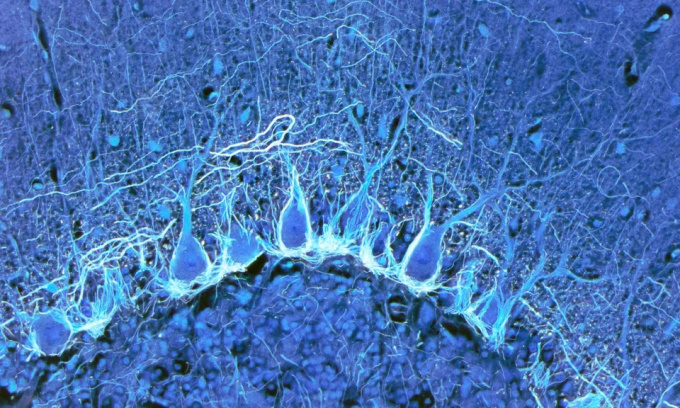
Purkinje cells, large neurons in the cerebellum, are located at the back and bottom of the brain. Photo: Steve Gschmeissner/Science Photo Library
New research mapping human brain cells was published on October 12th as 21 papers in three journals: Science, Science Advances , and Science Translational Medicine . "It's not just an atlas; it really opens up a whole new field where you can observe animal brains with extremely high cellular resolution that was previously not possible," said Ed Lein, a neuroscientist at the Allen Institute for Brain Science and lead author of five of the papers.



The new research was conducted as part of a major project by the U.S. National Institutes of Health (NIH). The project, launched in 2017, aimed to catalog cells in the brains of mice, humans, and non-human primates.
The mapped cells include neurons—brain cells that communicate through electrical and chemical messages—and other cells in roughly equal numbers. An adult human brain contains approximately 86 billion neurons, plus or minus 8 billion, and about 84 billion other cells.
The team of scientists used transcription techniques to catalog all the RNA in each cell. RNA is the genetic molecule that contains instructions for making proteins and performing several other important tasks. They also used epigenetic techniques to examine the chemical signals located on top of DNA and control how genes are used. The individual studies included in the project contained data from hundreds of thousands to millions of brain cells.
Combining these techniques, the research team created cellular maps of the developing and adult human brains, as well as the brains of several other primate groups, such as squirrel monkeys ( Callithrix ) and macaques ( Macaca ). From there, they were able to directly compare human and primate brains, showing that many of the cell types in the human brain are also found in chimpanzees and gorillas. But despite sharing the same cell types, the gene activity of these cells in humans and primates is very different, leading to differences in cell coordination.



Despite its unprecedented detail, the map of the human brain is only the research team's first sketch. Next, they want to decipher the function of the newly discovered cells in the brain, a large number of which are located deep within the brain, in structures such as the brainstem. They also want to understand how the gene activity of different cells contributes to the development of neurological diseases.
Thu Thao (According to Live Science )
Source link









![[GALLERY] Rejected 143 times, Harvard student builds a $10.1 billion empire.](https://vphoto.vietnam.vn/thumb/402x226/vietnam/resource/IMAGE/2026/07/03/1783083627107_wo-2-png.webp)