

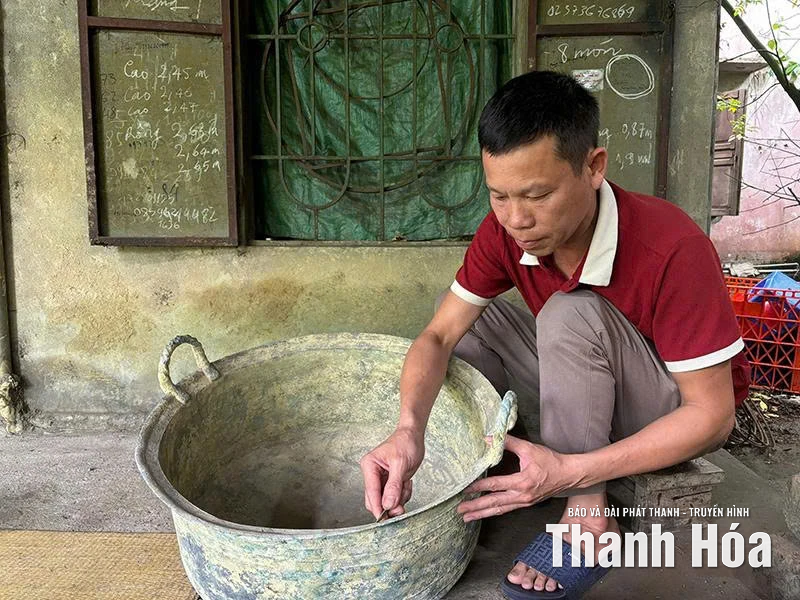
Distinguished artisan Nguyen Thanh Tu in Luu Ve commune restores damaged ancient artifacts.
People who "bring ancient artifacts back to life"
Bronze jars, drums, and antique vases... though no longer in their original form, are transformed into beautiful and perfect objects through the skillful and meticulous hands of artisan Tran Van Thanh (Hac Thanh ward). For many years, driven by a desire to help people restore valuable antiques, he has continuously explored, learned, and researched, becoming a rare craftsman in this field.
Mr. Thanh recounted: "I've been involved in this profession for quite some time, learning from experienced predecessors and further through books, newspapers, and social media. Initially, I only tried my hand at restoring some items like teapots and cups from my family's collection. Gradually, I started restoring antiques for some acquaintances and members of the Thanh Hoa Cultural Heritage and Antiques Association. To pursue the profession of restoring antiques requires meticulousness, dedication, and immense perseverance, because each antique item requires different restoration techniques, sometimes taking a great deal of research and time to complete."
Typically, before restoring an item, not only I but any craftsman would research the history, age, and patterns of the antique, in order to accurately recreate its original form and value. Next, sandpaper is used to smooth the surface, removing any rough areas. Finally, the process involves mixing colors, redecorating the newly completed imperfections, and applying a layer of varnish.
"For example, this broken Dong Son bronze drum was brought in by locals a long time ago for restoration. However, restoring bronze drums is a whole process of recovering the shape, patterns, and casting techniques of the Dong Son bronze drum. This process includes studying original artifacts, searching for fragments, and using traditional casting techniques to create replicas or reconstructed versions, so it requires quite a lot of time," Mr. Thanh said.
Having worked in this profession for a long time, Mr. Thanh can't even remember how many antiques he's "revived." He only knows that each time an antique is restored to its original state, he feels like he's brought back to life the ancient cultural values left behind by previous generations. However, according to Mr. Thanh, the number of people working in antique restoration in the province is not large, almost countable on the fingers of one hand. Therefore, he is very worried that when craftsmen like him get old, it will be difficult to find successors.
Also deeply concerned about finding someone to pass on the craft to, Meritorious Artisan Nguyen Thanh Tu from Luu Ve commune confided: "For many people, antiques are not only valuable in terms of their monetary value but also hold memories and recollections. It is for this reason that items that seemed to have lost their value, through the restoration efforts of craftsmen like us, not only become perfect and highly valuable but also contain many historical stories of our ancestors. That is also the reason why I chose the path of 'rediscovering memories' through antiques."
Holding the restored antique vase in his hand, Mr. Tú recounted: "This antique vase was broken in many places, so I spent a lot of time assessing its condition, the extent of damage, the material, and other related factors to determine the appropriate restoration method. At the same time, I had to research the vase's history and age to accurately recreate the original patterns and designs. Then, I applied glue to the damaged areas. After the glue dried, I proceeded to reshape the chipped parts. Next, I used a grinding machine and sandpaper to remove excess glue and mend the joints..."
Therefore, it can be said that the profession of antique restoration not only requires professional knowledge and skills, but also passion, patience, and a high sense of responsibility. Antique restorers are considered the "doctors" of antiques, helping them come back to life and continue telling their stories to future generations.
In today's fast-paced modern life, people like Mr. Thanh and Mr. Tu are perhaps rare. They are not only artisans who restore antiques, but also passionate individuals who cherish the traditional cultural heritage left by their ancestors. And so, day after day, they diligently gather each piece to "patch up" and breathe life into countless ancient artifacts, bringing them back to life.
Strengthening the protection of ancient artifacts.
Over the years, localities, units, and historical and cultural relic management boards in the province have paid special attention to the management and protection of artifacts, antiques, and religious objects at historical sites. At the same time, they have focused on digitizing artifacts to preserve and conserve them.
Regarding this issue, Deputy Director of the Ho Dynasty Citadel Heritage Conservation Center, Trinh Huu Anh, said: "To best preserve the artifacts, we regularly inspect, clean, neatly arrange, and classify each material to implement periodic maintenance measures for each artifact. At the same time, after excavation and collection, artifacts are measured and meticulously recorded to serve as a basis for inventory and scientific documentation, ensuring the scientific and legal validity of the artifacts. In addition, we regularly promote and raise awareness and responsibility among the people in protecting artifacts; encouraging people to donate artifacts unearthed from underground..."
Chairman of the Thanh Hoa Cultural Heritage and Antiquities Association, Ho Quang Son, stated: "To extend the lifespan of museum artifacts, institutions currently preserving antiquities need to invest in building exhibition halls that meet the necessary conditions for displaying treasures. At the same time, it is necessary to recruit more specialized technical staff to serve the research, preservation, and promotion of the value of antiquities. Furthermore, more attention should be paid to the inventory and digitization of valuable historical documents and artifacts. Building a database will not only help manage artifacts better but also facilitate the promotion and introduction of cultural and historical values to the community and internationally."
Recently, the Provincial People's Committee issued Official Letter No. 9972/UBND-VHXH on continuing to strengthen the management and protection of valuable relics, artifacts, and antiques in the province. Accordingly, it requested the Department of Culture, Sports and Tourism to take the lead and continue to closely coordinate with relevant departments and agencies; based on current legal regulations and according to assigned functions, tasks, and powers, to promptly implement and guide relevant localities, units, and individuals to strictly, fully, and effectively carry out the management and protection of valuable relics, artifacts, and antiques in the province. The task of protecting historical and cultural relics, scenic spots, artifacts, antiques, and national treasures belonging to relics in the province must be carried out in accordance with the law. At the same time, there should be plans for prevention, early detection, and readiness to stop and handle acts of damage and destruction, ensuring absolute safety for the relics and artifacts, relics, antiques, and national treasures belonging to the relics; preventing any loss, misplacement, or damage in any form.
Ancient artifacts are valuable assets and treasures left behind by our ancestors. Therefore, preserving and promoting the value of these artifacts is not just the responsibility of any one individual, but a shared responsibility of the entire community.
Text and photos: Nguyen Dat
Source: https://baothanhhoa.vn/bao-ton-phat-huy-gia-tri-co-vat-viec-can-lam-bai-cuoi-danh-thuc-co-vat-261043.htm















![[E-Magazine]: The season closes the chapter on sources of love](https://vphoto.vietnam.vn/thumb/402x226/vietnam/resource/IMAGE/2025/12/12/1765547070855_e-magazine-mua-w1200t0-di2549d199d5153818t11920l1-mkl-014.webp)


















































Comment (0)