

Girl D.TV (20 years old, Hung Yen ) suffered a traumatic brain injury due to a traffic accident in August 2025 and had to undergo surgery at a provincial hospital (hematoma removal, skull bone graft). After surgery, V's health was stable.
Just two months later, V's old surgical wound on his left temple began to leak yellow fluid. Although he had no fever or headache, his family still took him for a check-up. The doctor discovered a 5mm hole with bone loss in the frontal temporal region.
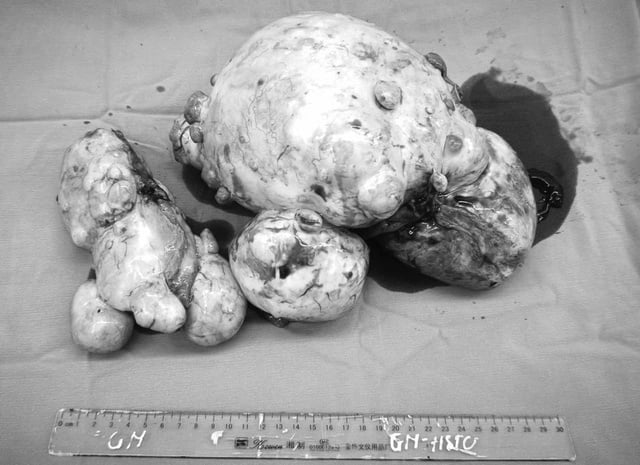
Image of the tumor after surgery. Photo: BVCC
V. was diagnosed with a surgical site infection after a traumatic brain injury. After 7 days of treatment without improvement, her family transferred her to a higher level facility. During the evaluation for re-surgery, the doctor also discovered a large tumor in the pelvic area.
Realizing the risk of progressive infection, V was transferred to the Central Hospital for Tropical Diseases.
Here, V started to have a high fever. Tests showed that V was positive for Dengue fever, and still had an infection in the brain surgery wound and a pelvic tumor.
After 20 days of priority treatment to stabilize the infection and Dengue fever, V was transferred to the General Surgery Department for surgical consultation to remove the tumor, suspected of malignancy.
Computed tomography showed a hypogastric tumor measuring 110 x 163 x 244 mm with irregular edges.
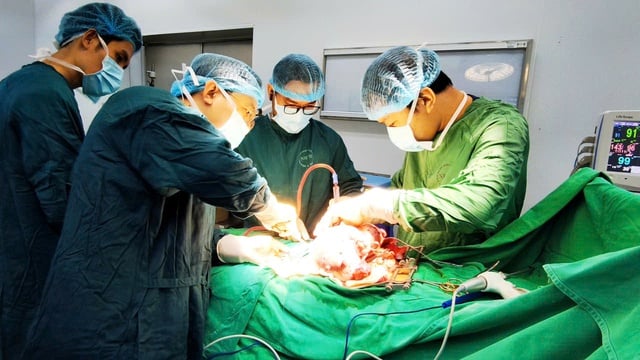
Doctors perform surgery to remove an ovarian tumor. Photo: BVCC
Dr. Tran Duy Hien performed surgery and was surprised to see that the ovarian tumor occupied almost the entire lower abdomen. The tumor was round and abnormally enlarged on both sides of the fallopian tubes, compressing the uterus.
The team had to remove the entire ovary, fallopian tube, uterus and greater omentum to avoid leaving behind metastatic cells. The surgery lasted 3 hours. The tumor was completely removed, weighing 2.9 kg and measuring 30 x 24 cm.
According to Dr. Tran Duy Hien, ovarian cancer is a dangerous disease because the early symptoms are vague and easily overlooked. Many cases are only discovered when the tumor is large, requiring extensive surgical intervention, affecting fertility and long-term health.
Common symptoms (nonspecific):
Vague pain or discomfort in the abdomen/pelvis.
Digestive disorders (loss of appetite, bloating, rapid satiety).
Change in bowel habits (frequent/difficult urination, constipation).
Physical changes (weight loss, increased waist circumference).
Abnormal vaginal bleeding, pain during intercourse.
For early detection (especially women of reproductive age):
Regular screening: Ultrasound, gynecological examination and general health check-up annually.
Take the initiative to see a doctor: When there are unusual signs such as lower abdominal pain, bloating, menstrual disorders or feeling an unusual mass in the pelvic area.
Early detection offers a much better chance of treatment and prognosis.
Source: https://suckhoedoisong.vn/bat-ngo-phat-hien-u-buong-trung-sau-chan-thuong-so-nao-169251204101353186.htm


![[Photo] Cat Ba - Green island paradise](/_next/image?url=https%3A%2F%2Fvphoto.vietnam.vn%2Fthumb%2F1200x675%2Fvietnam%2Fresource%2FIMAGE%2F2025%2F12%2F04%2F1764821844074_ndo_br_1-dcbthienduongxanh638-jpg.webp&w=3840&q=75)






































![[VIMC 40 days of lightning speed] Da Nang Port: Unity - Lightning speed - Breakthrough to the finish line](https://vphoto.vietnam.vn/thumb/402x226/vietnam/resource/IMAGE/2025/12/04/1764833540882_cdn_4-12-25.jpeg)















































Comment (0)