

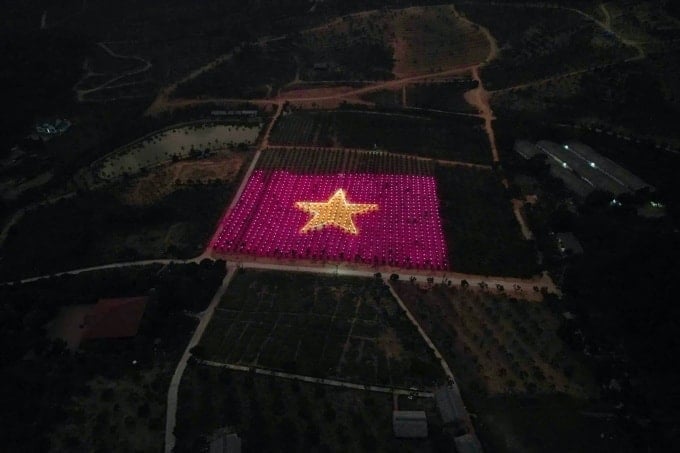
After more than three months of stringing lights to create the shape of the national flag in their dragon fruit garden, La Pitaya Valley resort posted photos and videos of the result on social media, attracting nearly 600,000 views and hundreds of comments. Most netizens and tourists were delighted with the resort's idea and encouraged each other to visit and check out the dragon fruit garden.
"Patriotism should be spread through creative actions," said Hoai Thu, a resident of Hanoi .
Nguyen Huu Cong, the resort manager, said he was "surprised" by the positive response to the idea of stringing lights in the shape of a flag. Nearly a week after the flag image was posted, the number of bookings at the resort surged. Most bookings were made from the second day of Tet (January 30th). Currently, the occupancy rate for the Tet holiday is around 50%, with most guests coming from Hanoi. From the fourth day (February 1st), the majority of pre-booked guests are Western tourists, reaching about 30% of the resort's capacity.
According to Mr. Cong, the idea of creating the national flag design stemmed from a desire to bring agricultural experiences closer to tourists. The implementation of the idea began in November 2024 with the goal of completing a flag measuring 8,800 square meters.
"The process of making this flag breaks away from traditional agricultural practices," Mr. Cong said.
Typically, dragon fruit orchards are illuminated by flexible copper wire, using household electricity. The wire is wrapped around steel wire, which is not very safe and is prone to electrical leakage. This method is also unsightly, resembling a tangled spiderweb, and "no one dares to enter at night except the orchard owner."
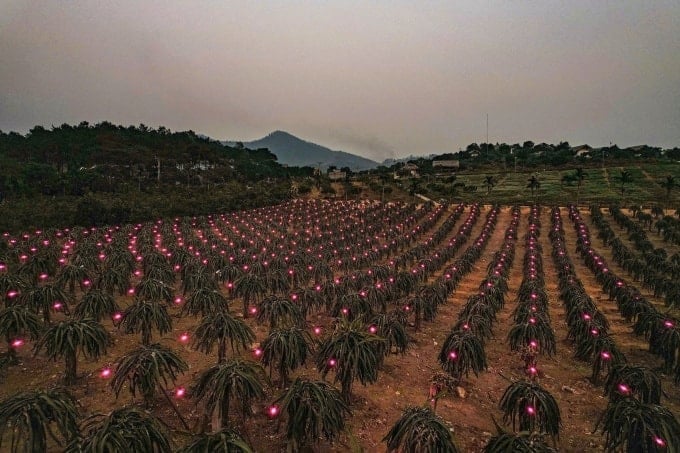
To ensure guests can enter and exit the garden at night, while maintaining both safety and aesthetics, the resort uses outdoor cables for lighting. Each row of dragon fruit plants is fitted with a residual current circuit breaker (RCCB).
After addressing the safety concerns, the team proceeded to balance the proportions of the flag and the star.
"The alignment was difficult because of the large area; we had to use a drone, send people to climb the utility poles, and adjust everything little by little over half a month," Mr. Cong said, adding that the final challenge was solving the problem of lighting coordination.
To prevent the yellow star from mixing with the red flag, the team had to add a separate wire border, spaced 50 cm apart. The remaining color sections had lights spaced 2.5 m apart.
According to a representative from the resort, on the first day the flag was lit, locals enthusiastically came to check in at the garden in the evening. For now, the resort will maintain the flag-shaped design. In the following months, they will decorate the garden with themed lights. The total area of the dragon fruit garden is 1.5 hectares, with the flag-shaped area occupying more than half of it.
In the North, dragon fruit bears fruit from May to October. Farmers use electric lights to produce off-season dragon fruit from November to March. Currently, dragon fruit is having difficulty budding and bearing fruit due to large temperature differences between day and night, and heavy frost at night.
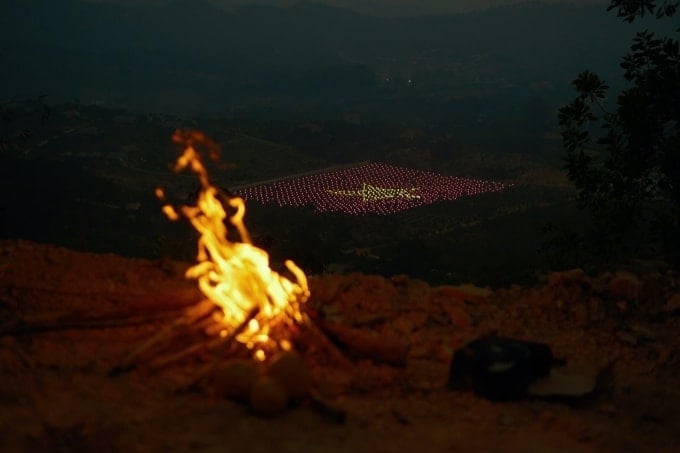
Mr. Cong said that the resort's operations are based on agricultural products. The entire resort has 35 hectares planted with various fruit trees, next to a national pine forest, surrounded by the Than Lan mountain range, providing visitors with a close-to-nature experience. The orchards within the resort are open to visitors for free.
"The resort's concept is to create a beautiful landscape, not only as a place to check in and create new experiences, but also to spread a patriotic spirit," commented Mr. Ngoc Nam, a tourist from Hanoi.
TH (according to VnExpress)Source: https://baohaiduong.vn/bien-vuon-thanh-long-thanh-co-to-quoc-403881.html


















![[Video] The craft of making Dong Ho folk paintings has been inscribed by UNESCO on the List of Crafts in Need of Urgent Safeguarding.](https://vphoto.vietnam.vn/thumb/402x226/vietnam/resource/IMAGE/2025/12/10/1765350246533_tranh-dong-ho-734-jpg.webp)
















































Comment (0)