

Global currency markets are bracing for potential increased volatility based on signals from the foreign exchange options market, with the Canadian dollar (CAD) in focus as the deadline for US tariffs on its top trading partners, Mexico and Canada, approaches.
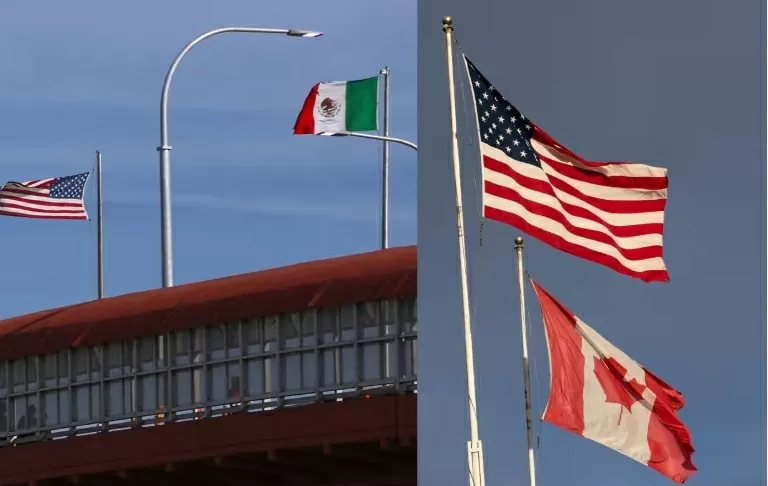 |
| Global currency markets are bracing for increased volatility as the deadline for U.S. tariffs on its trading partners Mexico and Canada approaches. (Source: Getty) |
The options market, which investors and companies often use to hedge risk, is showing signs of increased anxiety in the spot currency market.
Within minutes of Donald Trump's tariff comments on January 30th, the US dollar surged more than 1% against the Canadian dollar, reaching a near five-year high of 1.4596 CAD per USD before falling back. In London trading on January 31st (local time), the pair fluctuated around 1.4484 CAD per USD.
The Mexican peso also experienced significant volatility. After weakening by more than 1% against the US dollar on January 30th, it traded at around 20.68 pesos to 1 USD on January 31st.
On January 30, President Trump reaffirmed his intention to impose tariffs and stated that oil imports "may or may not" be excluded.
President Donald Trump set a February 1 deadline to impose a 25% tariff on imports from Mexico and Canada in an effort to force the two countries to stop the flow of illegal immigrants and fentanyl (a painkiller) into the United States.
Expected volatility for the Canadian dollar (CAD) this past week has risen to its highest level since October 2022. For the Mexican peso, this level of volatility is at its highest since the US election in November 2024.
The high expected volatility suggests that traders are preparing for a period of significant price fluctuations in a currency pair, but the direction remains unclear.
Sagar Sambrani, a senior forex options trader at investment bank Nomura, said there is strong demand for volatility options on the USD/CAD pair.
According to him, the USD/CAD and USD/Peso pairs are currently the focus of discussion due to the lingering threat of short-term tariffs from President Trump on both countries.
He stated that since President Trump took office, the expected future volatility of most other currency pairs has decreased significantly. However, both the USD/CAD and USD/Peso pairs have experienced very high monthly volatility over the past two months.
ING bank currency strategist Francesco Pesole said traders will view the US-Canada-Mexico situation as a benchmark for Trump's trade policy in the coming period.
He added that if President Trump does not carry out his threat by February 1st, the market will see the USD depreciate not only against the CAD and the Peso but also against other currencies at risk of tariffs such as the Euro, the Australian Dollar, and the New Zealand Dollar.
Source: https://baoquocte.vn/bom-thue-quan-cua-ong-trump-de-doa-thi-truong-tien-te-toan-cau-302786.html




























































































Comment (0)