

1. Several large stone steles with inscriptions have been transferred to museums in Hanoi and Da Nang, and recently placed in the exhibition hall of the My Son Relics Management Board for preservation.
We noticed a small stone slab still remaining at the archaeological site. The slab bore several faded lines of text, but they provided specific information about an important historical milestone.
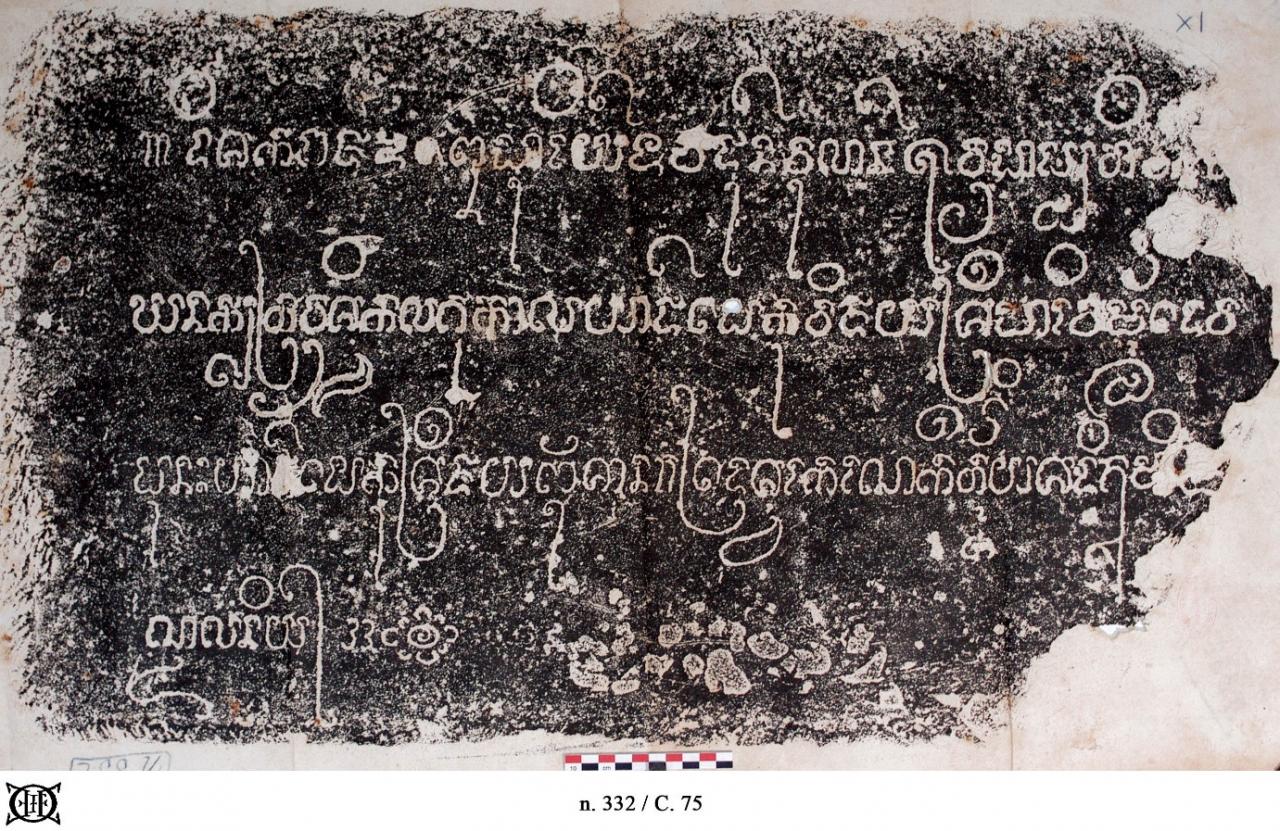
It is a stone slab bearing inscriptions that researcher George Coedes cataloged in 1908, designated C 75, and now listed with the new inventory number MSD350 by the My Son Relics Management Board.
The C 75 inscription contains only 4 lines of ancient Cham script, inheriting the Brahmi script (Sanskrit, of Indian origin); it was transcribed into Latin by Louis Finot (1904), translated into French, and published in a research paper in the Journal of the French School of Far Eastern Studies. More recently, Arlo Griffiths (2009) revised the Latin transcription, which consists of 4 lines:
(1) di śakarāja 913 huriy 5 vaṅun vulān 4 vr̥ haspativāra [ma]
(2)ghanakṣatravr̥ ścikalagna kāla yāṅ po ku vijaya śrī harivarmmadeva
(3) punaḥ yāṅ po ku śrī jaya īśānabhadreśvara karaṇa kīrtti yaśa di bhūmima
(4) ṇḍala niy
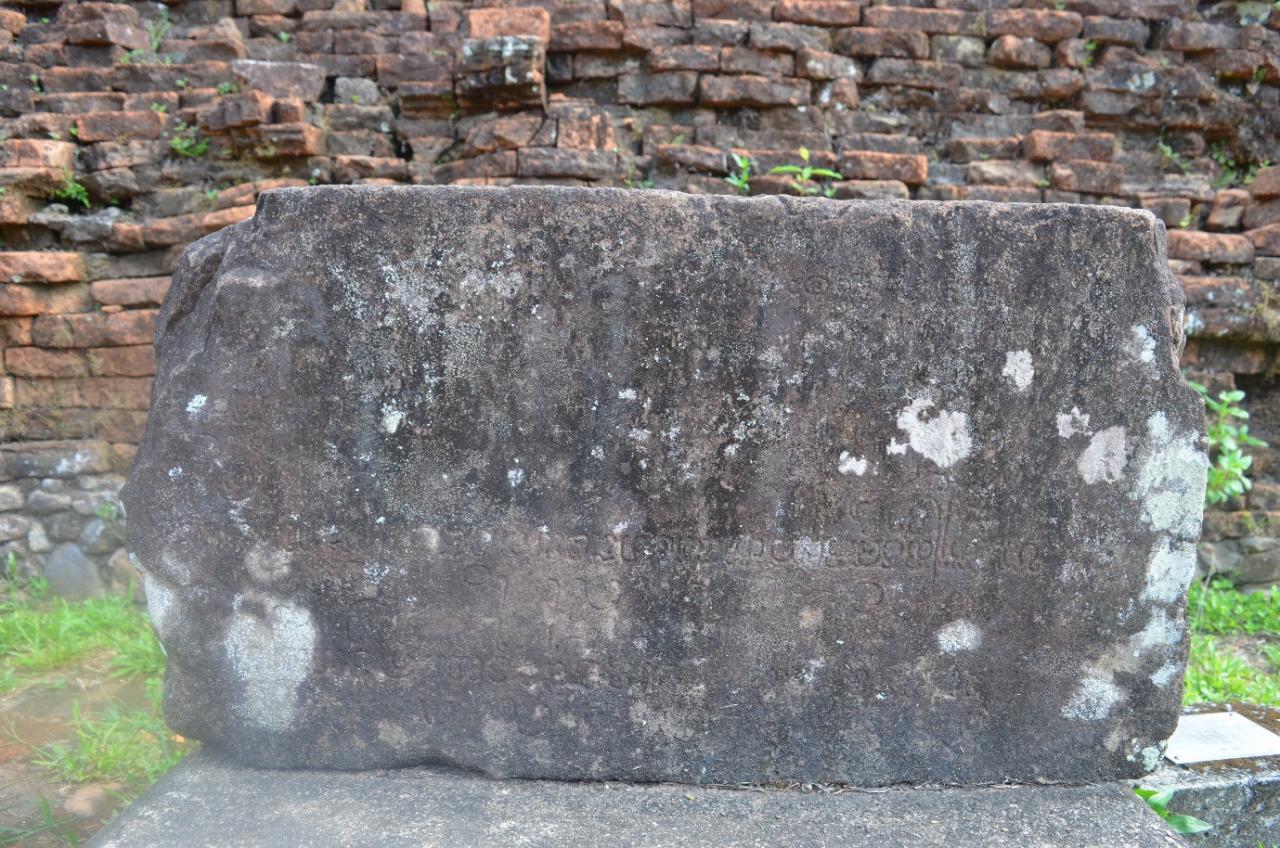
The text can be roughly translated as follows: “In the year 913 of the Saka calendar, on the 5th day of the 4th month, during the Maga lunar cycle, with the constellation Scorpio in the zodiac, King Yan Pu Ku Vijaya Śrī Harivarmadeva had the image (temple or linga) of the god Iśāna-Bhadreśvara rebuilt to bring glory to the land.”
Iśāna-Bhadreśvara is a title of the god Siva, associated with the names of the first kings of Champa, and is revered as the protector deity of the kingdom.
The year 913 in the ancient Saka calendar corresponds to the year 991 in the Gregorian calendar. This was the period following King Le Hoan's (Dai Viet) attack on the Champa capital.
The book "Dai Viet History Chronicle" records an event that occurred in 982: "The king personally led an expedition against Champa, capturing countless soldiers, along with a hundred courtesans and a Buddhist monk from India. He seized valuable items, accumulating tens of thousands of gold, silver, and treasures, leveling the city walls, destroying the ancestral temples, and returning to the capital after one year." And in 988, "The King of Champa, Bang Vuong La Due, established his temple in Phat Thanh and adopted the title 俱尸利呵呻排麻羅 (Cau Thi Li Ha Than Bai Ma La)."
2. Comparing this with an inscription found at the Dong Duong site (Thang Binh district) which records the Champa king establishing a temple in the capital Indrapura in 875, researchers conclude that King Le Hoan's attack in 982 took place in the Indrapura capital area. This led the Champa king to flee to the "Buddhist city" (understood to be Vijaya citadel in present-day Binh Dinh).
In relation to these events, the Song Dynasty (China) historical records also state that in 990, the new king of Champa ascended the throne in "the land of Buddha's Vow" and sent envoys to report that Champa was being attacked by Giao Chau (Dai Viet).
In 1007, the Champa king, named 楊普俱毗茶室離 (Dương Phổ Câu Bì Trà Thất Lợi), sent an envoy to the Song dynasty, saying that the king had fled to Phật Thệ, 700 miles north of his former capital.
In the C 75 inscription at My Son, there is a phrase referring to the Champa king: “yāṅ po ku vijaya śrī harivarmmadeva”. This phrase includes both a respectful form of address (yāṅ po ku = Supreme King), an honorific term of praise (vijaya = glorious victory), and a Sanskrit title (śrī harivarmmadeva = Divine Harivarman).
Meanwhile, Chinese and Vietnamese historical records, when documenting the names of Champa kings, often used short versions, employing phonetic (or semantic) representations of a few syllables.
In the case of the Song Dynasty historical records, it is 楊普俱毗茶室離, pronounced in Sino-Vietnamese as Dương Phổ Câu Bì Trà Thất Lợi, but when read in Chinese as yang-pu-ju-bi-cha-she-li, it can be recognized as a transliteration of yāṅ po ku vijaya.
Similarly, the Đại Việt chronicle records the name of the Champa king of this period as 俱尸利呵呻排麻羅, pronounced Câu Thi Lị Ha Thân Bài Ma La in Sino-Vietnamese, and ju-shi-li-a-shen-bei-ma-luo in Chinese; this may be a recording of the name Ku Śrī Harivarmadeva in ancient Champa, referring to the same king in the C 75 inscription.
Comparing the names refracted across the four languages—Indian, Chinese, Cham, and Vietnamese—requires further meticulous research. However, it is highly likely that the remaining inscriptions on the C 75 stone slab at the My Son site recorded an important milestone in Champa history: after King Le Hoan's attack in 982, the sacred site at My Son continued to be restored and built by King Yāṅ po ku vijaya śrī Harivarmmadeva, even though the Champa capital had moved to Cha Ban (Binh Dinh).
Source: https://baoquangnam.vn/bong-dang-lich-su-tren-mot-phien-da-3140066.html



![[Image] National Assembly discusses the implementation of the socio-economic development plan.](https://vphoto.vietnam.vn/thumb/1200x675/vietnam/resource/IMAGE/2026/04/20/1776696707422_ndo_br_img-20260420-185419-jpg.webp)
![[Photo] General Secretary and President To Lam meets with National Assembly delegates from ethnic minorities.](https://vphoto.vietnam.vn/thumb/1200x675/vietnam/resource/IMAGE/2026/04/20/1776696701056_a1-bnd-8331-3342-jpg.webp)


![[Photo] My Son at night: A thousand-year-old heritage site amidst the Milky Way](https://vphoto.vietnam.vn/thumb/402x226/vietnam/resource/IMAGE/2026/04/15/1776261039184_ndo_br_chon6-jpg.webp)





































































Comment (0)