

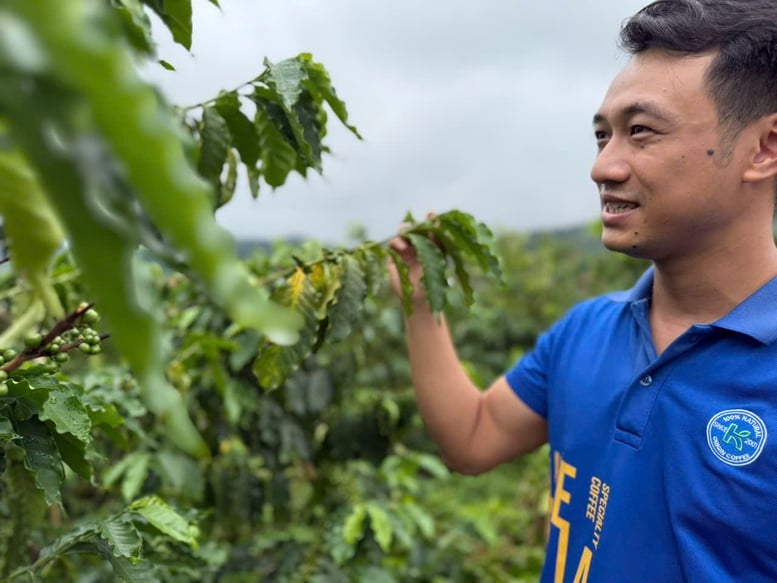
Many Vietnamese coffee brands are conducting research and establishing organic raw material areas - Photo: VGP/Do Huong
A new milestone for the coffee industry.
The Vietnamese coffee industry is making a strong impression in the first half of 2025 with export turnover reaching US$5.45 billion, far exceeding initial expectations and opening up prospects for a breakthrough this year. These impressive figures not only reflect the industry's dynamism but also demonstrate a transformation in quality and added value, especially with the rise of specialty coffee. In fact, Vietnam has now begun producing specialty coffee with selling prices one and a half to two times higher than the world average, marking a significant turning point in the industry's development strategy.
Mr. Phan Minh Thong, Chairman of the Board of Directors of Phuc Sinh Joint Stock Company, emphasized the potential of specialty coffee from the Northwest region, especially Honey Process Coffee and Natural Process Specialty Coffee made from Arabica coffee. These products possess unique flavors, superior acidity, sweetness, balance, and purity, making them popular with customers in the EU, the US, and many other countries. "Thanks to these special attributes, specialty coffee not only enhances added value but also creates a cultural narrative, attracting modern consumers," Mr. Thong shared.
Mr. Thong noted that the remarkable improvement in the quality of Vietnamese coffee over the past decade is a key factor. Vinh Hiep Co., Ltd. ( Gia Lai ) also made its mark with a 48% increase in export turnover in the first six months of the year, mainly thanks to deeply processed products such as instant coffee and roasted and ground coffee, especially in the EU market. Mr. Thai Nhu Hiep, the company's director, said: "The success comes not only from high coffee prices but also from a story of responsibility and transparency, meeting the stringent standards of a demanding market."
However, the coffee industry still faces many challenges in the international market. The EU continues to be a key market, accounting for the majority of Vietnam's coffee exports. Mr. Tran Ngoc Quan, Trade Counselor in Belgium and the EU, recommends that businesses focus on differentiated product lines such as high-quality, deeply processed, certified, and specialty coffee. This market is strongly shifting towards green consumption, with standards regarding labor, environment, and transparent production processes. "Businesses need to be quick to adapt to this trend to maintain a competitive advantage," Mr. Quan emphasized.
Mr. Nguyen Nam Hai, Chairman of the Vietnam Coffee and Cocoa Association (Vicofa), believes that the strategic goal is not just about production volume but also about increasing value and sustainable development. The industry aims to promote replanting, develop high-quality growing areas, apply certified production processes, and increase the export rate of deeply processed products from the current 10% to 25-30% in the coming years. This requires adapting to the EUDR, which demands traceability and elimination of links to deforestation after December 31, 2020. Although the EU extended the implementation of the EUDR until December 30, 2025 for large enterprises and June 30, 2026 for small enterprises, this remains a significant challenge but also an opportunity to raise standards.
According to information from the Ministry of Agriculture and Environment , the current coffee growing area is approximately 710,000 hectares, exceeding the planned area, so further expansion is not encouraged. Instead, the orientation for 2030 is to adjust the scale down to 610,000-640,000 hectares, focusing on replanting aging coffee trees with high-quality varieties and applying intensive farming techniques. In particular, the development of specialty coffee is targeted to reach 11,500 hectares by 2025, accounting for 2% of the total area, and increasing to 19,000 hectares by 2030, with an expected production of approximately 11,000 tons.
To address climate change – which is expected to reduce coffee production by 15-20% in the 2024-2025 crop year to 1.47 million tons – the Ministry encourages research into drought-resistant coffee varieties, the application of drip irrigation, and regenerative agriculture models. Simultaneously, a data system for growing areas in districts such as Krông Năng and Cư M'gar (Đắk Lắk) and Di Linh (Lâm Đồng) has been implemented, ensuring 100% traceability of coffee acreage and compliance with the EU's Deforestation Regulation (EUDR). The Ministry also promotes linkages between farmers, businesses, and markets, building high-quality production chains linked to sustainable certifications such as 4C, UTZ, and RFA.
Mr. Trinh Duc Minh, Chairman of the Buon Ma Thuot Coffee Association, assessed that Vietnam is integrating well into the coffee industry thanks to its increasingly strengthened internal capabilities. People and businesses have adopted a more professional approach to the market, from production to promotion. The rise of specialty coffee, with selling prices one and a half to two times higher than the world average, is clear evidence of this.
To realize the aspiration of building a national brand, the government needs to play a facilitating role. Registering and protecting geographical indications such as "Buon Ma Thuot Coffee" in the international market is a crucial foundation. Trade promotion programs should shift from general advertising to telling the story of the raw material region, the filter coffee culture, and the sustainable journey of farmers. On the business side, investing in research and development (R&D) and collaborating with farmers to build high-standard raw material areas is a key factor.
Products such as instant coffee and specialty coffee not only increase economic value but also strengthen their international standing. However, challenges from climate change, traceability pressures, and fierce competition require close cooperation between the government, businesses, and farmers.
The Ministry of Agriculture and Environment, along with associations and businesses, is developing a comprehensive, long-term strategy. From replanting high-quality varieties and applying advanced technologies to brand promotion, all efforts are aimed at achieving the expected annual revenue of $20 billion for Vietnam's coffee industry. With its current development momentum, Vietnam's "brown gold" is not only an agricultural product but also a symbol of sustainability and national identity in the global market.
Do Huong
Source: https://baochinhphu.vn/ca-phe-viet-nam-huong-toi-phan-khuc-cao-cap-102250718141737231.htm
![[Photo] Closing Ceremony of the 10th Session of the 15th National Assembly](/_next/image?url=https%3A%2F%2Fvphoto.vietnam.vn%2Fthumb%2F1200x675%2Fvietnam%2Fresource%2FIMAGE%2F2025%2F12%2F11%2F1765448959967_image-1437-jpg.webp&w=3840&q=75)

![[Photo] Prime Minister Pham Minh Chinh holds a phone call with the CEO of Russia's Rosatom Corporation.](/_next/image?url=https%3A%2F%2Fvphoto.vietnam.vn%2Fthumb%2F1200x675%2Fvietnam%2Fresource%2FIMAGE%2F2025%2F12%2F11%2F1765464552365_dsc-5295-jpg.webp&w=3840&q=75)



































![[OFFICIAL] MISA GROUP ANNOUNCES ITS PIONEERING BRAND POSITIONING IN BUILDING AGENTIC AI FOR BUSINESSES, HOUSEHOLDS, AND THE GOVERNMENT](https://vphoto.vietnam.vn/thumb/402x226/vietnam/resource/IMAGE/2025/12/11/1765444754256_agentic-ai_postfb-scaled.png)





































Comment (0)