

Many brands, but limited exploitation.
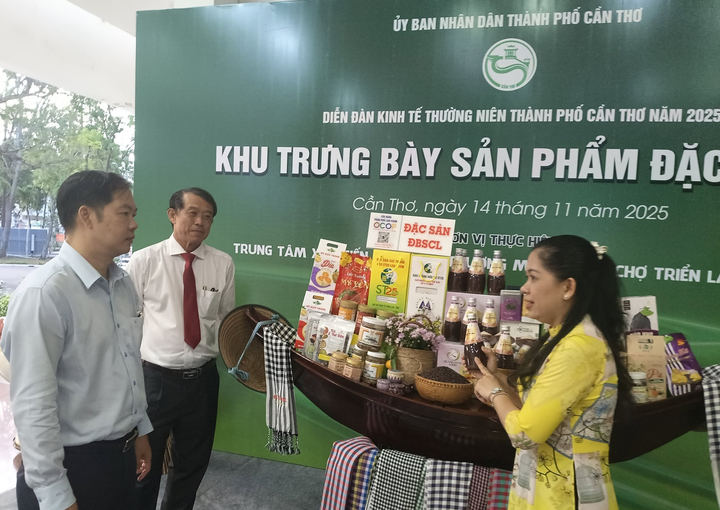
According to the Intellectual Property Office, from 2018 to 2022, the Mekong Delta region had nearly 9,870 intellectual property registration applications and more than 5,800 protection certificates. This region has the largest number of collective trademarks, certification marks, and individual trademarks in the country. Many brands have reached international recognition, such as Soc Trang ST fragrant rice, which won the title of "World's Best Rice," and Hoa Loc mangoes, which are exported to Japan, South Korea, and Canada.
In Can Tho City, following administrative reorganization, the city now has 3 geographical indications, 8 certification marks, and 41 collective marks. Products that have made a mark in the market, such as Hau Giang snakehead fish, Vinh Chau purple onions, Vinh Chau artemia, and Cau Duc pineapple, continue to be protected and developed.
However, according to Dr. Nguyen Quoc Nghi (School of Economics , Can Tho University), the commercial exploitation and application of digital technology are still not commensurate with their potential. Many registered trademarks are not fully utilized on product packaging, labels, or in communication, leading to a situation of "trademarks on paper."
Numerous obstacles range from production organization to legal issues.
One of the biggest reasons stems from the fragmented and uncoordinated production model. The lack of regional raw material sourcing leads to inconsistent traceability and quality assurance, affecting the reputation of registered brands.
Trademark management is primarily handled by local cooperatives or associations, which often have limited resources and commercial experience. Many entities register trademarks but are unable to maintain their usage, leading to reduced protection effectiveness.
Businesses and producers have limited awareness of intellectual property rights, leading to the risk of losing trademark ownership or having competitors register them first. Classifying goods, searching for protectability, and preparing application dossiers all pose difficulties for small businesses. Furthermore, the costs of registration, maintenance, and promotion are a heavy burden for small enterprises.
Furthermore, the lengthy approval process, ranging from 18 to 24 months, significantly impacts business plans. Local intellectual property enforcement remains limited, while trademark infringement and misuse of geographical indications are still prevalent, particularly on e-commerce platforms.
We need strong solutions, ranging from digital transformation to policy improvement.
According to Ms. Tran Thi Thanh Diep, Head of the Intellectual Property Department under the Department of Science and Technology of Can Tho City, to optimize the value of intellectual property assets, it is necessary to integrate intellectual property with digital transformation. The locality needs to invest in online management platforms, shared databases, apply blockchain and QR codes for traceability to ensure transparency and quality control. Digital mapping applications (GIS) can also be integrated to locate brands and manage raw material areas.
Can Tho City has identified the need to strengthen connections between management agencies, cooperatives, businesses, and farmers to form a unified value chain, in which trademarks play the role of a "passport" for key products.
Dr. Nguyen Huu Can, Acting Director of the National Institute of Intellectual Property, believes that the Mekong Delta has a golden opportunity to reposition itself from a "basket of agricultural products" to a "region of digital agricultural brands." The prerequisite is to comprehensively address difficulties ranging from small-scale production and limited awareness of intellectual property rights to legal procedures.
Digital transformation is considered a key solution to more effectively utilize the 350 protected collective trademarks and certifications in the region. In addition, perfecting the policy framework and enhancing the management capacity of collective trademarks will help the Mekong Delta not only protect but also increase the value of agricultural products, thereby affirming its position in domestic and international supply chains.
With its strong agricultural foundation and iconic specialties, the Mekong Delta has the potential to become a digitized agricultural economic region – where agricultural product brands are protected, traceable, and distributed transparently and sustainably.
Center for Science and Technology Communication
Source: https://mst.gov.vn/cach-thao-go-kho-khan-ve-dang-ky-nhan-hieu-hang-hoa-tai-vung-dbscl-197251211140614931.htm
![[Photo] Closing Ceremony of the 10th Session of the 15th National Assembly](/_next/image?url=https%3A%2F%2Fvphoto.vietnam.vn%2Fthumb%2F1200x675%2Fvietnam%2Fresource%2FIMAGE%2F2025%2F12%2F11%2F1765448959967_image-1437-jpg.webp&w=3840&q=75)






































![[OFFICIAL] MISA GROUP ANNOUNCES ITS PIONEERING BRAND POSITIONING IN BUILDING AGENTIC AI FOR BUSINESSES, HOUSEHOLDS, AND THE GOVERNMENT](https://vphoto.vietnam.vn/thumb/402x226/vietnam/resource/IMAGE/2025/12/11/1765444754256_agentic-ai_postfb-scaled.png)












































Comment (0)