

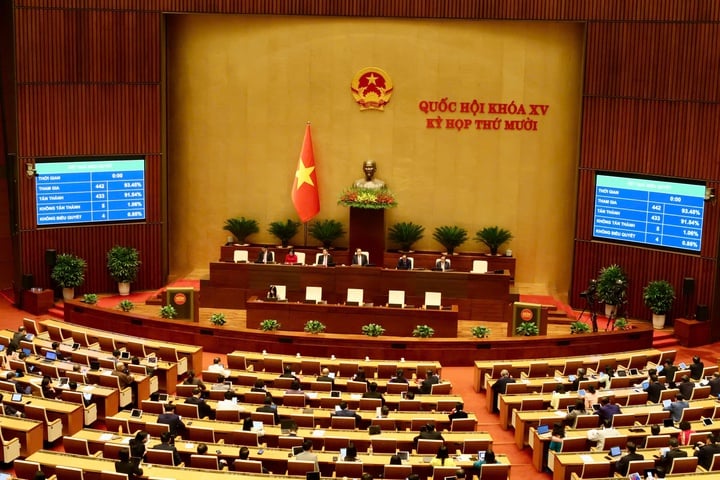
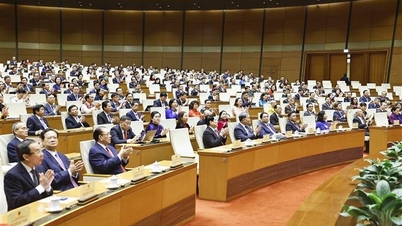
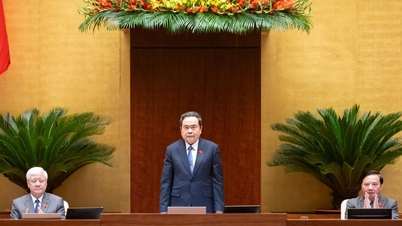
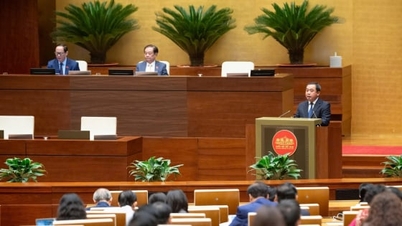
The National Assembly voted to pass the Law on Digital Transformation.
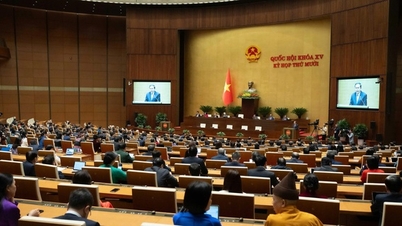
At its Tenth Session, the 15th National Assembly devoted significant time to legislative work, particularly focusing on draft laws in the field of science and technology (S&T). This year, the Ministry of Science and Technology had the highest number of draft laws considered by the National Assembly, with five important draft laws included in the legislative agenda. This is considered the largest-scale institutional reform effort undertaken by the Ministry in recent years.
The five draft laws include: the Law on Artificial Intelligence, the Law on High Technology (amended), the Law on Digital Transformation, the Law amending and supplementing a number of articles of the Law on Intellectual Property, and the Law amending and supplementing a number of articles of the Law on Technology Transfer. The adoption of these five major legal frameworks at the session reflects the urgent need to create a legal framework for new technologies, meeting the rapid pace of change and the pressure of innovation and competition.
These draft laws not only update regulations to suit current practices but also establish principles for long-term development.
The Artificial Intelligence Law, for the first time, laid the foundation for the governance, development, and application of AI in Vietnam; the Digital Transformation Law aims to build open data, digital identity, and a comprehensive digital service ecosystem. Simultaneously, amendments to the High-Tech Law, the Technology Transfer Law, and the Intellectual Property Law are expected to remove many bottlenecks in the commercialization of research results, protect intellectual property, and enhance the technology absorption capacity of businesses.
Dr. Trinh Nhu Thuy (Director of the DNA Tissue Bank, DNA International Hospital) believes that this is not only a legislative event but also "a philosophical declaration about the national vision".
Ms. Thuy assessed: "These laws create a systematic framework of protection and encouragement. For me, the biggest impact is the shift in research mindset, from struggling with the old mechanisms to confidently setting goals and creating within a legally guaranteed ecosystem."
According to Dr. Thuy, for the five draft laws to be effectively implemented, special attention must be paid to the implementation of detailed decrees and the reform of scientific management mechanisms, especially the two core issues.
Firstly, legal flexibility is crucial; it's necessary to quickly issue sub-legal documents, especially research and testing mechanisms (sandboxes), to help new technologies like AI, stem cells, exosomes, or new materials be deployed and evaluated for safety without being delayed by outdated procedures.
Secondly, it is necessary to transform the funding management mechanism, accept scientific risks, and loosen the accounting system so that scientists dare to conduct groundbreaking research instead of being afraid of excessive financial control.
Previously, at the Ninth Session of the 15th National Assembly, five laws drafted under the leadership of the Ministry of Science and Technology were passed. Specifically, the five laws include: the Law on Science, Technology and Innovation; the Law on Digital Technology Industry; the Law amending and supplementing a number of articles of the Law on Product and Goods Quality; the Law amending and supplementing a number of articles of the Law on Standards and Technical Regulations; and the Law amending and supplementing a number of articles of the Law on Atomic Energy.
With 10 large-scale draft laws passed at two consecutive sessions, the Ministry of Science and Technology has become one of the ministries and sectors with the most outstanding achievements in legislative work, affirming the central role of science and technology in the country's new development drivers.
Source: https://mst.gov.vn/dau-an-lap-phap-noi-bat-cua-bo-khcn-tai-quoc-hoi-197251211153935238.htm
![[Photo] Closing Ceremony of the 10th Session of the 15th National Assembly](/_next/image?url=https%3A%2F%2Fvphoto.vietnam.vn%2Fthumb%2F1200x675%2Fvietnam%2Fresource%2FIMAGE%2F2025%2F12%2F11%2F1765448959967_image-1437-jpg.webp&w=3840&q=75)













































![[OFFICIAL] MISA GROUP ANNOUNCES ITS PIONEERING BRAND POSITIONING IN BUILDING AGENTIC AI FOR BUSINESSES, HOUSEHOLDS, AND THE GOVERNMENT](https://vphoto.vietnam.vn/thumb/402x226/vietnam/resource/IMAGE/2025/12/11/1765444754256_agentic-ai_postfb-scaled.png)







































Comment (0)