

The Chinese-funded Siem Reap-Angkor International Airport is now the main gateway to one of the most popular tourist destinations – the Angkor archaeological complex, a UNESCO World Heritage site.
Last Monday morning, a flight operated by Thailand's Bangkok Airways was the first to land at the new airport, located about 40 km from Angkor, according to CNN.
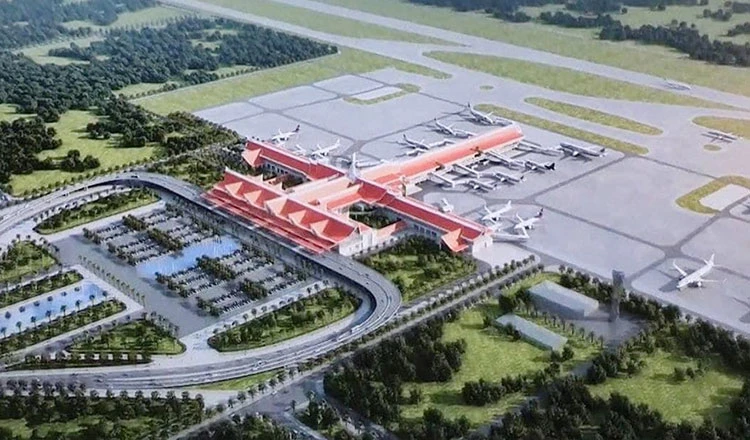
Cambodia's newest and largest airport is being funded by China.
Using the SAI code assigned by the International Air Transport Association, the new airport replaces Siem Reap International Airport (REP), which first opened in 1932 and is located just a few kilometers from the Angkor complex.
The new airport, funded by China as part of the Belt and Road Initiative at a cost of approximately $1.1 billion, was initially designed to serve 7 million passengers per year – 2 million more than REP – and has a 3,600m runway.
SAI anticipates increasing its passenger capacity to 12 million from 2040 upon completion of phased construction. This corresponds to 65,800 flights per year from 2023 and 112,700 flights annually from 2040.
According to the Economic and Trade Office of the Chinese Embassy in Cambodia, this is the first international airport overseas built by Chinese enterprises using the "Build-Operate-Transfer" model, operated and managed by the Yunnan Aviation Industry Investment Group. Designed to "4E airport" standards, it can accommodate large commercial aircraft, including many used on long-haul global routes.
Construction began in 2020, with the airport's design reportedly inspired by traditional Cambodian architecture. The airport's official website provides minimal information on the services, shops, and restaurants available at the new facility but offers a full schedule of incoming and outgoing flights.
Recent data released by Cambodia's Ministry of Tourism shows that the country welcomed 3.5 million international tourists in the first eight months of 2023.
According to UNESCO, many tourists come to Siem Reap to experience the Angkor complex, one of the most important archaeological sites in Southeast Asia.
However, despite a 250.8% increase compared to the same period last year, it is down 19.7% compared to 2019, before the country closed its borders due to the pandemic. The Cambodian Ministry of Tourism said it is on track to welcome approximately 4.5 to 5 million international tourists by the end of this year.

Cambodia wants the new airport to boost the country's economy.
The Khmer Times reported that with the opening of Siem Reap-Angkor International Airport on October 16th, Cambodia hopes to revive tourism and further boost its recovery in the future. The airport will attract new international airlines to operate direct flights to Siem Reap province, the country's tourism hub, thereby boosting tourism and foreign investment.
In Siem Reap, a city heavily reliant on tourism, the recent closure of The Lucky Mall came as a shock to some, but the decline in tourist numbers compared to pre-pandemic levels and the fewer Chinese tourists have impacted the local economy.
Spanning over 400 square kilometers, the park contains the ruins of various capitals of the Khmer Empire, dating from the 9th to the 15th centuries. But only a few sites here—specifically Angkor Wat, Angkor Thom, and Bayon—attract a large number of visitors.
Between January and September 2023, 191 new foreign direct investment (FDI) projects were approved, a 27% increase compared to 2022. Chinese investors provided the largest source of FDI capital for Cambodia.
Source link


![[Photo] Prime Minister Pham Minh Chinh holds a phone call with the CEO of Russia's Rosatom Corporation.](/_next/image?url=https%3A%2F%2Fvphoto.vietnam.vn%2Fthumb%2F1200x675%2Fvietnam%2Fresource%2FIMAGE%2F2025%2F12%2F11%2F1765464552365_dsc-5295-jpg.webp&w=3840&q=75)



























































Comment (0)