

On the morning of October 15, 2025, in Can Tho, the Department of Economic Cooperation and Rural Development, the School of Public Policy and Rural Development - Ministry of Agriculture and Environment in collaboration with the German International Cooperation Agency (GIZ) organized the Workshop "Application of digitalization to support financial access within the framework of the Project on Sustainable Development of One Million Hectares of High-Quality, Low-Emission Rice Cultivation Associated with Green Growth in the Mekong Delta by 2030".
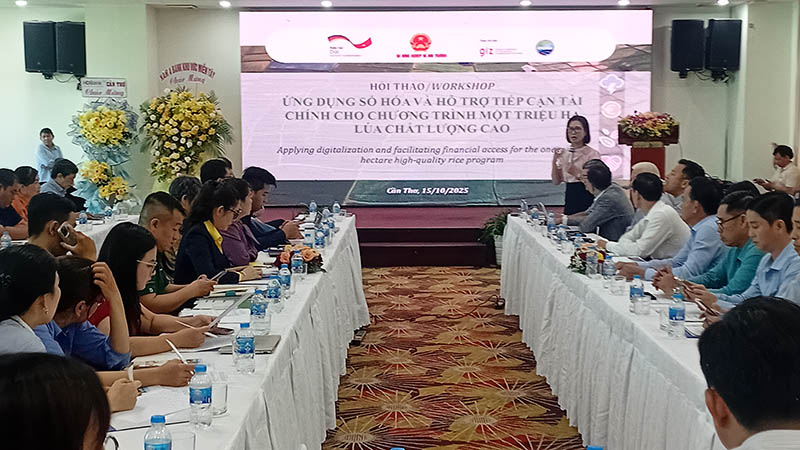 |
| Ms. Nguyen Thi Hoang Yen - Deputy Director of the Department of Economic Cooperation and Rural Development provided information at the Workshop. |
Ms. Nguyen Thi Hoang Yen - Deputy Director of the Department of Economic Cooperation and Rural Development, Ministry of Agriculture and Environment said that in the past two years, under the direction of the Ministry and the support of localities, banks, enterprises, and cooperatives, the Project has taken important steps: identifying more than 942,000 hectares of specialized areas, attracting over 1,230 cooperatives/cooperative groups (HTX/THT) and 210 participating enterprises; synthesizing credit demand of about 82,989 billion VND for production, processing, and consumption linkages; launching a shared digital platform to identify raw material areas, connect MRV data, trace and monitor credit, pilot agricultural insurance, green credit in many localities... affirming the right direction: greener, more digital, more effective.
However, according to Ms. Yen, there are still many bottlenecks that need to be addressed together, especially in the fields of credit, data and technical infrastructure, and 5 main bottlenecks need to be removed: Challenges in accessing value chain credit. Challenges in mechanization and investment efficiency. Challenges in data - digital identification - MRV for green finance. Agricultural insurance "risk shield" is still thin. Inconsistent input quality - seed standardization - chain transparency reduces productivity, rice quality and reputation of raw material areas.
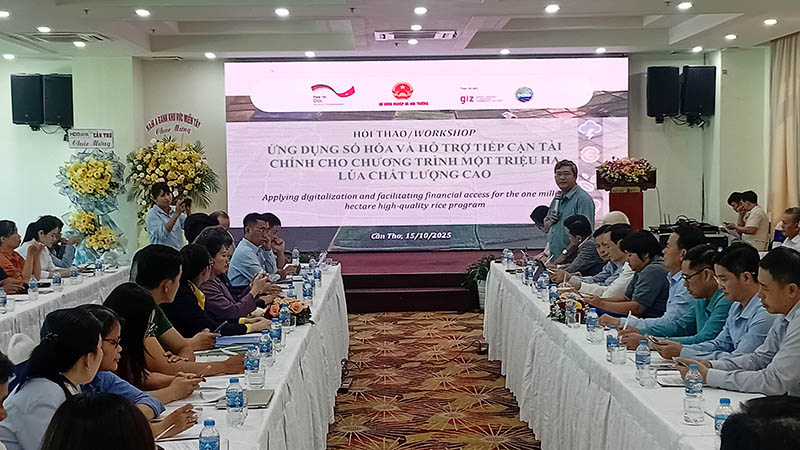 |
| Dr. Tran Minh Hai - Vice Principal of the School of Public Policy and Rural Development proposed 4 breakthrough solutions to access credit for the Project of 1 million hectares of high-quality, low-emission rice in the Mekong Delta. |
Sharing the same view, according to Dr. Tran Minh Hai - Vice Principal of the School of Public Policy and Rural Development, the proposal of 4 main contents to create new momentum for the Project is: Standardizing data - identifying specialized areas; Designing credit - insurance packages "with data"; Replicating the standard linkage model; and Connecting the market - green jobs for youth.
Many opinions of experts, managers, international organizations, credit and cooperatives/groups at the Workshop also focused on introducing and sharing digital initiatives, green finance models, agricultural risk insurance implemented by domestic and foreign partners. Discussing the mechanism of connecting credit - technology - enterprises - cooperatives to support farmers and cooperatives to access capital conveniently, transparently and effectively...
"One million hectares of high-quality rice is not just a number, but a symbol of innovative thinking, data connection and trust between farmers - businesses - banks. When data is transparent, credit is convenient, technology is present in the field, and farmers are protected by insurance and green finance, the 1 million hectare rice project will truly become a model of low-emission agriculture in Vietnam," Ms. Nguyen Thi Hoang Yen emphasized.
Source: https://baodautu.vn/can-co-che-tin-dung-dot-pha-cho-de-an-1-trieu-ha-lua-chat-luong-cao-vung-dbscl-d413415.html


![[Photo] Cat Ba - Green island paradise](/_next/image?url=https%3A%2F%2Fvphoto.vietnam.vn%2Fthumb%2F1200x675%2Fvietnam%2Fresource%2FIMAGE%2F2025%2F12%2F04%2F1764821844074_ndo_br_1-dcbthienduongxanh638-jpg.webp&w=3840&q=75)



































![[VIMC 40 days of lightning speed] Da Nang Port: Unity - Lightning speed - Breakthrough to the finish line](https://vphoto.vietnam.vn/thumb/402x226/vietnam/resource/IMAGE/2025/12/04/1764833540882_cdn_4-12-25.jpeg)































Comment (0)