

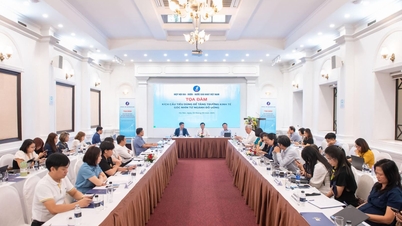
Associate Professor Ngo Tri Long, former Director of the Institute for Market and Price Research ( Ministry of Finance ), said he was quite shocked by the proposal to increase the special consumption tax on alcoholic beverages.
 |
| Associate Professor Dr. Ngo Tri Long, former Director of the Institute for Market and Price Research (Ministry of Finance) |
"If the tax rate is unreasonable, the objectives set by the excise tax on alcoholic beverages will not be achieved," Mr. Long emphasized.
In this latest amendment to the Special Consumption Tax Law, the Ministry of Finance has proposed a rather high tax increase. Will this new tax rate be a shock to beer and wine manufacturers, sir?
Since its promulgation (in 1998), the Special Consumption Tax Law has been amended and supplemented numerous times. Unlike other laws, each amendment, supplement, or replacement has resulted in an increase in taxes and an expansion of the tax base, especially for alcoholic beverages and tobacco products.
Undeniably, imposing excise tax on restricted consumer goods has brought many positive effects such as increasing state budget revenue and protecting domestic manufacturing businesses... but it also raises many issues that need consideration.
Currently, the tax rate on alcoholic beverages is not low, even quite high compared to people's income, yet the Ministry of Finance still wants to continue increasing it. Without careful consideration, this tax increase could be counterproductive. According to the Ministry of Finance's proposal, the tax increase roadmap from 2026 to 2030 for spirits with an alcohol content of 20 degrees or higher will be 70-90% (option 1) or 80-100% (option 2), instead of the current 65%. Spirits with an alcohol content below 20 degrees, currently subject to a 35% special consumption tax, will be raised to 40-60% (option 1) or 50-70% (option 2); and beer will be subject to a tax rate of 70-90% (option 1) or 80-100% (option 2), instead of the current 65%.
In the draft amendment to the Law on Special Consumption Tax, the Ministry of Finance leans towards option 2. This is a very shocking tax increase for both manufacturing and trading businesses and the general public.
According to him, will the objectives set out in the amendment of the special consumption tax be achieved?
When adjusting taxes on alcoholic beverages upwards, policymakers aim for three objectives: regulating consumption, reducing the negative impact of alcohol on human health; ensuring stable and sustainable state budget revenue; and protecting the domestic beverage industry.
Adjusting taxes on alcoholic beverages to regulate production and consumption in a rational manner is appropriate and an inevitable trend. However, imposing taxes too high, too quickly, and too aggressively will have a counterproductive effect. Each time the excise tax on alcoholic beverages is increased, policymakers emphasize the goal of regulating consumption and reducing the negative impact of alcohol on human health. However, in reality, the number and percentage of people using, and even abusing, alcohol continue to rise. Alcohol consumption is becoming increasingly prevalent among younger people, and Vietnam is considered one of the countries with the highest alcohol consumption in the world . Therefore, increasing taxes fails to achieve this goal.
And what about the objective of ensuring state budget revenue, sir?
According to data from the Ministry of Finance, the contribution of excise tax in general to the state budget during the period 2017-2023 accounted for approximately 8-9% of total state budget revenue. Specifically, in 2017 it accounted for 8.32%; in 2018 it was 8.52%; in 2019 it was 9.21%; in 2020 it was 8.27%; in 2021 it was 8.21%; in 2022 it was 9.6%; and in 2023 it was 8.8%. This tax contributes to the budget quite steadily, so is it really necessary to amend it?
If it is argued that further increases in excise tax will increase state budget revenue, this needs to be reconsidered. With excessively high taxes, the price of alcoholic beverages is high compared to people's income, while the demand for alcohol does not decrease, and may even continue to increase. This forces people to use "homemade liquor," "microbial beer," and smuggled alcoholic beverages, leading to a decrease in the production of alcoholic beverages by factories, businesses, and even imports. Consequently, state budget revenue will decrease from excise tax, import tax, and value-added tax. The budget will also suffer from reduced revenue from indirect activities related to alcohol, such as hotels, entertainment venues, restaurants (from high-end to budget-friendly), and even street beer stalls.
If the first two objectives are not achieved, and the third objective—protecting the domestic beverage industry—is also unlikely to be achieved if excessively high excise taxes are imposed on alcoholic beverages?
Brewing alcohol is one of the oldest professions. Vietnamese people have a long tradition of brewing alcohol. When alcohol taxes are too high, people cannot afford it, so instead of consuming commercially produced or imported alcohol, they drink "banana leaf-stoppered liquor," homemade beer, "microbial beer," or even alcohol diluted with water as a substitute for liquor.
State authorities can only manage registered businesses and establishments producing and importing alcoholic beverages. However, smuggled and spontaneously produced alcoholic beverages (currently accounting for 63% of total alcohol production) remain unregulated. As a result, businesses are forced to scale back production, and consumers are poisoned by substandard alcohol. Every year, thousands of cases of alcohol poisoning, fights, and even murders occur due to the consumption of cheap, spontaneously produced, and low-quality alcoholic beverages.
With the current tax rate of 65%, about two-thirds of the selling price of each liter of liquor with an alcohol content of 20 degrees or higher is tax, while homemade liquor and "microbial beer" are not subject to any taxes. Businesses producing and importing genuine, officially labeled beer and liquor are already struggling to compete; further tax increases would make it even harder for them to survive.
If tax policies are not used, what other policies, in your opinion, should be employed to curb alcohol abuse?
Taxes play only a small role in curbing alcohol abuse. In recent years, Vietnam has managed to control alcohol abuse to some extent through other policies, not just taxation.
In fact, while the prices of alcoholic beverages haven't increased recently, their consumption has been sharply declining due to a series of policies stipulated in the Road Traffic Law; the Law on Prevention and Control of Harmful Effects of Alcohol; the Advertising Law, etc. Particularly noteworthy are Decree 100/2019/ND-CP on administrative penalties for violations in the field of road and rail transport; and Decree 123/2021/ND-CP amending and supplementing several articles of decrees regulating administrative penalties in the fields of maritime, road, rail, and civil aviation, with penalties strong enough to deter and reduce alcohol abuse.
Restricting alcohol consumption is a necessary measure due to the enormous consequences of alcohol abuse, but it shouldn't be achieved solely through tax policies. The Ministry of Finance has proposed two options for increasing the excise tax on alcoholic beverages. In my opinion, the impact needs to be considered and assessed from many aspects, such as the price of the product after the tax increase; consumer behavior; the impact on budget revenue; and the impact on the production and business activities of enterprises, as there are currently about 220,000 direct and millions of indirect workers employed in the beer and alcohol production and business sector.
Source: https://baodautu.vn/can-nhac-khi-tang-thue-tieu-thu-dac-biet-voi-bia-ruou-d222297.html

















![[Photo] Prime Minister Pham Minh Chinh holds a phone call with the CEO of Russia's Rosatom Corporation.](/_next/image?url=https%3A%2F%2Fvphoto.vietnam.vn%2Fthumb%2F1200x675%2Fvietnam%2Fresource%2FIMAGE%2F2025%2F12%2F11%2F1765464552365_dsc-5295-jpg.webp&w=3840&q=75)











































Comment (0)