

 |
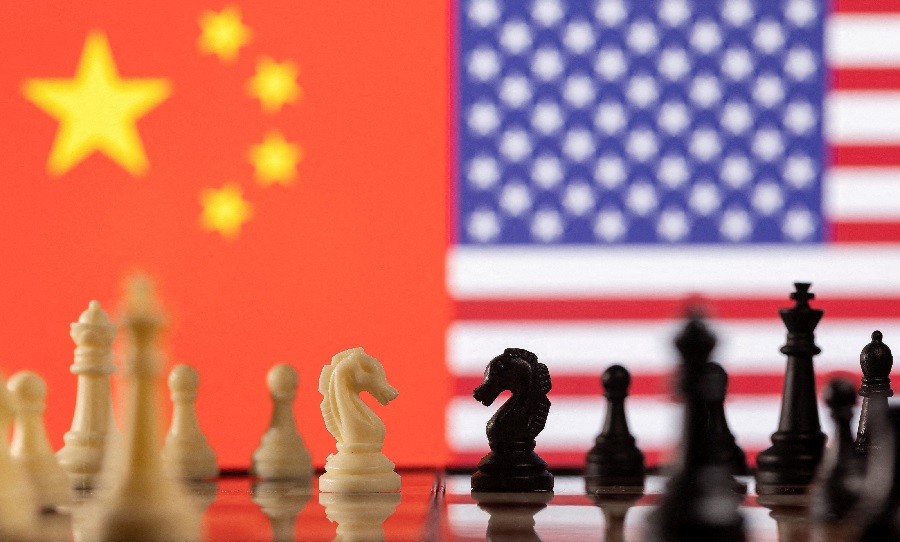
| US-China relations have been deteriorating for some time, with Washington complaining about Beijing's trade and currency practices. (Source: Reuters) |
On June 28, Chinese President Xi Jinping approved a new law that essentially allows the country to retaliate against the increasing number of sanctions imposed by the United States and its allies. The new foreign policy law provides a legal framework for China to take action against companies and countries it deems to be imposing sanctions. The new law takes effect on July 1.
The Global Times , the mouthpiece of the Chinese Communist Party, reported: “China’s top legislative body passed the Law on Foreign Relations on June 28, marking a significant milestone. This is the first fundamental and comprehensive law on foreign relations aimed at addressing loopholes in foreign policy.”
The law was enacted amid new challenges in foreign relations, particularly as China frequently faces external interference in its internal affairs, including unilateral sanctions from the West.
The US increases sanctions.
It's no secret that US-China relations have been deteriorating for some time, with Washington complaining about Beijing's trade and currency practices.
For example, the U.S. often accuses China of currency manipulation – keeping the yuan weak – in order to gain a trade advantage. The trade deficit with Asia's number one economy is a key issue that former U.S. President Donald Trump has repeatedly raised.
Similarly, Washington is concerned about Beijing stealing technological secrets. In October 2022, US President Joe Biden announced a series of sweeping export bans. Essentially, this prevented Chinese companies from purchasing advanced chips and related equipment originating from the US.
The increasing rapprochement between the US and India is also seen through the lens that the world's largest economy hopes to use the South Asian nation as a counterweight to the rise of the Northeast Asian country.
The Covid-19 pandemic has seen many countries, particularly the US, increasingly try to develop strategies to mitigate the risks of engaging with China.
However, this is easier said than done.
In fact, over the past three decades, China has become the world's factory. Moving factories out of the world's second-largest economy is not easy because there are no immediate replacements.
Few countries can boast the human and physical infrastructure that China does. Leaving the world's factory, even due to geopolitical and foreign policy concerns, would not be without cost.
China's reaction
Unsurprisingly, Beijing has repeatedly criticized Washington's sanctions and restrictions, while rejecting accusations of corporate espionage and alleged currency manipulation. Furthermore, China advocates for a more open global economic order.
Beijing's attitude and actions have become increasingly assertive, especially since the economic confrontation with Washington has also spilled over into territorial issues such as Hong Kong and Taiwan.
For example, on June 27, while speaking at the 14th annual meeting of the World Economic Forum in Tianjin – also known as Summer Davos – Chinese Premier Li Qiang warned Western powers that attempts to “mitigate risks” from China could lead to the fragmentation of global supply chains. He said governments should not “overstep their boundaries” to pressure companies to leave China.
The Chinese leader emphasized: "We should oppose the politicization of economic issues and cooperate together to keep global supply chains and industries stable, smooth, and secure, so that the benefits of globalization can be delivered to different countries and groups of people in a fairer way."
According to People's Daily , the new law implies that: “China has the right to take necessary countermeasures under the law against acts that violate international law and the basic rules governing international relations and endanger China’s sovereignty, security and national interests. Beijing will formulate laws, administrative regulations, establish corresponding working systems and mechanisms, strengthen coordination among departments, and establish and implement relevant countermeasures and restrictions.”
In response to the Global Times , Huang Huikang, a professor at the Institute of International Law of Wuhan University, stated: “For the first time, the law clearly outlines the purpose, conditions, and policy direction of applying Chinese law in foreign relations, and stipulates the principles for countermeasures and restrictions against foreign countries, individuals, or organizations.”
Beijing has also been taking actions such as banning domestic companies from purchasing products from Micron Technology Inc., a US chip manufacturer.
China hopes to surpass the United States to become the world's largest economy and a technological superpower. At the same time, Beijing cannot relinquish its existing control as the central hub of global manufacturing.
The new law is expected to allow China to respond to U.S. actions even more forcefully.
Source
![[Photo] Closing Ceremony of the 10th Session of the 15th National Assembly](/_next/image?url=https%3A%2F%2Fvphoto.vietnam.vn%2Fthumb%2F1200x675%2Fvietnam%2Fresource%2FIMAGE%2F2025%2F12%2F11%2F1765448959967_image-1437-jpg.webp&w=3840&q=75)
![[Photo] Prime Minister Pham Minh Chinh holds a phone call with the CEO of Russia's Rosatom Corporation.](/_next/image?url=https%3A%2F%2Fvphoto.vietnam.vn%2Fthumb%2F1200x675%2Fvietnam%2Fresource%2FIMAGE%2F2025%2F12%2F11%2F1765464552365_dsc-5295-jpg.webp&w=3840&q=75)









































![[OFFICIAL] MISA GROUP ANNOUNCES ITS PIONEERING BRAND POSITIONING IN BUILDING AGENTIC AI FOR BUSINESSES, HOUSEHOLDS, AND THE GOVERNMENT](https://vphoto.vietnam.vn/thumb/402x226/vietnam/resource/IMAGE/2025/12/11/1765444754256_agentic-ai_postfb-scaled.png)







































Comment (0)