

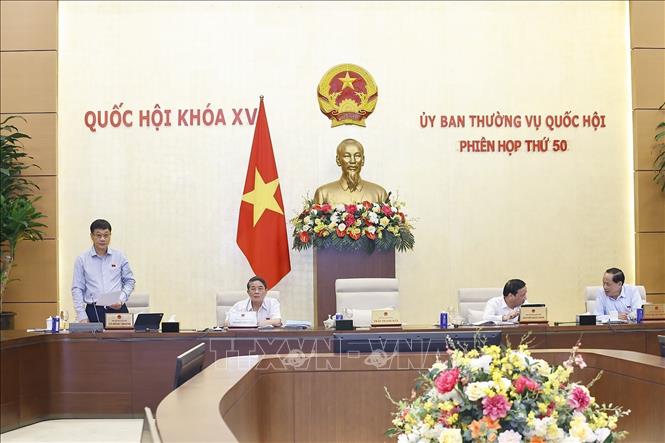
Strengthening the application of science and technology and digital transformation.
According to the Government 's submission, the purpose of enacting the Law amending and supplementing a number of articles of the Law on Insurance Business is to reduce investment and business conditions for insurance business activities; simplify administrative procedures; and resolve some urgent difficulties and obstacles that need to be amended.
Compared to the current Law, the draft Law amends 24 articles. Specifically, the draft Law cuts, reduces, and simplifies business conditions in 7 articles; cuts, reduces, and simplifies administrative procedures in 2 articles; addresses other difficulties and obstacles for businesses in 7 articles; and amends 5 articles to ensure consistency with the provisions of the Inspection Law and the Enterprise Law.
At the same time, the draft Law refines the regulations on risk-based capital in one article; adds one article on the principles of organizations and individuals contributing capital, establishing, managing, and controlling enterprises in the insurance business, agency activities, and provision of insurance auxiliary services; and adds one article on the investment principles of insurance brokerage enterprises to ensure safe and effective investment activities.
The Standing Committee of the National Assembly's Economic and Financial Committee agreed on the necessity of enacting the Law; and requested the drafting agency to continue reviewing and revising the draft Law in the direction of providing a general framework for state management of insurance business activities to create a legal basis for effective decentralization in this field; and to review and ensure the consistency and uniformity of the legal system, especially the Enterprise Law and the Inspection Law.
Regarding the conditions for contributing members to establish insurance and reinsurance companies in the form of limited liability companies; and the conditions for granting licenses to establish and operate insurance brokerage businesses, the reviewing agency believes that studying the removal of conditions that are barriers to market access and ensuring a transparent business environment is necessary.
However, the drafting agency should consider removing this condition, as it is one of the important regulations for screening the legal status, ensuring the credibility, capacity, and legal compliance of foreign organizations when participating in contributing capital to establish insurance companies. If it is necessary to remove this condition, the drafting agency should study alternative solutions and implement appropriate "post-audit" monitoring and control measures to ensure market safety.
Through discussion, the Standing Committee of the National Assembly agreed on the necessity of amending and supplementing several articles of the Law on Insurance Business; and requested the drafting agency to coordinate with the reviewing agency and relevant agencies to further research and clarify the political, legal, and practical basis, and to continue evaluating and summarizing the implementation of regulations, investment and business conditions, administrative procedures, and difficulties and obstacles arising since the Law on Insurance Business of 2022 came into effect.
Deputy Speaker of the National Assembly Vu Hong Thanh noted the need to strengthen the application of science and technology and digital transformation to further reduce and simplify administrative procedures; comprehensively assess the overall impact and legal consequences of reducing and simplifying investment and business conditions, focusing on the legitimate rights and interests of relevant parties, ensuring appropriate inspection, examination, and supervision mechanisms, and preventing legal loopholes in state management of the insurance business sector…
Proposal to add regulations for online citizen reception.
The draft Law amending and supplementing a number of articles of the Law on Citizen Reception, the Law on Complaints, and the Law on Denunciations focuses on amending and supplementing regulations to institutionalize the policy on reorganizing the political system's organizational structure, implementing a two-tiered local government model; and reorganizing the inspection agency system to be streamlined, efficient, effective, and effective.
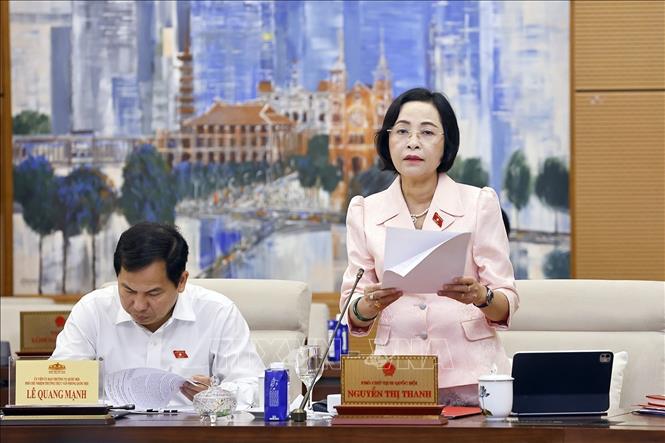
The draft law institutionalizes the Party's policy on breakthroughs in science, technology, innovation, and national digital transformation: it adds provisions on online citizen reception; and stipulates that citizens can use their citizen identification number or electronic identification code instead of presenting physical identification documents when visiting citizen reception centers.
Regarding the promotion of decentralization and reduction of administrative procedures, the draft Law adds a provision allowing the Prime Minister to authorize the Inspector General of the Government in handling complaints; it also adds a mechanism for determining the authority to handle complaints in cases where the authority cannot be determined according to current laws; and it assigns the Government the responsibility to regulate the form of online citizen reception. In addition, the draft addresses shortcomings, difficulties, and obstacles, and enhances the effectiveness and efficiency of state management in citizen reception and complaint resolution.
According to Duong Thanh Binh, Chairman of the National Assembly's Committee on Citizen Petitions and Supervision, the majority of opinions within the Standing Committee agreed with the draft Law's provisions on online citizen reception to promote digital transformation in citizen reception, handling of petitions and letters, and resolution of complaints and denunciations; contributing to facilitating citizens in exercising their right to complain and denounce, while reducing pressure at citizen reception offices.
However, it is suggested that the Government further assess the effectiveness of the implementation of the online citizen reception model in the past period, the technical infrastructure conditions to ensure connectivity between provincial-level citizen reception offices and central-level citizen reception offices, and between provincial-level citizen reception offices and provincial and commune-level citizen reception points...
While agreeing with the addition of online citizen reception services to align with current practices and the application of science, technology, and digital transformation in all fields, saving time and costs for citizens, National Assembly Vice Chairwoman Nguyen Thi Thanh suggested that, to ensure consistency, the concept of citizen reception needs to be studied.
Accordingly, the draft Law stipulates that receiving citizens is the act of agencies, organizations, units, and individuals welcoming and listening to complaints, denunciations, suggestions, and feedback from citizens. This concept is only suitable for the current form of receiving citizens, which is in person. Therefore, the drafting agency needs to study and adjust this concept to be consistent with the addition of online forms.
Regarding the issue of decentralization and delegation of authority in handling complaints, denunciations, and receiving citizens, the Vice Chairman of the National Assembly stated that receiving citizens and resolving complaints and denunciations directly relates to human rights and civil rights. In reality, the shortcomings and limitations in resolving complaints and denunciations in the past have largely stemmed from the fact that those responsible, instead of directly carrying out the task, delegated authority to their deputies, or even delegated authority to others. This has led to prolonged delays in handling complaints and cases.
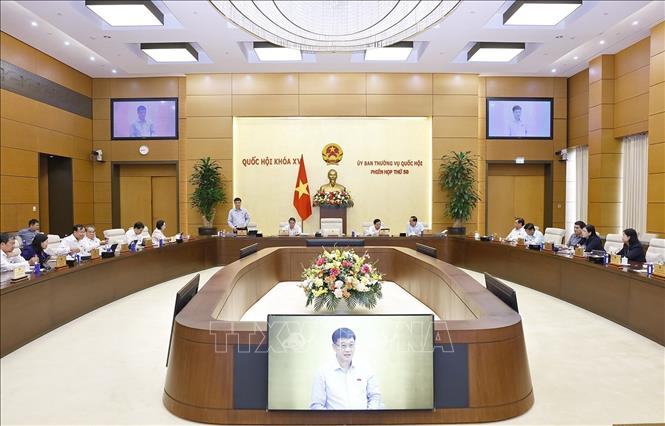
The Vice Chairman of the National Assembly suggested that this issue be carefully considered and clearly defined; implemented in accordance with the Law on Government Organization and the Law on Local Government Organization, ensuring the effective handling of complaints and denunciations.
Source: https://baotintuc.vn/thoi-su/cat-giam-dieu-kien-dau-tu-kinh-doanh-bao-hiem-20251013113234952.htm


![[Photo] Prime Minister Pham Minh Chinh holds a phone call with the CEO of Russia's Rosatom Corporation.](/_next/image?url=https%3A%2F%2Fvphoto.vietnam.vn%2Fthumb%2F1200x675%2Fvietnam%2Fresource%2FIMAGE%2F2025%2F12%2F11%2F1765464552365_dsc-5295-jpg.webp&w=3840&q=75)


![[Photo] Closing Ceremony of the 10th Session of the 15th National Assembly](/_next/image?url=https%3A%2F%2Fvphoto.vietnam.vn%2Fthumb%2F1200x675%2Fvietnam%2Fresource%2FIMAGE%2F2025%2F12%2F11%2F1765448959967_image-1437-jpg.webp&w=3840&q=75)








































































Comment (0)