

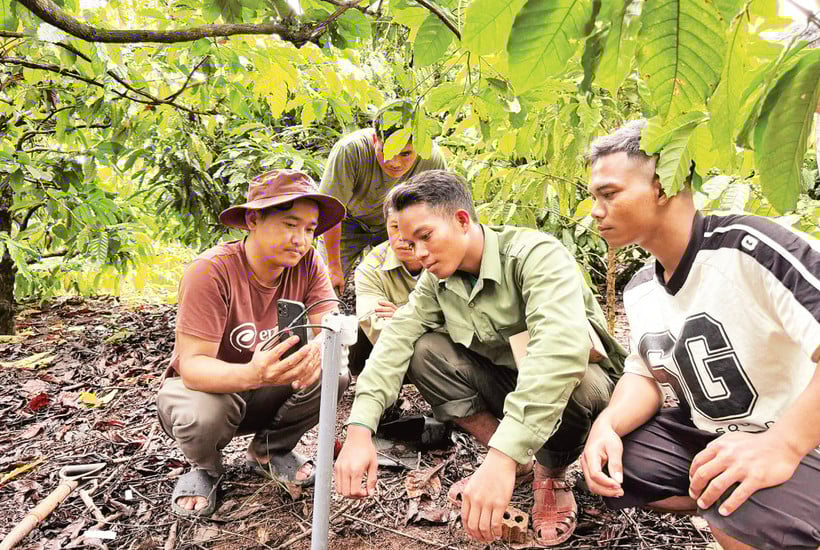
Orientation for green growth
Vietnam has identified green growth as a core development orientation, as evidenced by the series of policies implemented over the past decade. According to the Ministry of Science and Technology , out of more than 4,000 innovative startups currently operating, approximately 200-300 are pursuing renewable energy, environmental technology, sustainable agriculture, or the circular economy.
According to Pham Hong Quat, Director of the Department of Startups and Technology Enterprises (Ministry of Science and Technology), despite challenges in long-term capital, the demand for transforming production models according to global green standards is opening up new growth opportunities. Many startups have raised $1-5 million for green energy, waste recycling, or green transportation projects. In the context of climate change causing losses of approximately 3.2% of GDP annually, green transformation must be considered an investment in development, especially in high-emission sectors such as agriculture , energy, processing industries, and construction.
Around the world, many countries are demonstrating the effectiveness of applying green technologies. Kenya uses AI to balance the power grid and warn of natural disasters, while in the Middle East, the United Arab Emirates (UAE) has chosen innovation as a sustainable path to address the challenges of extreme climate change.
UAE Ambassador to Vietnam Bader Almatrooshi emphasized that the UAE is promoting smart agriculture and hydroponics models. These experiences show that leveraging AI can help countries shorten their journey towards sustainable development. The common thread among successful nations is placing technology at the center of their green strategies.
Denmark, one of the global leaders in green growth, is proof that technological innovation can generate growth while simultaneously reducing emissions. Vietnam and Denmark established a Strategic Partnership on Green Growth in 2011. Many international corporations also consider Vietnam a green investment destination. LEGO Group's $1.3 billion carbon neutrality plant project in Binh Duong is evidence of Vietnam's potential for deeper participation in the global green supply chain.
Important leverage
Vietnam is accelerating its green transformation through streamlining procedures, reducing investment costs, and encouraging the use of clean energy. In this context, public-private partnerships (PPP) have become a crucial lever. The Partnership for Green Growth and Global Goals 2030 (P4G) Summit is a prime example, supporting early-stage startups with technical and financial advice and partner connections. Vietnam is also an active member of the P4G, with 12 collaborative projects implemented to date in the fields of renewable energy, circular economy, and environment, helping green businesses access international resources.
However, the gap between potential and reality remains significant. Green technologies are currently concentrated mainly in areas that are easier to implement, while heavy industry, the largest source of emissions, only has about 11% of its emissions treated using clean technologies. This requires a stronger combination of innovation, green investment, and multi-stakeholder cooperation models. This gap also explains why Vietnam needs to more actively access highly applicable green technology solutions from leading countries.
Many international partners are collaborating with Vietnam by offering highly applicable technological solutions. Japan has introduced waste-to-energy technology and the Johkasou wastewater treatment system, suitable for expanding urban areas and regions lacking centralized drainage infrastructure. In Vietnam, the waste-to-energy models in Bac Ninh and Johkasou in Ha Long Bay have demonstrated the feasibility of PPPs in the environmental sector. Japan is also promoting technologies for recycling solar cells, plastics, and metals from electronic waste; and the GOSAT satellite, integrated with AI, helps to increase transparency in emission data in accordance with the Paris Agreement.
The United Nations Industrial Development Organization (UNIDO) warns that sustainable development cannot be achieved when communities continue to be impacted by floods, droughts, rising sea levels, and biodiversity loss. UNIDO is implementing a program worth approximately US$13 million in Vietnam, focusing on green industry, sustainable supply chains, and clean technologies. Simultaneously, the AIM Global initiative – the AI Alliance for Industry and Manufacturing – expands international cooperation on AI, knowledge sharing, and technology transfer, further driving the green transformation.
Domestically, the Department of Startups and Technology Enterprises has proposed building a "green startup map," a framework for measuring impact, and a financial support mechanism. The Ministry of Science and Technology is researching tools such as green venture capital funds, green startup exchanges, tax incentives, and reforms to loan procedures. Experts from the Global Green Growth Institute (GGGI) believe that Vietnam needs to prioritize the development of renewable energy infrastructure, energy-efficient data centers, AI human resource training, and the construction of a data governance framework – fundamental elements for a green technology ecosystem. Green technology will only be truly effective when expanded to high-emission sectors, coupled with AI governance linked to digital ethics. However, for these solutions to be effective, the ecosystem needs a synchronized structure between institutions, technology, and the market, rather than fragmented efforts on individual projects.
Innovation, creative entrepreneurship, and collaboration are key to solving environmental problems while promoting a circular economy.
Mr. Hoang Minh,
Deputy Minister of Science and Technology
Along with collaborative models, Vietnam needs a comprehensive policy framework to promote green startups. Developing green supply chain models and strengthening cooperation will help Vietnamese businesses confidently expand into international markets.
Deputy Minister of Science and Technology Hoang Minh affirmed: "Innovation, creative entrepreneurship, and cooperation are key to solving environmental problems and promoting the circular economy." In the context of technology becoming the key to unlocking the Net Zero market, Vietnam not only needs to invest but also lead in the application, innovation, and scaling up of green models.
Source: https://baosonla.vn/kinh-te/chia-khoa-mo-duong-บน-hanh-trinh-huong-toi-net-zero-dgFpIHGvg.html










































































Comment (0)