

Currently, Thu Dau Mot Market ( Binh Duong province) is located on a relatively flat area, adjacent to the Saigon River and the roads surrounding the market; bordered to the north by Nguyen Thai Hoc Street, to the south by Bach Dang Street, to the west by Doan Tran Nghiep Street, and to the east by Tran Hung Dao Street.
Thu Dau Mot Market is a center with a very convenient location for exchange and trade.
Phu Cuong - the original name of Thu Dau Mot market
Thu Dau Mot Market was originally called Phu Cuong Market. According to local history, the Phu Cuong area was still undeveloped land until the early 17th century, with the landscape consisting mainly of dense forests.
Among them, the most striking image is that of the ancient forests—the old oil palm trees—in the area of present-day Chánh Nghĩa, especially the riverside areas which at that time were just swamps and flooded areas gradually formed by the alluvial deposits of the Saigon River.
To the south of Phu Cuong market, tiled roofs are hidden in green foliage. The small canal is covered with sailboats, the market is located at the first bend of the canal.
When Nguyen Huu Kinh surveyed Gia Dinh province in 1698, the area of present-day Phu Cuong had a later population concentration compared to Lai Thieu and Thi Tinh, but it grew larger and more rapidly due to its location as the administrative center of Binh Dien commune, Binh An district, which belonged to Bien Hoa province at that time.
The place name Phú Cường appeared around 1838 (during the 18th year of Emperor Minh Mệnh's reign) along with many changes in the names of communes and villages in Bình An district.
Therefore, the name of the ancient market, Phu Cuong Market, may have originated around this time. Historically, Phu Cuong Ancient Market was formed later than some other markets in Binh An district, such as Tan Hoa Market, Thi Tinh Market, and Binh Nham Thuong Market.
The “Thi Diem” (Market) section of the book Dai Nam Nhat Thong Chi - a geography book compiled between 1864 and 1875, mentioned the name of Phu Cuong market: “Phu Cuong market in Phu Cuong village, Binh An district, also known as Thu Dau Miet (or Dau Mot) market, is located next to the district headquarters, bustling with people and boats.”
In 1889, in Binh An district, Thu Dau Mot province was established, Phu Cuong market became Thu Dau Mot provincial market.
Since then, the name Thu Market or Thu Dau Mot has been frequently mentioned in folklore and in poetry, books, and newspapers.
"Every afternoon I borrow Mr. Do's horse."
I borrowed three soldiers to take my aunt home.
Take them to Thu market to sell jars and scraps.
"Selling tea sets, selling mortar and pestle for grinding spices..."
Before the French invaded the Thu Dau Mot military outpost in 1861, the old Phu Cuong market was already a bustling trading center, with many vehicles and boats gathering there to exchange and trade goods.
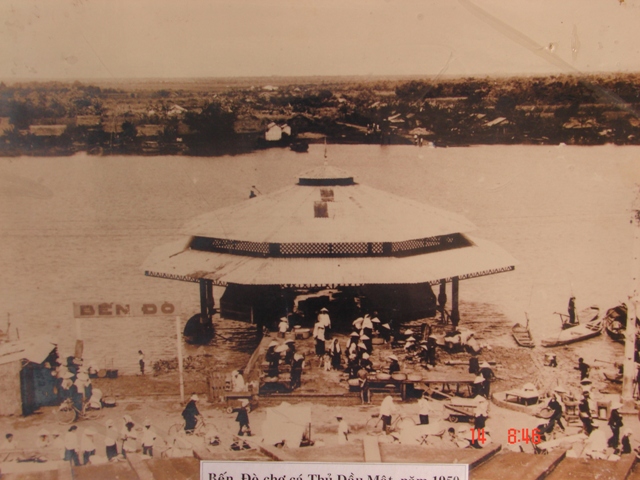
The ferry terminal at Thu Dau Mot fish market (Binh Duong province) in 1950.
Thu Dau Mot Market - French-style architecture with a strong European influence.
After the French occupied the six southern provinces of Vietnam, including Bien Hoa province (Binh An district within Bien Hoa province), they completely restored and transformed Phu Cuong market, adding a stone-paved gate and a raised road inside.
According to the "Binh Duong local history" written in 1888, the French authorities filled in the Phu Cuong canal connecting to the Saigon River and completed this work in 1890.
By 1935, the French realized the great profit potential of investing in the market, so they proceeded to restore and completely transform Phu Cuong Market, modeling it after old markets in France with a structure similar to Phnom Penh Market (Cambodia) and Ben Thanh Market (Saigon).
What's special about this model is that they still respect and maintain the original location. In 1938, Thu Market was inaugurated with a new model, featuring a more open and elegant architecture, which was advantageous for the time and had many more advantages than other places.
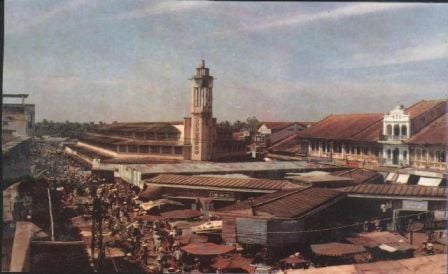
Thu Dau Mot Market (Binh Duong province) before 1975.
The market is divided into seven sections of varying sizes and is built in a rectangular shape, consisting of three separate buildings.
Entering from Tran Hung Dao Street, you'll encounter a long building with one floor and one ground level, also known as the (Shopping Mall), built and arranged into small sections commonly referred to as "market stalls" for displaying and selling goods.
Behind the shopping mall is a horizontal building (food court), built between the shopping mall and the clock tower area, arranged into three main sections for dining. Behind that is the long building – the market building (or the Clock Tower market area) – also built and arranged into small sections, even right at the foot of the Clock Tower market.
The market house was the first one built by the French colonialists in 1935, with a ship-shaped architecture and a clock tower with a European motif, designed by French architect Mr. Bonnemain and inaugurated in 1938.
The row of buildings, constructed in a longhouse style, covers an area of 2,590 m² , has two roofs divided into two levels, and a height from the base to the top of 10.3 m. These buildings are of great significance in the formation and development of Thu Market.
The market clock tower is built in a hexagonal shape, attached to the market building, with a height of 23.72m, consisting of four floors. The ground floor, from floor to ceiling, is 6.5m high and made of reinforced concrete, with iron stairs attached inside the tower.
In addition to the stone paving and tilework on the east and west sides of the tower, from the second floor upwards, the tower is reinforced internally with eight pillars along its hexagonal sides.
The tower is built in a tiered style, narrowing as it rises. At the third floor, a concrete slab is poured and raised about one meter to serve as the base for the clock face, which also houses the clock. The clock face has a white background, blue numbers, and black hands.
Four concrete slabs were poured on top of the clock to provide protection from the sun and rain. Four clocks were mounted on the top of the tower.
It is precisely these clocks, arranged in the order of East, West, South, and North, that have created a distinctive landmark, fostering a deep and familiar affection among the people of Binh Duong.
The image of the Clock Tower in the market represents the heartbeat and symbol that has witnessed countless periods of prosperity and decline throughout the history of this land's formation and development.
Thu Dau Mot Market has always held a prominent position as a commercial center of Binh Duong province, and it has also witnessed many significant historical events in the national liberation struggle.
Therefore, Binh Duong Market is not only a place for buying and selling but also a cultural symbol closely associated with the historical development of Binh Duong and Southern Vietnam.
Source: https://danviet.vn/cho-co-cho-thu-dau-mot-dat-binh-duong-xua-la-rung-ram-vo-so-cay-co-thu-khong-lo-ven-song-sai-gon-20240723180701999.htm

![[Photo] Prime Minister Pham Minh Chinh holds a phone call with the CEO of Russia's Rosatom Corporation.](/_next/image?url=https%3A%2F%2Fvphoto.vietnam.vn%2Fthumb%2F1200x675%2Fvietnam%2Fresource%2FIMAGE%2F2025%2F12%2F11%2F1765464552365_dsc-5295-jpg.webp&w=3840&q=75)

![[Photo] Closing Ceremony of the 10th Session of the 15th National Assembly](/_next/image?url=https%3A%2F%2Fvphoto.vietnam.vn%2Fthumb%2F1200x675%2Fvietnam%2Fresource%2FIMAGE%2F2025%2F12%2F11%2F1765448959967_image-1437-jpg.webp&w=3840&q=75)











































![[OFFICIAL] MISA GROUP ANNOUNCES ITS PIONEERING BRAND POSITIONING IN BUILDING AGENTIC AI FOR BUSINESSES, HOUSEHOLDS, AND THE GOVERNMENT](https://vphoto.vietnam.vn/thumb/402x226/vietnam/resource/IMAGE/2025/12/11/1765444754256_agentic-ai_postfb-scaled.png)













































Comment (0)