

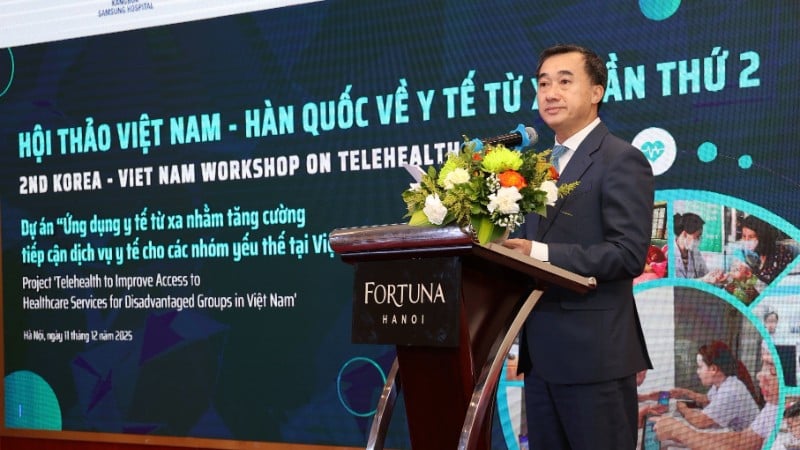
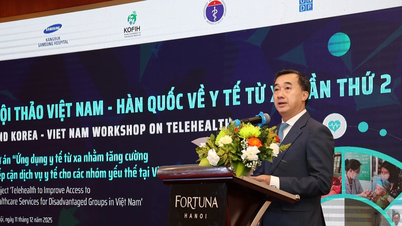
On the morning of December 11th, the Department of Medical Examination and Treatment Management, Ministry of Health, in collaboration with UNDP, KOFIH, and Kangbuk Samsung Hospital - South Korea, organized the 2nd Vietnam-Korea Telemedicine Workshop, within the framework of the project "Applying Telemedicine to Enhance Access to Healthcare Services for Vulnerable Groups in Vietnam".
The urgent need for standardizing medical data.
Professor, Doctor Tran Van Thuan, Deputy Minister of Health, said that telemedicine is not just a technical solution, but a method of reorganizing healthcare services in a patient-centered way, shortening geographical distances, sharing professional knowledge, and enhancing the capacity of the healthcare system closest to the people.
However, for telemedicine to develop sustainably, we cannot stop at just connecting people. The biggest challenges now lie in standardizing data, ensuring information security, building digital trust, and designing long-term operational mechanisms.
According to Mr. Nguyen Truong Nam, Deputy Director of the National Center for Health Information, Vietnam currently faces a shortage of high-quality data for artificial intelligence in healthcare. The amount of data available for AI applications is very limited, and most of this data exists in unstructured form (a mixed collection of images, videos , audio, and free-form text that is not neatly organized and cannot be immediately used to train AI models).
The core features of high-quality data still have many issues to consider, for example, regarding relevance, the data must be directly related to the task assigned to the AI. Regarding diversity, the training dataset must fully reflect real-world scenarios, target groups, and specific cases.
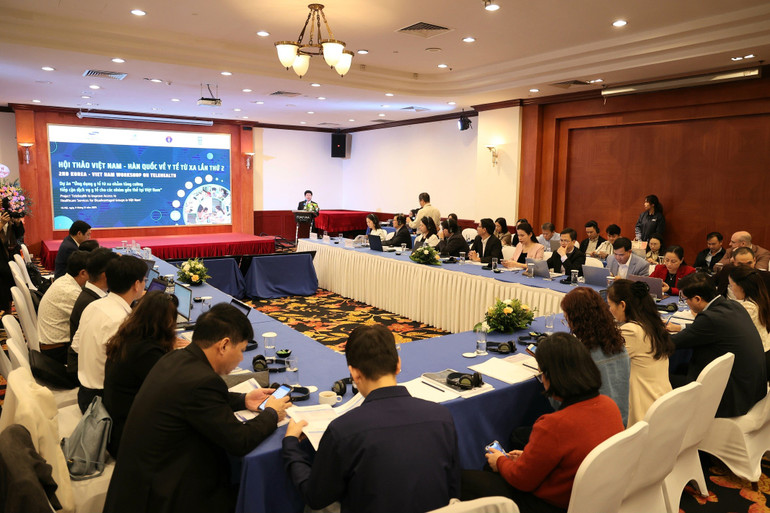
Furthermore, ensuring the accuracy and integrity of the data is crucial, which requires a process of "cleaning" the raw data to guarantee the integrity of the input data. Consistency in labeling is also very important for AI to learn from the data correctly.
Vietnam also faces the challenge of lacking standardized Vietnamese language data for building large-scale Vietnamese language models.
According to experts, telemedicine offers significant benefits to individuals and society but also creates risks, a wider scope of cyberattacks, and challenges in protecting personal data. Therefore, to ensure the safety of medical data, personal data, and patient privacy, a synchronized approach is needed in telemedicine: technology, processes, legal regulations, and raising awareness.
The Ministry of Health will issue ethical guidelines on AI in healthcare.
Mr. Nguyen Truong Nam believes that, in order to use and manage artificial intelligence in healthcare, it is necessary to complete the legal framework regulating the use of AI in healthcare. Accordingly, the Ministry of Health will develop regulations on the verification, licensing, and quality control of AI in medical examination and treatment, ensuring that only AI systems that meet standards are deployed in clinical practice.
To enhance the quality of medical data and protect patient data, the Ministry of Health will coordinate with relevant agencies to ensure that AI systems strictly comply with information security regulations, avoiding the risk of personal data leaks.
A key element is that the Ministry of Health will issue ethical guidelines on AI in healthcare, clearly defining the responsibilities of all stakeholders. All final treatment decisions must be overseen and confirmed by physicians, ensuring professional accountability and protecting the rights of patients.
"The Ministry of Health will continue to research, evaluate, and adjust policies related to AI in healthcare, ensuring that new technological solutions are applied effectively, safely, and appropriately to the Vietnamese healthcare system, while also meeting ethical standards in medical examination and treatment. Accordingly, international standards will be used to build standardized datasets, and to develop education and training programs for doctors and healthcare workers to understand and effectively use AI in their work," Mr. Nam said.
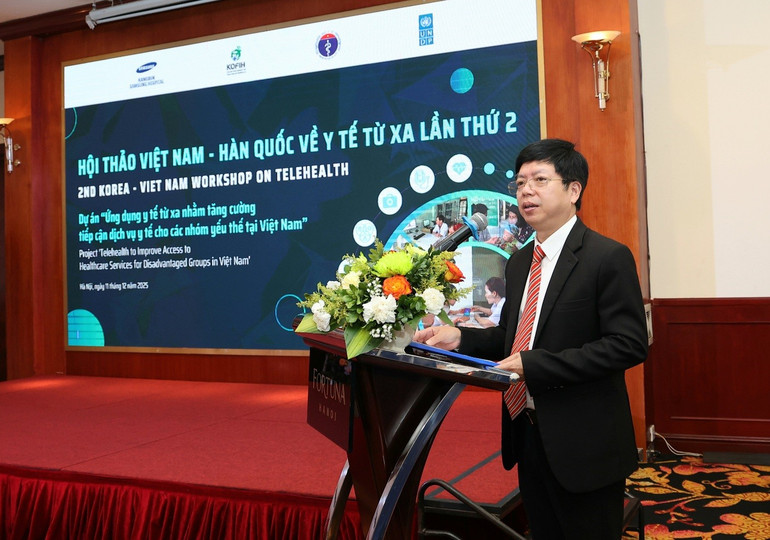
According to Dr. Nguyen Trong Khoa, Deputy Director of the Department of Medical Examination and Treatment Management, standardizing medical examination and treatment data at medical facilities is crucial for the application of electronic medical records to serve remote medical examination and treatment.
Therefore, hospitals need to upgrade their hardware infrastructure and management processes to meet operational and information security standards at level 2 (as currently implemented) and level 3; refer to appropriate specialized medical record templates; and participate in providing feedback on the standards drafted and issued by the Ministry of Health.
At the same time, the hospital needs to prepare resources to upgrade the electronic medical record software to meet interoperability and terminology standards.
Deputy Minister Tran Van Thuan expressed his hope that the results, recommendations, and experiences shared at the workshop would contribute to shaping specific, feasible, and sustainable policies and implementation models after the project concludes.
Source: https://nhandan.vn/chuan-hoa-du-lieu-y-te-de-trien-khai-manh-me-y-te-tu-xa-post929425.html

![[Photo] Prime Minister Pham Minh Chinh holds a phone call with the CEO of Russia's Rosatom Corporation.](/_next/image?url=https%3A%2F%2Fvphoto.vietnam.vn%2Fthumb%2F1200x675%2Fvietnam%2Fresource%2FIMAGE%2F2025%2F12%2F11%2F1765464552365_dsc-5295-jpg.webp&w=3840&q=75)


![[Photo] Closing Ceremony of the 10th Session of the 15th National Assembly](/_next/image?url=https%3A%2F%2Fvphoto.vietnam.vn%2Fthumb%2F1200x675%2Fvietnam%2Fresource%2FIMAGE%2F2025%2F12%2F11%2F1765448959967_image-1437-jpg.webp&w=3840&q=75)































![[OFFICIAL] MISA GROUP ANNOUNCES ITS PIONEERING BRAND POSITIONING IN BUILDING AGENTIC AI FOR BUSINESSES, HOUSEHOLDS, AND THE GOVERNMENT](https://vphoto.vietnam.vn/thumb/402x226/vietnam/resource/IMAGE/2025/12/11/1765444754256_agentic-ai_postfb-scaled.png)


























![[Photo gallery] Long Thanh Airport 'lights up' ready to welcome its first flight](https://vphoto.vietnam.vn/thumb/402x226/vietnam/resource/IMAGE/2025/12/11/1765467251707_bia_20251211222704.jpeg)


















Comment (0)