

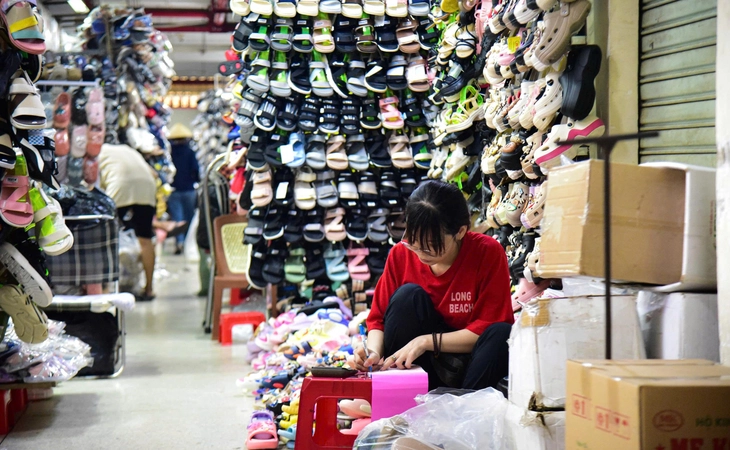
Small traders do business at Binh Tay market, Binh Tay ward, Ho Chi Minh City. This is one of the largest wholesale markets in Ho Chi Minh City - Photo: TRI DUC
According to many traditional wholesale and retail markets in Ho Chi Minh City, the number of customers coming to the market to shop is quite modest compared to previous years, especially non-essential goods such as clothes, shoes, fashion accessories... are very quiet.
Ensuring the rights of traders
Having been selling ready-made clothes at Thu Duc market (HCMC) for many years, Ms. Nguyen Thi Khai Minh said that after the COVID-19 pandemic, the business situation of most traders at the market has declined significantly; many clothing and footwear stalls have been open all day but have no customers, many people have had to close their stalls and abandon their stalls.
Speaking with Tuoi Tre, Ms. Bui Thi Anh Nguyet, Deputy Head of the Pham Van Hai Market Management Board (HCMC), confirmed that currently the market only has food products that are temporarily surviving, while the fashion industry is very sluggish. Therefore, the market designed 1,688 stalls, but now only 1,002 stalls are operating, the rest are mostly empty because no one rents them. The number of stalls in business is small, so the market's revenue has decreased sharply, the market is facing many difficulties because the revenue is not enough to cover expenses.
Ms. Nguyen Thi Khai Minh said that more than 15 years ago, she spent 300 million VND to transfer the stall, which was a large sum at that time. Therefore, in case the State plans to change the market's function or abolish the market, it is necessary to carefully calculate the compensation support to ensure the legitimate rights of the traders.
Sharing the same view, Ms. Nguyet said: "Changing the market's function requires a thorough plan, satisfying the rights and obligations of the individuals involved, otherwise it will face opposition from many traders. The conversion needs to take into account the ability to suit the tastes, culture, and living habits of the people at that location."
Not to affect people's shopping
Speaking with Tuoi Tre, a representative of the Cho Lon Ward Market Management Board (HCMC) said that traditional markets have many types with different functions, locations, scales, and areas such as people's markets with houses, markets without houses, markets selling on the sidewalk (with management), specialized business markets, semi-industry markets...
Therefore, choosing a market to convert its function needs to be carefully calculated, because if the change is not successful, the newly formed but ineffective business model will create a lot of waste, affecting people's shopping activities.
Meanwhile, the area has two traditional markets, Tu Duc and Thu Duc markets. A representative of the People's Committee of Thu Duc Ward (HCMC) said that the two markets have existed for quite a long time and are considered relics, so according to regulations, any plans for changes or renovations, if any, must be approved by the cultural management agency.
According to this unit, calculating the conversion of market functions is not a simple issue and has not been considered yet, but Thu Duc market alone has been included in the public investment project for upgrading and renovation.
On December 3, a representative of the Department of Industry and Trade of Ho Chi Minh City said that the old Ho Chi Minh City previously had a plan to renovate and change the functions of traditional markets, but after arranging with Ba Ria - Vung Tau and Binh Duong, it must conduct a comprehensive assessment of 405 markets, not just 234 markets of the old Ho Chi Minh City as before.
Accordingly, the city will deploy a master plan. After having a master plan, each locality will base on its own reality to propose solutions on how to convert and renovate markets in the area, not leveling them.
"HCMC must make a comprehensive assessment of each locality, area, and city in an orientational manner. Changing the function of markets is not easy because many people need markets for their lives, and in remote areas, markets are still an essential channel. We clearly distinguish that renovating the current status of traditional markets does not mean converting and abandoning markets," said this representative.
Traditional markets in some Asian countries: still important social spaces
China
Since the 1970s, China has been moving outdoor food stalls into indoor markets as part of its efforts to modernize urban areas, improve sanitation, and manage public spaces. In 2002, the government launched the Transforming Markets into Modern Food Supermarkets initiative, but implementation has been slow and difficult.
In recent years, with the development of supermarket chains, especially after the COVID-19 pandemic, many small outdoor markets in the centers of big cities such as Beijing and Shanghai were quickly closed to make way for supermarkets and shopping malls, according to the international network Hungry Cities Partnership.
However, many people note that traditional markets are still the dominant form of fresh food sales, with more markets and wider distribution than supermarkets; people still mainly buy food from markets, especially fresh food, because they are cheaper and more convenient. Therefore, some cities have started to modernize traditional markets instead of completely eliminating them.
Typically, in 2018, the Hong Kong Food and Environmental Hygiene Department built indoor markets with escalators, air conditioning, fixed stalls, drainage, sanitation and quality control systems to maintain traditional activities in a modern space, ensuring both hygiene and urban order.
Thailand
In Thailand, the traditional market model is still very popular, from people's markets, agricultural markets to weekend markets, meeting the daily needs of buying vegetables, fish and fresh food at prices often cheaper than supermarkets.
Recently, the Bangkok government has even launched the Bangkok Farmer Market, a network of direct markets from farmers to consumers, according to The Nation. This initiative not only meets the demand for fresh, clean food but also supports the local economy.
In addition, the Bangkok Post reported that research funded by the Thailand Science Research Innovation Fund is also focusing on upgrading facilities and hygiene in traditional markets, while redefining the role of markets: from a mere place for buying and selling to a bridge between agricultural products and consumers, ensuring food safety, transparency and convenience.
Singapore
In Singapore, traditional wet markets selling fresh produce, vegetables, meat, fish and cheap, low-cost, multi-stall food courts are considered important social spaces. In the 1990s, overcrowding and chaos led the government to redevelop most of the markets into centrally managed areas with adequate infrastructure, sanitation and amenities.
According to The Straits Times, traditional markets in Singapore are not only places for buying and selling but also connect the community, keep food prices affordable and maintain urban culture, even when supermarkets and modern markets develop strongly. Therefore, Singapore does not abolish traditional markets but brings them into the official system and improves management to ensure hygiene, stable supply, serving the middle- and low-income population.
Recently, the government has also implemented policies to support small traders: eligible stalls can receive subsidies for upgrading machinery, digital transformation and modern payment, while keeping rents stable for many years to reduce cost pressure on sellers.
During a parliamentary debate last November, Senior Minister Koh Poh Koon also highlighted three goals in the management policy: keeping prices affordable, ensuring livelihoods for vendors and preserving the unique cultural identity of traditional markets, according to Sin Chew Daily.
Source: https://tuoitre.vn/chuyen-doi-cong-nang-cho-truyen-thong-bai-toan-khong-de-20251204085009621.htm


![[Photo] Cat Ba - Green island paradise](/_next/image?url=https%3A%2F%2Fvphoto.vietnam.vn%2Fthumb%2F1200x675%2Fvietnam%2Fresource%2FIMAGE%2F2025%2F12%2F04%2F1764821844074_ndo_br_1-dcbthienduongxanh638-jpg.webp&w=3840&q=75)



































![[VIMC 40 days of lightning speed] Hai Phong Port determined to break through, reaching the target of 2 million TEUs by 2025](https://vphoto.vietnam.vn/thumb/402x226/vietnam/resource/IMAGE/2025/12/04/1764816441820_chp_4-12-25.jpeg)


































Comment (0)