

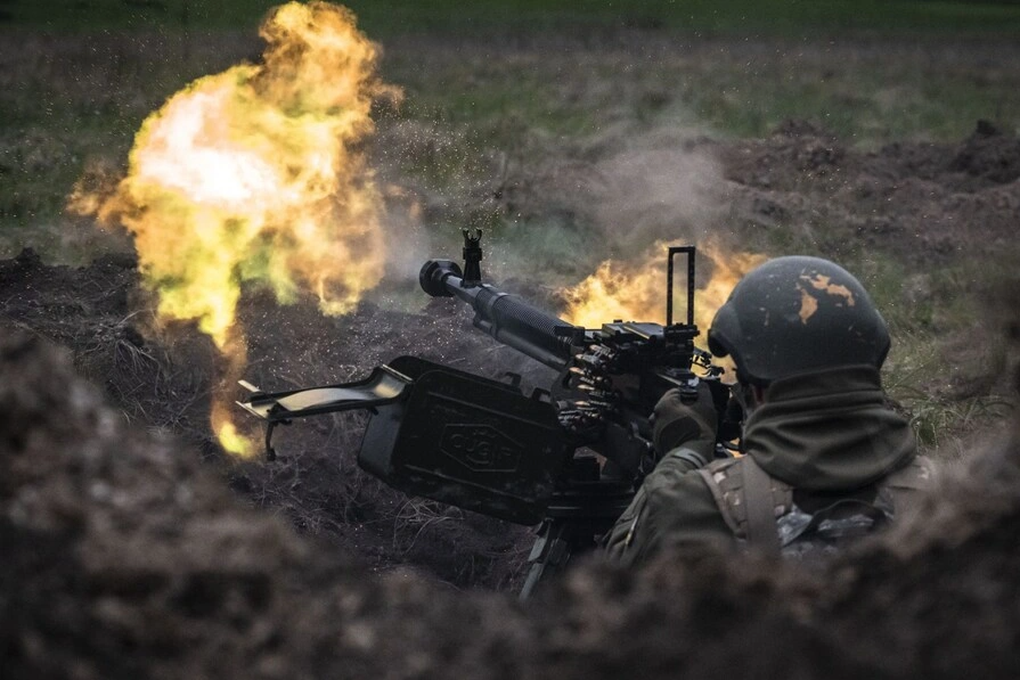
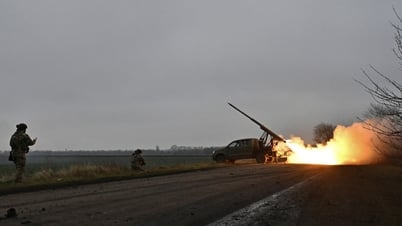
Ukrainian soldiers open fire (Illustrative image: Anadolu).
Last week, the German newspaper Bild , citing informed sources, reported that the US and Germany are seeking to bring Ukraine to the negotiating table with Russia by reducing military aid to Kyiv, leaving the government of Ukrainian President Volodymyr Zelensky with few options.
The source also said that these countries have a Plan B for a scenario where the conflict freezes.
According to Dmitry Evstafiev, a Russian political science analyst at the Higher School of Economics (HSE), the West is pushing Ukraine to the negotiating table at this time because these countries are beginning to feel exhausted from providing aid to Ukraine.
"Support for Ukraine is becoming increasingly costly for Western countries, primarily Germany and the United States… Of course, there will still be a reassessment through the Pentagon, but we will no longer see large aid packages. The EU will continue to provide support, but mainly to help Ukraine maintain the functioning of its public administration system and some forms of social assistance, but not focusing heavily on military support," Evstafiev said.
The expert further commented: "Secondly, it is clear from Western statements that Ukraine is facing a final hurdle before it can make acceptable demands in a ceasefire agreement with Russia."
Evstafiev also suggested that the West would not waste time trying to persuade Ukrainian President Zelensky to negotiate with Russia; instead, they would issue an ultimatum: either negotiate with Russia or let his successor do it.
On the other hand, he argued that Zelensky would not easily change his long-standing stance on peace talks with Russia. Late last year, President Zelensky even issued a decree banning negotiations with the administration of Russian President Vladimir Putin.
Russia launched a special military operation in Ukraine last February. Western nations responded by imposing comprehensive sanctions on Moscow and increasing military support for Kyiv.
In the early stages of the conflict, Russia and Ukraine held several rounds of negotiations, but without success.
Moscow accuses the West of pressuring Kyiv to withdraw from negotiations at the last minute when Russia and Ukraine were close to reaching a peace agreement.
In an interview with the 1+1 television channel on November 24, David Arakhamia, a senior Ukrainian MP and former chief negotiator with Russia, rejected the accusation. He explained that Kyiv did not sign a peace agreement with Russia because Ukraine did not agree to remain outside NATO and partly due to a lack of trust in Moscow.
The official also revealed that some Western allies advised Ukraine against compromising because Russia had not offered any substantive security guarantees. Following the negotiations between Russian and Ukrainian delegations in Istanbul (Türkiye), then-British Prime Minister Boris Johnson visited Kyiv and urged Ukraine to continue fighting.
Source


![[Photo] Closing Ceremony of the 10th Session of the 15th National Assembly](/_next/image?url=https%3A%2F%2Fvphoto.vietnam.vn%2Fthumb%2F1200x675%2Fvietnam%2Fresource%2FIMAGE%2F2025%2F12%2F11%2F1765448959967_image-1437-jpg.webp&w=3840&q=75)


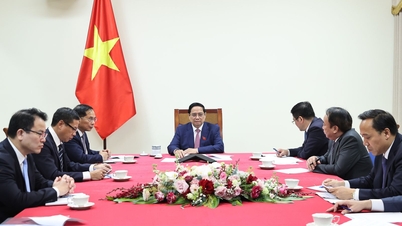
![[Photo] Prime Minister Pham Minh Chinh holds a phone call with the CEO of Russia's Rosatom Corporation.](/_next/image?url=https%3A%2F%2Fvphoto.vietnam.vn%2Fthumb%2F1200x675%2Fvietnam%2Fresource%2FIMAGE%2F2025%2F12%2F11%2F1765464552365_dsc-5295-jpg.webp&w=3840&q=75)
































![[OFFICIAL] MISA GROUP ANNOUNCES ITS PIONEERING BRAND POSITIONING IN BUILDING AGENTIC AI FOR BUSINESSES, HOUSEHOLDS, AND THE GOVERNMENT](https://vphoto.vietnam.vn/thumb/402x226/vietnam/resource/IMAGE/2025/12/11/1765444754256_agentic-ai_postfb-scaled.png)












































Comment (0)