

"Since the time of President Bill Clinton, when the two countries normalized relations, US presidents have visited Vietnam. We want to send the message that Vietnam is important to the United States," US Ambassador to Vietnam Marc E. Knapper affirmed to VietNamNet.
Continuously strengthening the relationship between the two countries.
On September 10th, the US President will visit Vietnam at the invitation of General Secretary Nguyen Phu Trong. What can we expect regarding even stronger cooperation between the two countries following this high-level visit, Ambassador?
We are very much looking forward to welcoming US President Joe Biden to Vietnam. This visit would further complement the telephone conversation between General Secretary Nguyen Phu Trong and President Joe Biden last March.
The visit is also an important part of larger efforts this year to mark the 10th anniversary of the establishment of the comprehensive partnership between the two countries. We view the Vietnam-US relationship in many ways. These include visits by leaders, aircraft carrier operations, and trade relations between the two countries reaching nearly $140 billion, making Vietnam the 8th largest trading partner of the US, and the US being Vietnam's largest export market…
Besides strengthening economic cooperation, we are constantly working to further solidify the relationship between the people of our two countries.
Nearly 30,000 Vietnamese students are studying in the U.S., making Vietnam the fifth-largest source of students studying in the U.S. , and I want to find ways to further increase that number. Fulbright University in Ho Chi Minh City has already had its first graduating class. We have the Peace Corps with its team of volunteers teaching English in Hanoi. We are collaborating wonderfully on climate change issues.
In addition, we are collaborating on the clean energy transition in Vietnam. Many great things have happened this year, and many great things have come of the overall relationship between our two countries.
Conveying the message
Ambassador, could you elaborate on how President Biden's visit to Vietnam was prepared?
In terms of the overall message, we are fortunate that since the time of President Bill Clinton, when relations were normalized, US presidents have visited Vietnam. We want to send the message that our relationship is very meaningful.
The intrinsic value of the relationship between the two countries far surpasses any imaginable aspect of the US-Vietnam relationship. Returning to the visit, I think the focus was on helping Vietnam build an innovative economy, including developing a high-tech workforce, responding to the challenges and seizing the opportunities of the 21st century.
I think you've heard a lot about our two countries, about our people, and about how we can develop our relationship in the future.
Healthcare cooperation has always been a strong hallmark of the friendship between the United States and Vietnam, whether it's collaboration to help each other during the Covid-19 pandemic or efforts to combat HIV/AIDS.
Therefore, in many ways, this visit conveys the powerful message that the relationship between the United States and Vietnam is very important.
What we are doing is demonstrating respect for each other's political systems. All of this will be emphasized through this historic visit. Of course, the visit requires a great deal of effort, but ultimately, the results of these efforts will be excellent for both countries.
According to him, what is the greatest potential in the relationship that both sides need to strongly promote in the coming time?
I believe those areas will be related to education. This will help people from both countries understand each other better, and cooperate to ensure Vietnam has the necessary workforce to respond to the challenges and seize the opportunities of the 21st century.
I believe we will cooperate on environmental issues, particularly climate change, realizing the efforts of Vietnam in particular and both countries in general to achieve the goal of net zero emissions by 2050. The United States hopes to achieve this, whether through financial, technological, or human resource cooperation.
The US President's Special Envoy for Climate, John Kerry, has visited Vietnam several times. This is a very important area where we can cooperate to address climate change. Vietnam is one of the countries in the world most affected by this issue.
The United States is the largest contributor to the Partnership for a Fair Energy Transition. And I think we will have discussions to optimize cooperation in order to meet the important goals that Vietnam has set for itself.
A journey of 28 years
Looking back over the past 28 years, and especially the 10th anniversary of the establishment of the Vietnam-US Comprehensive Partnership, how does the Ambassador feel about the achievements the two countries have made in the pillars of cooperation?
That is certainly trade investment. Among the most obvious achievements, bilateral trade reached $140 billion. This is an impressive figure given the context of the two countries' previous relationship. This figure has increased by 360% since we began our comprehensive partnership.
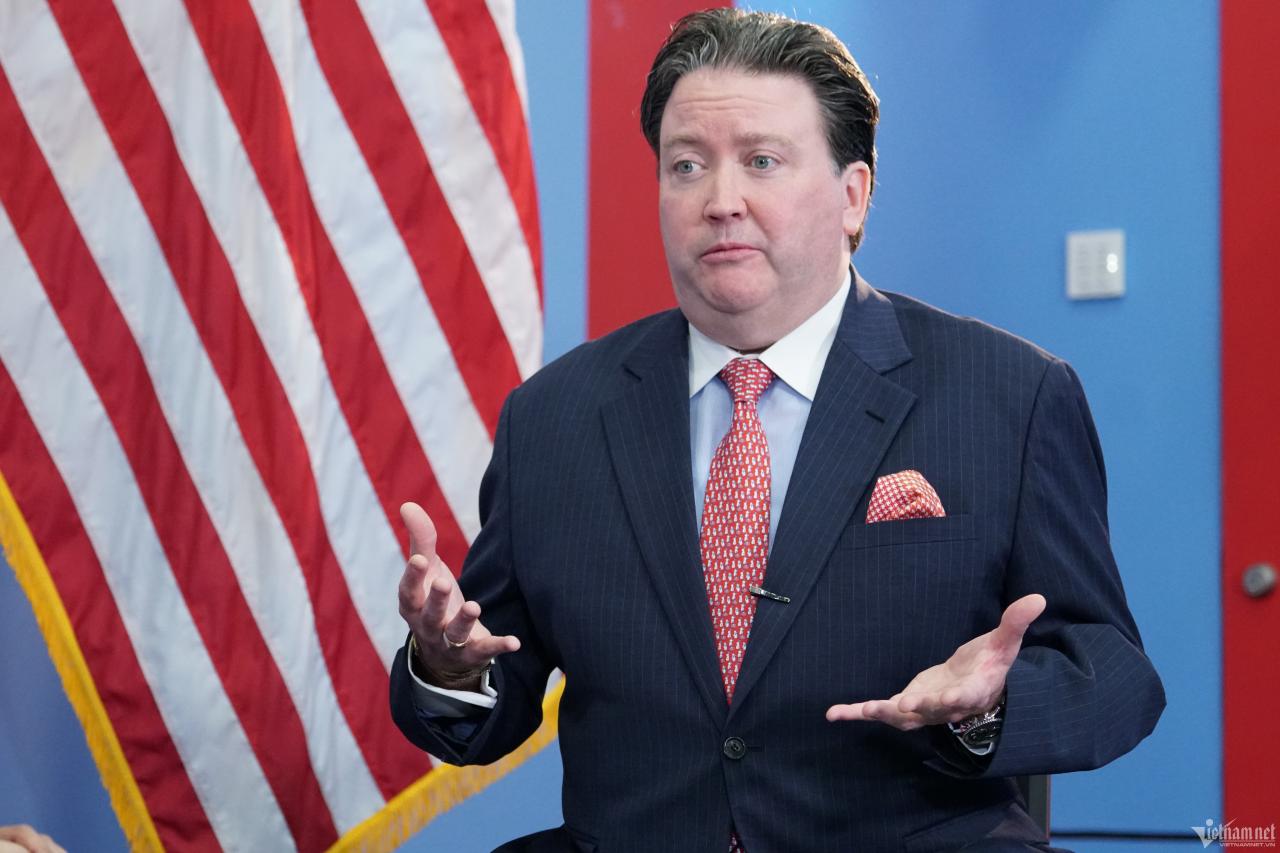
Ambassador Marc E. Knapper: "Our cooperation is built on a foundation of human relationships, based on understanding and trust."
We are witnessing Vietnamese companies investing in the US, as well as Vietnamese companies appearing on the US stock market. These are all genuine signs of the growing linkage between the two countries' economies. This is a great achievement, made possible by the efforts of both the US and Vietnam.
Both countries have made significant efforts in the field of climate change, and these efforts will continue to grow.
Once again, whether through financial cooperation, technical cooperation, or education, we are delighted that many young Vietnamese people, and perhaps even very young students, want to study in the United States. We are proud that many families place their trust in American education and are willing to send their children to study in the United States.
Beyond undergraduate and postgraduate programs, we also implement many smaller programs. For example, the US government has programs that allow young people to come to the US for a week or a few months. This is an opportunity for young people in Vietnam or the US to travel and learn more about each other's countries.
That's absolutely essential because everything we do in collaboration is built on a foundation of human relationships, based on understanding and trust.
This year, we celebrate 35 years of our joint efforts to search for American servicemen missing in action during the war. This is a tremendous and humane effort from Vietnam, and I know that hundreds of thousands of Americans are incredibly grateful for what you have done.
Several years ago, we also launched an initiative to assist you in the search for missing soldiers from the war, through the use of archival research and DNA analysis. Hopefully, this program will help to alleviate the pain of many Vietnamese families, in the same way that Vietnam's efforts have helped American families.
Both sides also undertook other efforts such as demining and removing unexploded ordnance, whether at Da Nang Airport or Bien Hoa military airport, hoping to clear away remaining landmines from the war; and providing support to people with disabilities. These efforts had already begun during the normalization of relations, helping to establish a foundation of trust between the two countries, which continues to benefit both sides today.
* Part 2: Vietnam and the US jointly lay the foundation for stronger future development
![[Photo] Prime Minister Pham Minh Chinh holds a phone call with the CEO of Russia's Rosatom Corporation.](/_next/image?url=https%3A%2F%2Fvphoto.vietnam.vn%2Fthumb%2F1200x675%2Fvietnam%2Fresource%2FIMAGE%2F2025%2F12%2F11%2F1765464552365_dsc-5295-jpg.webp&w=3840&q=75)

![[Photo] Closing Ceremony of the 10th Session of the 15th National Assembly](/_next/image?url=https%3A%2F%2Fvphoto.vietnam.vn%2Fthumb%2F1200x675%2Fvietnam%2Fresource%2FIMAGE%2F2025%2F12%2F11%2F1765448959967_image-1437-jpg.webp&w=3840&q=75)

































![[OFFICIAL] MISA GROUP ANNOUNCES ITS PIONEERING BRAND POSITIONING IN BUILDING AGENTIC AI FOR BUSINESSES, HOUSEHOLDS, AND THE GOVERNMENT](https://vphoto.vietnam.vn/thumb/402x226/vietnam/resource/IMAGE/2025/12/11/1765444754256_agentic-ai_postfb-scaled.png)


































Comment (0)