

In Vietnamese culture, the worship space is always the most solemn place of each family, and the altar is one of the indispensable sacred worship items on the family altar. The altar is used to burn incense to create fragrance, to express respect, purity, nobility and to neutralize bad energy, increase good energy according to spiritual beliefs.
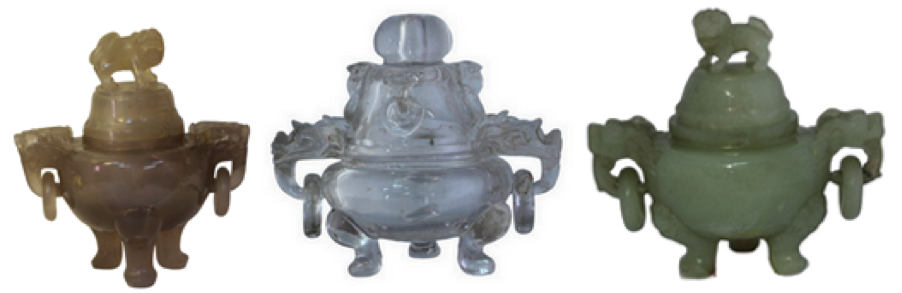
Some altars in the Nguyen Dynasty Royal Antiquities Collection at Lam Dong Museum
Photo: Lam Dong Museum
In the Nguyen Dynasty Royal Antiquities Collection at Lam Dong Museum, the altar artifacts have interesting similarities.
All the incense burners are symbolic and decorative objects in worship spaces: Due to their small size and lack of ventilation holes, the incense burners in this collection cannot be used to burn incense like regular incense burners, but are only used for symbolic and decorative purposes in worship spaces.
All the altars were meticulously and elaborately crafted by artisans in the Nguyen Dynasty's Royal Workshop. During the Nguyen Dynasty, the Royal Workshop was the place to manufacture and supply items for the king and the royal family. The artisans working here were talented craftsmen carefully selected from traditional craft villages in the country. At that time, there were no modern machines like today, so the artisans crafted the altars entirely by hand.
All the incense burners are crafted from jade blocks following a common motif, consisting of two parts: the body and the lid. On the top of the lid, there are often carved mascots such as the kylin or unicorn as handles. The body of the incense burner is polished, has a bulging belly, a narrow neck, a standing mouth and a rim to cover the lid.

The altars are crafted from many types of jade in a kneeling style.
Photo: Lam Dong Museum
The base of the altar is often crafted in a kneeling style: In the Vietnamese mind, the worship space is a sacred place and the ancients believed that a altar crafted in a sturdy kneeling style would revive the worship space. Therefore, most of the altars in the Nguyen Dynasty Royal Antiquities Collection at Lam Dong Museum are crafted in this style.
The decorative themes on the altars are quite diverse: The altars in this collection show that, with the talented hands of the artisans in the Nguyen Dynasty's Royal Workshop, the decorative themes on the altars are very diverse. It not only vividly depicts images of sacred animals (dragons, unicorns) or symbols of longevity (tiger talismans), but also vividly shows images symbolizing strength and power (elephants, lions).
Besides the similarities, the altar artifacts in the collection also have very unique features.
The altars are crafted from jade of different origins, both domestic and foreign. The Nguyen Dynasty mined jade from several regions in the country, and imported raw jade from China and Myanmar. The altars in the collection are crafted from many different types of jade, such as transparent jade, brown jade, greenish-white jade, opaque white, and grayish-white jade.
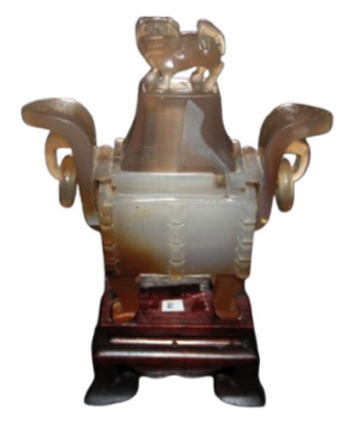
The altar is crafted with the image of two long lotus petals, around the body of the altar are embossed bamboo-shaped moldings.
Photo: Lam Dong Museum
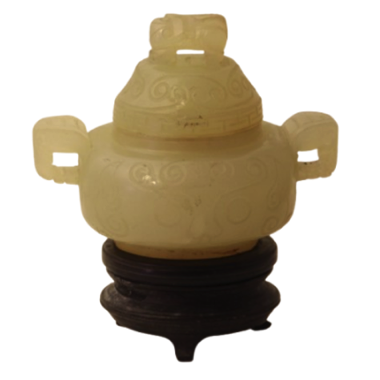
The altar is crafted with a scarf-shaped base.
Photo: Lam Dong Museum
The lid of the altar is crafted by artisans in many shapes. Some lids are crafted in the shape of a cone, a truncated cone, some are crafted in the shape of a cup, or a bell.
In addition to crafting altars with motifs vividly depicting sacred animals (dragon, kylin, unicorn), symbols of longevity (tiger talisman), or animals symbolizing strength and power (elephant, lion), artisans also craft altars with the image of two lotus petals stretching out and attached with round rings. Around the body of the altar are embossed bamboo-shaped moldings. This is a rather special highlight, because the lotus is a flower with a rustic yet elegant beauty, although born in the mud, it rises above and radiates its color and fragrance; and the bamboo symbolizes a gentleman. In addition, the lotus and bamboo are two of the four symbols of the Four Seasons theme (apricot symbolizes spring; lotus and bamboo symbolize summer; chrysanthemum symbolizes autumn; pine symbolizes winter). Eastern people believe that the Four Seasons are a symbol of fullness, stability, eternity, happiness...
In addition to the kneeling-style altars that create a solid position, there are also altars crafted with a scarf-shaped base attached to a round wooden base in the shape of a 3-legged lathe. This contributes to the diversity in the shape of the altars in the collection. (continued)
Source: https://thanhnien.vn/co-vat-trieu-nguyen-o-xu-suong-mu-dinh-tho-che-tac-tu-khoi-ngoc-18525012122510096.htm


![[Photo] Cat Ba - Green island paradise](/_next/image?url=https%3A%2F%2Fvphoto.vietnam.vn%2Fthumb%2F1200x675%2Fvietnam%2Fresource%2FIMAGE%2F2025%2F12%2F04%2F1764821844074_ndo_br_1-dcbthienduongxanh638-jpg.webp&w=3840&q=75)






























![[VIMC 40 days of lightning speed] Da Nang Port: Unity - Lightning speed - Breakthrough to the finish line](https://vphoto.vietnam.vn/thumb/402x226/vietnam/resource/IMAGE/2025/12/04/1764833540882_cdn_4-12-25.jpeg)







































Comment (0)