

 |
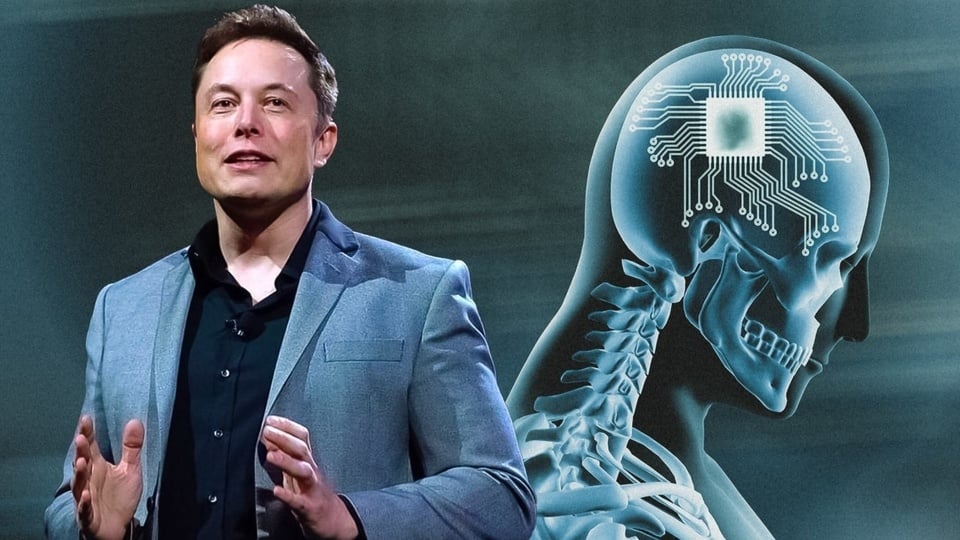
Elon Musk's company has achieved a technological breakthrough with an unprecedented implant placement time. Photo: Wccftech . |
Neuralink says that more than 10,000 people worldwide have already registered and are on the waiting list for the trial. The company expects to complete 20 transplant surgeries on humans by the end of this year.
Meanwhile, Science Corp, founded by former Neuralink co-founder Max Hordak, also introduced technology that is claimed to be capable of "restoring vision to the blind."
Absolute speed and precision
The company says its surgical robot has significantly reduced the time it takes to implant an electrode fiber from 17 seconds to just 1.5 seconds.
This robot uses ultra-fine implant needles, thinner than a red blood cell, to precisely insert flexible electrode fibers into the brain, avoiding dense blood vessels.
To address this micrometer-level challenge, Neuralink has developed its own system combining six microscopes with Optical Coherence Tomography (OCT) technology. This allows the robot to synchronize brain tissue movement and predict trajectories in milliseconds.
In addition, the disposable needle holders used in Neuralink's surgical robots have seen a 95% reduction in manufacturing costs. These once expensive components are now reportedly ready for mass production.
Initial trials of Neuralink have allowed paralyzed patients to control the robotic arm with their thoughts.
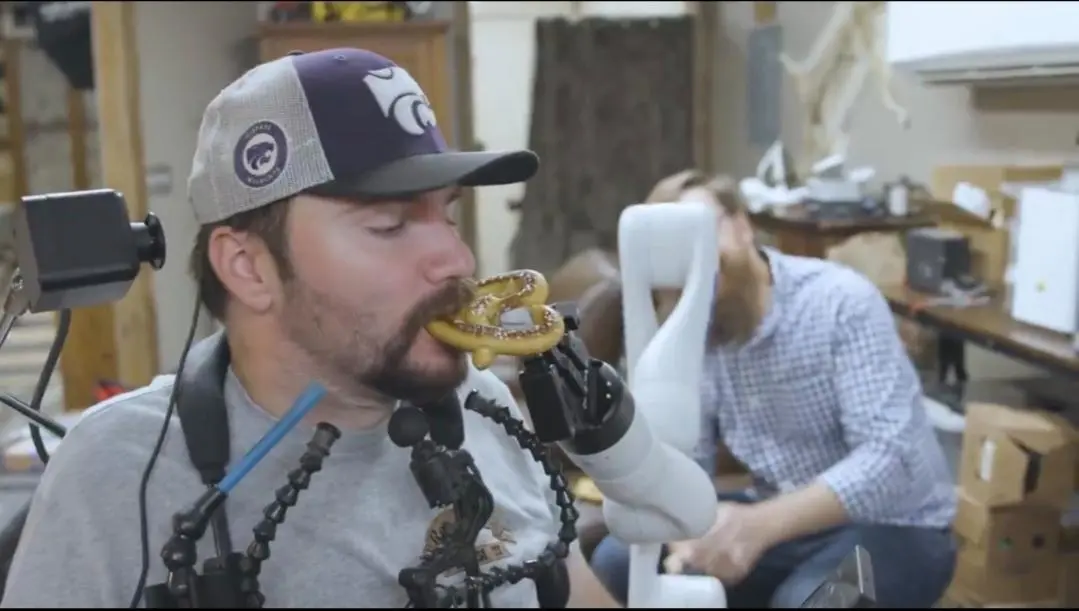 |
Patients use their thoughts to control a robotic arm to deliver food into their mouths. Photo: Neuralink. |
In a video posted on social media, Rocky Stottenberg, a patient paralyzed from the neck down, demonstrated the product's effectiveness. The video shows him using his thoughts to control a robotic arm to feed himself. Previously, he had to rely on a mouthpiece to perform tasks such as playing games.
Another participant in the trial, Nick Ray, who suffers from amyotrophic lateral sclerosis (ALS), also successfully tested the new function, using the robotic arm to hold a cup and drink water.
Musk claims that future versions of Neuralink will not only allow users to stream music directly into their brains, creating a "symbiotic" relationship with artificial intelligence, but could even evolve to the point of "uploading memories."
"This might sound like science fiction, but I think we could save an 'alternative version' and then download it to a robotic body or a clone, which would give humans a form of immortality," the billionaire said.
Vision restoration technology
Max Hordak, who was formerly the co-founder and chairman of Neuralink, has become a major competitor to Elon Musk.
Hordak, who played a key role in Neuralink's early technological breakthroughs, left the company in 2021 and founded Science Corp, bringing with him three former colleagues. This new company is rapidly rising and is seen as a direct competitor, challenging Neuralink's position.
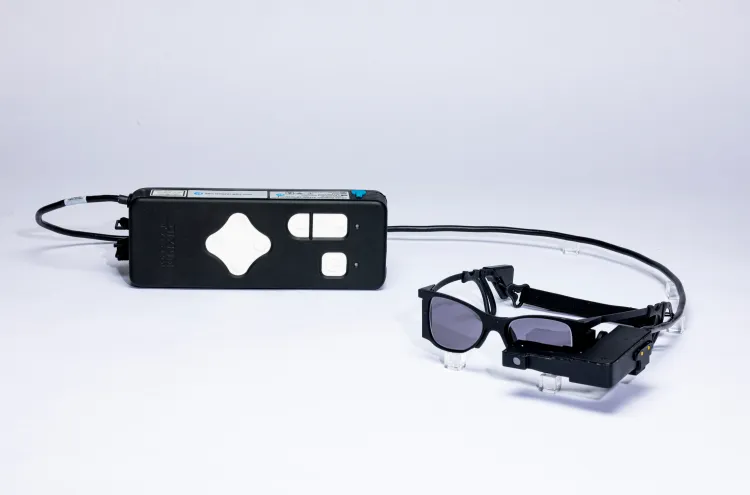 |
The patients wore smart glasses connected to retinal implants in their eyes. Photo: Science Corp. |
Science Corp has mastered a retinal implant technology featured in the "Prima." This tiny, rice-grain-sized implant is designed to restore "form vision" to patients with severe macular degeneration. The technology was initially developed by the French company Pixium Vision and subsequently refined by Science Corp, attracting considerable attention.
With the help of specially designed camera glasses, Prima achieved promising results in the trial. Of the 38 visually impaired participants, 80% regained their reading ability, although the current speed only allows them to recognize two letters at a time; this is still a significant breakthrough.
Hordak said Science Corp has raised $260 million in investment and generated revenue by selling neuroscience tools to researchers. The company has not only completed trials in Europe but also plans to officially launch a commercial product next summer.
Source: https://znews.vn/cong-ty-cua-elon-musk-cay-chip-vao-nao-nguoi-chi-mat-1-5-giay-post1610166.html


























































































Comment (0)