



Every storm season, flood-affected schools are transformed from mud by the hands of teachers and students. But along with the joy of returning to class is a lingering fear: Will the flood wash everything away again next year?
In just 10 days from late October to early November 2025, hundreds of schools in Hue and Da Nang experienced three historic floods. Many schools suffered major damage to their facilities and teaching equipment, such as collapsed walls, broken gates, water-soaked tables and chairs, broken TVs, projectors, speakers, and toilets clogged with mud and rubbish.
Many schools had just cleaned up mud and garbage, cleaned and disinfected after one flood, but then another flood came, and all the efforts of teachers and local authorities went down the drain.
According to statistics from the Hue Department of Education and Training, 500 out of 570 schools in the city were flooded.
Mr. Nguyen Tan, Director of the Department of Education and Training of Hue City, said that during the recent flood, many schools were flooded for months. However , because they live in an area with floods all year round, the teaching staff and the school always maintain a high level of vigilance. When receiving flood warnings, teachers proactively removed all machinery and equipment and moved their assets to higher floors, thereby avoiding significant damage.
The Department Director commented that the efforts of many schools in low-lying areas are commendable. Despite frequently facing risks and damages caused by floods, the schools have taken remarkable actions in effectively protecting their properties and overcoming the consequences of floods very quickly. This demonstrates the initiative and high sense of responsibility of all staff and teachers of the schools.
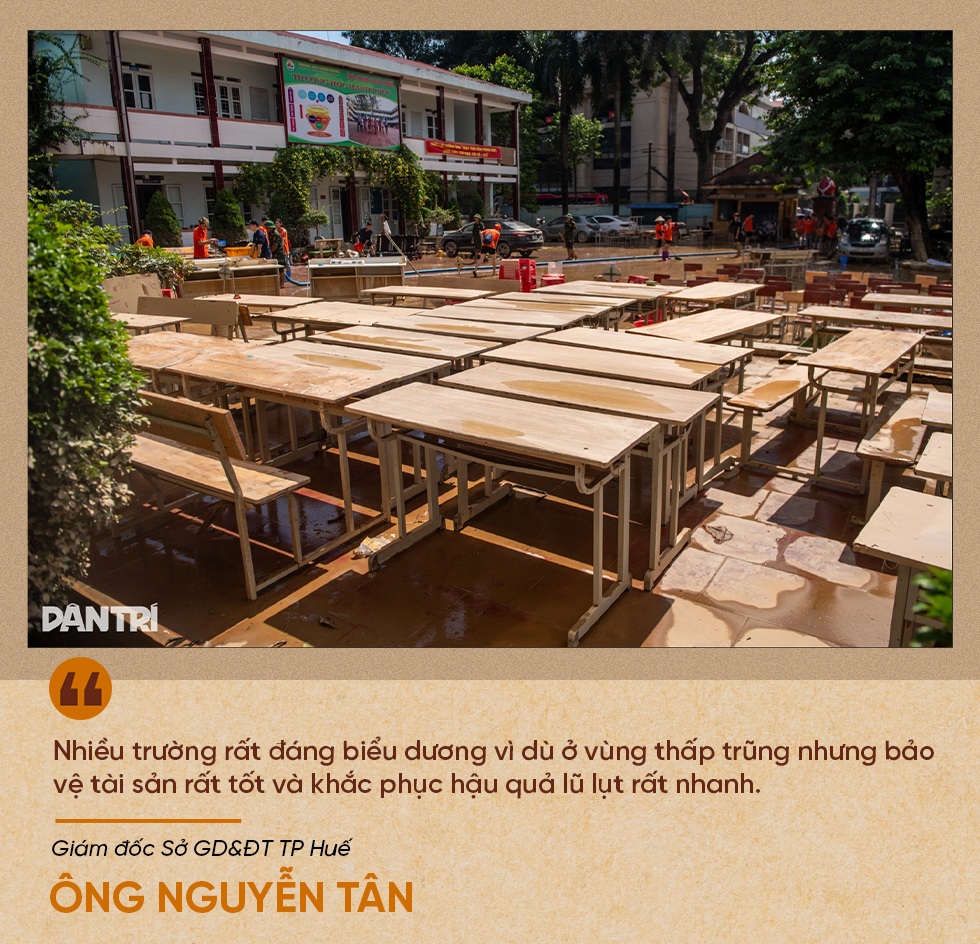
According to the head of the Hue City education sector, in addition to self-preservation of assets, there is also a movement in Hue of "highland schools supporting lowland areas". Specifically, teachers in non-flooded areas will be sent to flooded schools to clear mud, and the mud will be cleared as the water recedes. Thereby, the spirit of solidarity and mutual love in the education sector will be further strengthened and expanded, creating a combined strength to quickly bring teaching and learning activities back to normal after natural disasters.
In particular, in Hue, there were previously a number of projects funded by foreign organizations to prevent floods, including flood-proof schools built by the Japan International Cooperation Agency (JICA) in a number of low-lying communes.
Accordingly, schools are built solidly in high locations so that when there is a flood, people can go to school to avoid the flood.
Regarding the solution, Mr. Tan said that because the level of flooding in each school will not be the same, schools should "improvise" or divide students into groups to have appropriate make-up teaching plans.
For some schools that are always flooded for a month like Quang Dien and Phong Dien, there is not enough time to make up for lost time. Schools will be flexible between in-person and online teaching regularly.
“Currently, the locality cannot apply the Saturday off regime for students and teachers. Although we really want to do this, because Hue is often affected by floods and natural disasters, ensuring enough time for the study program becomes difficult,” Mr. Tan confided.
In addition, due to the complicated weather situation, the Department cannot apply a holiday or mass teaching regime for all schools in the area. Instead, this unit requires schools to closely follow weather forecasts to proactively arrange suitable and flexible teaching/vacation schedules.
In Da Nang, there are areas where 100% of schools are flooded, typically Dien Ban ward. Some areas are deeply flooded, the water recedes slowly, forcing students to stay home from school for a long time. It was not until 3 weeks after the first flood that students in the whole city returned to school.

The education sector in Gia Lai province suffered even more damage, especially after the historic flood at the end of November. Many educational facilities were damaged, severely damaged, with some areas being flooded 2-3 meters deep. Tens of thousands of students had to stay home from school due to the immeasurable losses caused by natural disasters.
To stabilize teaching and learning after the flood, the Department of Education and Training of Gia Lai province requested schools to coordinate with localities to urgently clean and sanitize classrooms to ensure safety, cleanliness, and disease prevention; proactively stabilize teaching and learning order and implement assigned educational plans.
In particular, the Department noted that units should proactively organize for students to return to school after heavy rains and floods, but must ensure absolute safety for both teachers and students.
According to the World Bank’s “Vietnam 2045: Greener Growth” report, Vietnam is one of the countries most vulnerable to climate change. With over 3,260km of coastline, low-lying deltas and a tropical climate, Vietnam is facing major natural disaster risks with increased heat, flooding, storms and rising sea levels.
These are not only environmental challenges but also threaten people's livelihoods and the country's economy.
According to the WB, without adaptation action, Vietnam's economic losses could reach 12.5% of GDP and 1.1 million people could be pushed below the poverty line by 2050. In particular, "human capital" - including students, teachers and educational infrastructure - is directly affected.
The WB emphasized recommendations for Vietnam such as investing in climate-resilient infrastructure, transforming adaptive agriculture, developing renewable energy, building disaster risk insurance policies, and strengthening the safety net for vulnerable groups...
The WB recommendations raise an urgent question: When schools are places to educate and nurture the future, are we investing enough in their resilience to natural disasters?
In the last 5 months of 2025, natural disasters spread from the North to the South Central region, from Lang Son, Cao Bang, Tuyen Quang, Thai Nguyen, Hanoi to Thanh Hoa, Nghe An, Ha Tinh, Quang Tri, Hue, Da Nang, Gia Lai, Dak Lak, Khanh Hoa, Lam Dong... showing that natural disasters are no longer a regional problem.
Vietnam’s major cities are increasingly becoming “risk zones” if planning and infrastructure are not adapted. Every time a flood passes, the sight of schools everywhere being flooded is living proof of the vulnerability of “human capital”.
This is also an urgent message to policymakers: Investing in disaster-resilient schools is not only about protecting assets but also about protecting the nation's future.


Schools are always places to nurture knowledge and look towards the future. With that vision, Architect Tran Huy Anh, Standing Member of the Hanoi Architects Association, emphasized an important principle: “Schools must be the safest place in a risky area”.
In fact, in many countries, the role of schools goes beyond education, becoming a fulcrum to help communities overcome natural disasters and emergencies.
Architect Tran Huy Anh has given many typical examples of this model in the world. In the Philippines, from the 60s to 70s, schools were designed as shelters for the community when natural disasters occurred.
In Taiwan (China), schools are also one of the community shelters against earthquakes, forest fires or storms.
In the arid African country of Uganda, schools have wells drilled so that students can bring water back to their parents.
In Vietnam, the challenge lies in the fact that educational infrastructure is not really linked to disaster response planning, sometimes not ensuring minimum safety, especially in urban areas.
“There are few schools in Hanoi that do not allow cars into the school yard. This is a principle to ensure the safety of students. Schools in the center lack playgrounds for children, they are covered with concrete, losing the necessary flexibility,” said Mr. Tran Huy Anh.
Mr. Anh also cited Ngo Si Lien Secondary School - which he participated in designing in the 90s - this project was originally designed with wide corridors, high railings and the entire first floor left empty, both as a playground and to avoid flooding.

However, after a period of use, the pressure of increasing classroom and functional room space has changed the original architecture of the school. The rooms on the first floor are gradually built up, narrowing the playground area.
Architect Anh believes that climate change is a threat but also an opportunity to re-think planning. Instead of having the mentality of “running away from floods”, we need to proactively switch to “living with floods” by integrating disaster prevention right from the design of school infrastructure.
He stressed that this could be applied immediately in large cities like Hanoi, where school buildings with empty first floors need to be restored. Although this design may increase the initial construction cost, it brings long-term value, especially in adapting to floods and storms.
Architect Anh calls this philosophy “architecture for people”. He asserts that a school can be a classroom, a shelter, a place to store food, provide clean water, and even a place to organize community activities during a crisis.
The expert also emphasized the need to promote “indigenous wisdom” when building schools in localities. That is the understanding of local people through hundreds of years of living with nature in each land.
This will be valuable experience that planners should refer to and listen to when building schools, from choosing the location, choosing the direction of the gate, the direction of the roof tiles, gutters, etc.
Schools should be built on land where people have taken shelter from many storms, because they are the ones who know best where water is and where landslides are most likely.
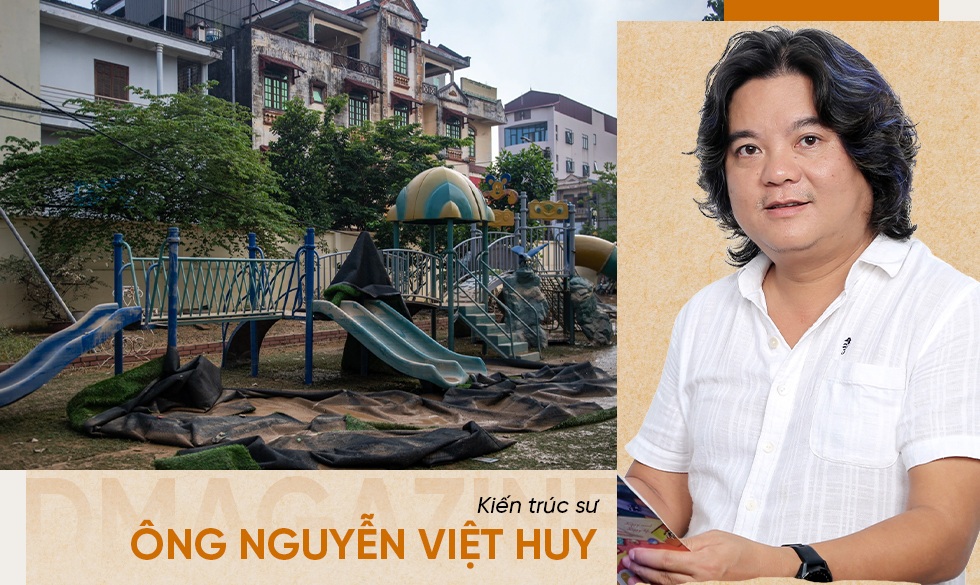
Sharing this view, Associate Professor Architect Nguyen Viet Huy, lecturer at Hanoi University of Construction, affirmed that choosing a location to build a school is extremely important, especially in mountainous provinces - where there is a high risk of flooding.
“A sustainable location is the first criterion in green architecture and sustainable construction. To have a sustainable location, we need to take advantage of the practical experience of local people,” said Associate Professor Nguyen Viet Huy.
According to Mr. Huy, building flood-proof schools is impossible, but it is completely feasible to build flood-adapted schools using a series of scientific solutions.
In particular, the construction site is the decisive factor, followed by arranging the space according to natural conditions - from respecting the flow, direction of sunlight, direction of wind... At the same time, the school needs to take advantage of construction materials that can withstand natural disasters and have been used by local people for many generations.
Finally, a humane architectural space, suitable for the culture, lifestyle, and living habits of local students. Students can only feel safe when they feel familiar at their school.

With many years of experience implementing flood-proof housing projects in the Central provinces, Architect Dinh Ba Vinh believes that there cannot be a common set of standards for building disaster-resistant schools for the whole country.
Instead, each locality needs to identify its own risks, whether flooding will recur, and to what extent, in order to design infrastructure - including schools - accordingly. In particular, each place will need its own plan instead of a "uniform solution".

According to architect Dinh Ba Vinh, the schools flooded during the recent prolonged natural disaster belong to two groups with very different characteristics and adaptation needs.
The first group is located in areas that are familiar with storms and floods, where schools have good prevention and response skills, typically in the Central provinces. Many schools in Quang Binh, Quang Tri, Hue, etc. are also funded by JICA to build in a disaster-resilient direction, along with educational programs on coping skills when storms and floods occur.
These projects not only protect property but also preserve learning, helping teachers and students return to class as soon as possible after the flood.
In these provinces and cities, “flood escape” has become a reflex. When there is a warning, teachers proactively move teaching and learning equipment to higher floors. Therefore, what teachers fear most is no longer water, but mud. Cleaning up mud after a flood is extremely hard and tiring work.
The remaining schools are in localities that have "suddenly experienced floods" and have never been on the risk map, so neither the government, schools nor the people have had time to adapt.
In many cases, schools are built in low-lying areas. When the flood comes sooner than expected, they cannot move equipment, property, desks, chairs, books to the second floor in time, and damage is inevitable.
Therefore, according to Mr. Vinh, the construction of schools that adapt to natural disasters needs to be calculated based on local realities as well as ensuring feasibility in terms of investment costs. It is not necessary that every school must be a disaster shelter, but only select a few specific locations in a large area.

Mr. Vinh also stated that the key element of any disaster response plan is early warning and warning at the right intensity.
“If the forecast was accurate, the school could have prepared a few hours before the flood, the damage would have been greatly reduced,” the architect affirmed.
From World Bank recommendations to experts’ “architecture for people” initiatives, a clear message is emerging: disaster-resilient schools are necessary and feasible.
Each school is designed properly, both as a classroom and a safe shelter, to help teachers and students return to class as soon as possible after a natural disaster. When schools learn to “live with the flood”, student and community life will quickly return to normal, and education will continue to nurture people who are adaptable and proactive in the face of natural changes.
Investing in disaster-resistant schools is not just about protecting assets or infrastructure, but about protecting human capital and the future of the nation. It is time for policymakers and communities to act together, to make every classroom truly the safest place in the midst of natural disasters, and to make each storm season no longer a season of fear for students.
Part 1: The principal burst into tears in the middle of the flooded schoolyard, heartbrokenly watching his education go down the drain.
Part 2: Floods "took away" the school, teachers went around asking for notebooks, sowing a new season of letters
Source: https://dantri.com.vn/giao-duc/da-den-luc-can-mot-chien-luoc-dau-tu-truong-hoc-thich-ung-thien-tai-20251129183633837.htm



![[Photo] Parade to celebrate the 50th anniversary of Laos' National Day](/_next/image?url=https%3A%2F%2Fvphoto.vietnam.vn%2Fthumb%2F1200x675%2Fvietnam%2Fresource%2FIMAGE%2F2025%2F12%2F02%2F1764691918289_ndo_br_0-jpg.webp&w=3840&q=75)
![[Photo] Worshiping the Tuyet Son statue - a nearly 400-year-old treasure at Keo Pagoda](/_next/image?url=https%3A%2F%2Fvphoto.vietnam.vn%2Fthumb%2F1200x675%2Fvietnam%2Fresource%2FIMAGE%2F2025%2F12%2F02%2F1764679323086_ndo_br_tempimageomw0hi-4884-jpg.webp&w=3840&q=75)

![[Video] Protecting World Heritage from Extreme Climate Change](https://vphoto.vietnam.vn/thumb/402x226/vietnam/resource/IMAGE/2025/12/03/1764721929017_dung00-57-35-42982still012-jpg.webp)












































































Comment (0)