

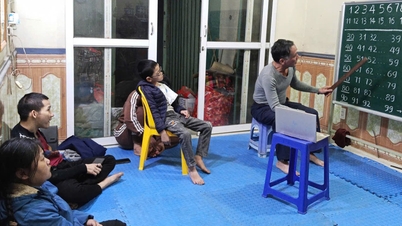
Teacher Pham Thi Lan will never forget the moment when the Mong children in Muong Nhe first saw the map of Vietnam appear on the computer screen; everyone's eyes widened, whispering as if afraid to touch something too new.
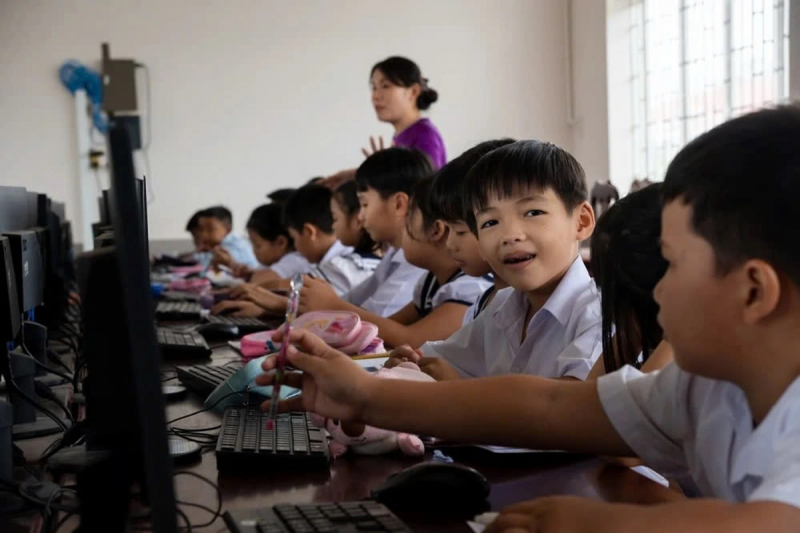
The cables go through the mountains and forests and open the door of knowledge
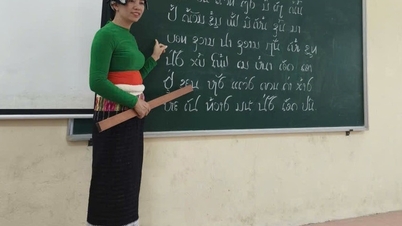
In the middle of the rugged rocky mountains in the far west of the country, Muong Nhe commune used to have days of prolonged rainy season, the road to school was cut off by flooded streams. The class of less than twenty Hmong, Khmu, and Thai students sat close together, looking at the chalkboard that had faded with time. Before the Internet appeared, teachers' lectures mainly relied on textbooks or self-searched materials, while students had access to the outside world through worn-out pages.

The journey to bring the Internet to areas like Muong Nhe started with a very simple need: how to let the children in the most remote places learn like their peers in the plains. But it was a long and challenging journey.
Many schools are located in areas with divided terrain, and in some places, to get the transmission line, one has to walk dozens of kilometers through the forest. Many routes have to cross rocky mountains, slippery dirt roads, landslides in the rainy season, and thick fog in the winter.
In some places, the electricity grid is unstable, and equipment is not always available. Classrooms are sometimes just corrugated iron roofs on the ground, making it nearly impossible to build a standard computer room. To bring the transmission line into the school, many localities have to coordinate to erect columns, reinforce walls, and arrange separate rooms. In some places, teachers and parents have become "seasonal workers", carrying each coil of wire and each box of equipment into the school.

And then the first lines lit up. Classrooms that were used to a quiet space suddenly became more bustling with illustrative videos, simulated experiments, and realistic images of lands that students had previously only heard about in books. Talking to each other in the school yard, Ms. Lan said that the students “thought she was showing a movie,” and when they understood that it was a real lesson, the whole class was excited as if they had just entered a new world.
For many teachers in the highlands, the Internet is not just a change in the way they teach. It is a bridge to connect them with knowledge, methods, electronic lesson plans, and open lecture libraries. Ms. Lan used to have to travel dozens of kilometers to meet colleagues to exchange expertise, but now she can just turn on her computer and attend an online training session.
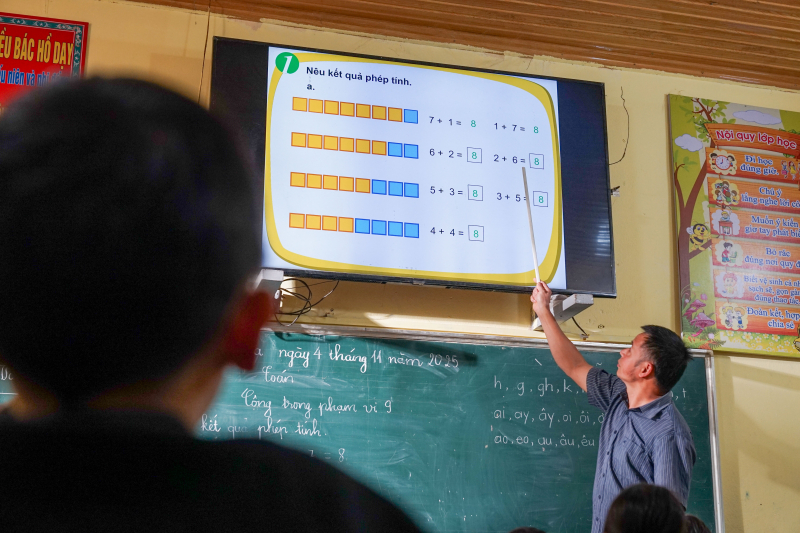
From remote villages, the change gradually spread to the plains. Many urban schools also switched to a hybrid teaching model, exploiting online resources. Parent-teacher conferences can be held via digital platforms, learning management systems, electronic records, and electronic contact books are widely used. From the mountains to the cities, the Internet has become an essential infrastructure of education, promoting equality in access to knowledge.
A teacher in the sunny and windy Central region once confided that the biggest impact the Internet brings is not the digitalized lesson plans or lectures, but "the belief that their children will learn new things and go further than their parents."
Many students in remote areas have the opportunity to access foreign language, programming, and soft skills courses – things that were previously only available in the city. Some of them, after growing up, have become engineers, doctors, lecturers, etc. and when recounting, they say that it all started from “the first time seeing the world through a computer screen”.
Go further
When the first highland classrooms had Internet, few people thought that many years later the “School Internet” program would become a typical example of the continent. To date, more than 46,000 educational institutions in Vietnam and 10 countries around the world have been connected by broadband Internet, completely free of charge through this program.

More than 23,000 km of fiber optic cables were built to connect millions of hotspots. About 25 million teachers and students benefited, and more than that, it fundamentally changed the way teaching and learning in Vietnam.
Many schools that once had the most difficulty with infrastructure now have stable connections, helping teachers access online learning resources, organize blended classes, and hold professional meetings, while students can access an unprecedented wealth of knowledge.
The total investment value is up to 78.9 million USD for digital education infrastructure, along with a technical system operating in 100% of provinces and cities, ensuring the program operates continuously and stably, especially in difficult areas. This implementation method has helped the model not only survive but also develop sustainably through many stages of the education sector.
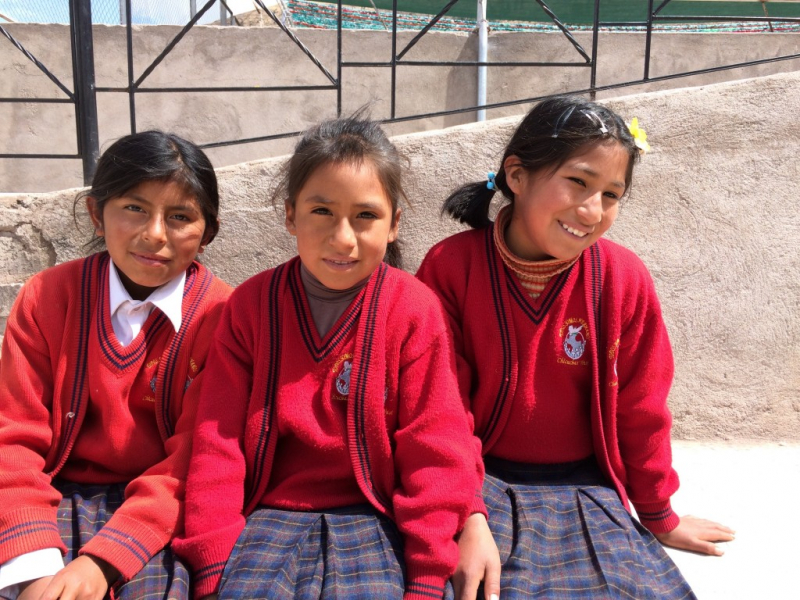
That is also the foundation for the enterprise that created this meaningful program, Viettel, to be recognized by the international community. Recently, Viettel was honored by the ACES Council - one of the leading prestigious organizations in Asia in assessing corporate social responsibility and sustainable development - in the category for enterprises with outstanding community impact.
ACES stressed that the award is only given to initiatives that have a broad impact, create significant social change and have a lasting impact. In ACES’s recognition, the School Internet program was described as “a rare model in Asia that directly enhances the digital capacity of disadvantaged communities through education.”
ACES representative commented: “Viettel’s steadfast commitment to ensuring no one is left behind in the digital age is truly inspiring. From pioneering school internet to education, healthcare, and poverty reduction, Viettel proves that business success can be linked to social progress.”
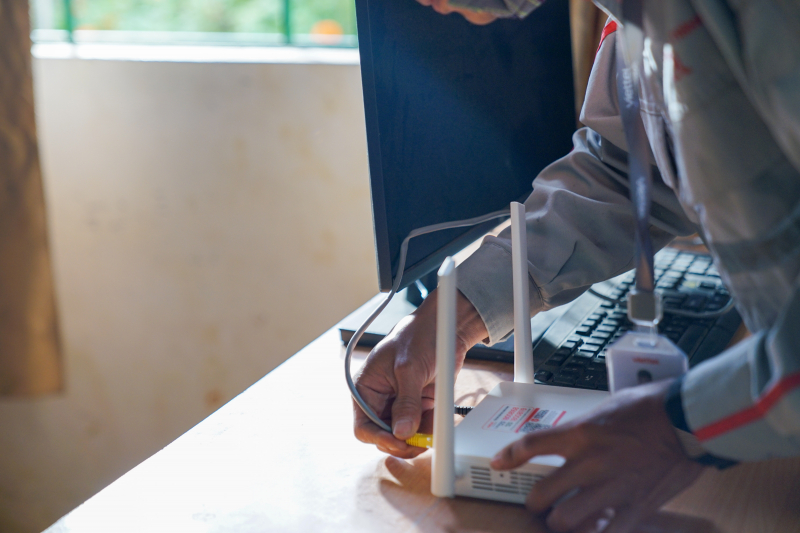
The future of the program lies not only in the continued expansion of transmission lines, but also in the generation of students raised in a fully digital environment. The children who first saw a map of Vietnam on a computer screen have grown up in a world where knowledge is just a tap away.
The ACES award is a milestone, but what is more valuable is the change that is happening quietly every day in classrooms across the country. From the most remote places in Vietnam, Viettel has brought the internet and the world closer, and in doing so, has brought children further on their own path.
Source: https://cand.com.vn/giao-duc/soi-cap-mo-ra-bau-troi-tu-lop-hoc-vung-cao-den-su-vinh-danh-chau-a-i789941/

![[Photo] Parade to celebrate the 50th anniversary of Laos' National Day](/_next/image?url=https%3A%2F%2Fvphoto.vietnam.vn%2Fthumb%2F1200x675%2Fvietnam%2Fresource%2FIMAGE%2F2025%2F12%2F02%2F1764691918289_ndo_br_0-jpg.webp&w=3840&q=75)












![[Photo] Worshiping the Tuyet Son statue - a nearly 400-year-old treasure at Keo Pagoda](/_next/image?url=https%3A%2F%2Fvphoto.vietnam.vn%2Fthumb%2F1200x675%2Fvietnam%2Fresource%2FIMAGE%2F2025%2F12%2F02%2F1764679323086_ndo_br_tempimageomw0hi-4884-jpg.webp&w=3840&q=75)




















































Comment (0)