

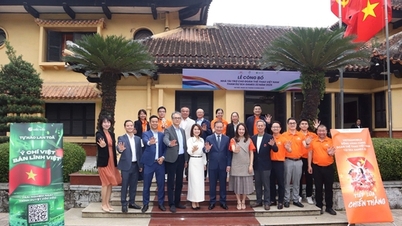
On December 3 in Hanoi, the project “Heritage tourism itineraries in Hanoi” was officially launched to the capital’s residents and tourists. This is an activity within the framework of the EFER-R Patrimoine project, sponsored by the French Ministry for Europe and Foreign Affairs (through the French Embassy and the French Institute in Vietnam – IFV), in coordination with the University of Social Sciences and Humanities – Vietnam National University, Hanoi (USSH – VNU), the French School of the Far East (EFEO) and the Francophone University Organization (AUF).
This initiative aims to introduce and promote the value of Hanoi's tangible, intangible and digital heritage through heritage tourism itineraries, interactive map systems, H-Heritage applications and QR code systems at many relic sites in central Hanoi.
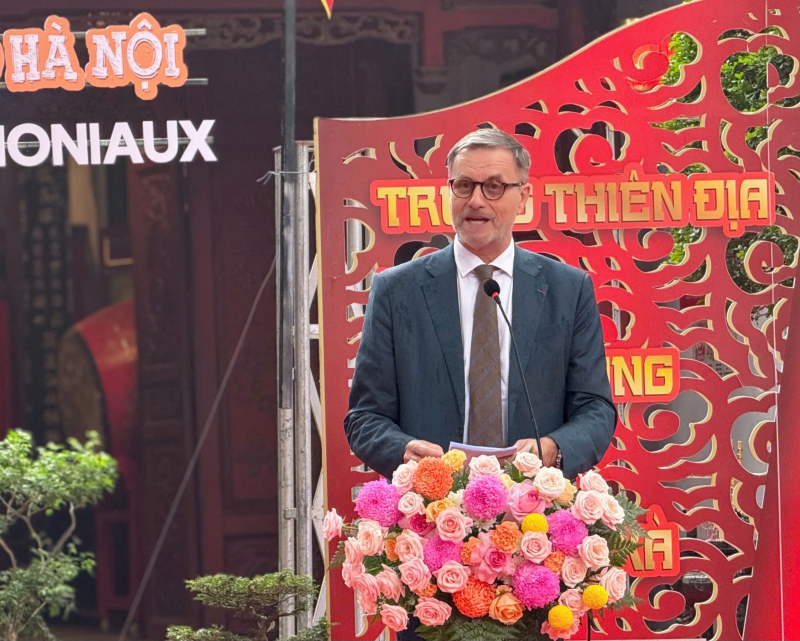
Speaking at the event, French Ambassador to Vietnam Olivier Brochet stated that Hanoi possesses a particularly rich heritage treasure, but access and introduction to the public, especially the youth, has not been convenient and consistent for many years. "The French Institute in Vietnam is very pleased to cooperate with the Hanoi government to honor and bring the unique heritage values of the capital closer to everyone," said Ambassador Olivier Brochet.
According to the Ambassador, the project not only serves tourists but also targets the people of Hanoi: “Hanoi people or young people will have the opportunity to understand and feel their city when walking on each street, when accidentally encountering an ancient pagoda, a French villa, or a historical site. The application helps them immediately find information, what the construction is, what period it belongs to, what events it witnessed. It is like a pocket encyclopedia, always available in everyone's phone.”
The Ambassador emphasized: "Thanks to the application of digital technology, especially the QR code system and interactive maps, Hanoi is gradually becoming one of the pioneering cities in Asia in digitizing heritage data, creating convenient, vivid and intuitive access to information."

As an international technical expert and the leader of this cultural project, Ms. Nguyen Thi Hiep shared that, from the love of heritage, perseverance and serious scientific spirit, the experts surveyed more than 100 ancient relics in Hanoi. A massive archive of documents in French, Han-Nom and Vietnamese was "awakened" from the archives, becoming the foundation to vividly recreate each relic through complete scientific records.
In particular, the project team has selected 28 typical relics to build four heritage tourism itineraries, associated with four traditional beliefs of the Vietnamese people. First, the Thang Long Tu Tran journey - Four guardian gods of the capital. Second, the Mother Goddess temples - the unique Mother Goddess worship of Vietnam. Third, the communal house worshiping the ancestors - the memory of the labor of the prosperous capital. Fourth, the Hanoi pagoda - The mark of the great master's meditation and the transformation of urban Buddhism.
Each journey is a story, reflecting the structure, spirit and memories of Hanoians past and present, allowing users with just a smartphone to "touch history", exploring the cultural depth of Thang Long - Hanoi in the most intuitive way.
The project not only serves the purpose of promoting culture and enhancing tourism experiences, but also provides data for researchers, lecturers, experts, and graduate students; supports cultural knowledge training in schools and extracurricular activities in the locality, raises students' awareness of cultural heritage, and contributes to affirming the role of French-Vietnamese cultural cooperation.
Source: https://cand.com.vn/Chuyen-dong-van-hoa/ra-mat-cac-hanh-trinh-du-lich-di-san-ha-noi-bang-cong-nghe-so-i789966/








![[Photo] Parade to celebrate the 50th anniversary of Laos' National Day](/_next/image?url=https%3A%2F%2Fvphoto.vietnam.vn%2Fthumb%2F1200x675%2Fvietnam%2Fresource%2FIMAGE%2F2025%2F12%2F02%2F1764691918289_ndo_br_0-jpg.webp&w=3840&q=75)
![[Photo] Worshiping the Tuyet Son statue - a nearly 400-year-old treasure at Keo Pagoda](/_next/image?url=https%3A%2F%2Fvphoto.vietnam.vn%2Fthumb%2F1200x675%2Fvietnam%2Fresource%2FIMAGE%2F2025%2F12%2F02%2F1764679323086_ndo_br_tempimageomw0hi-4884-jpg.webp&w=3840&q=75)


















































Comment (0)