

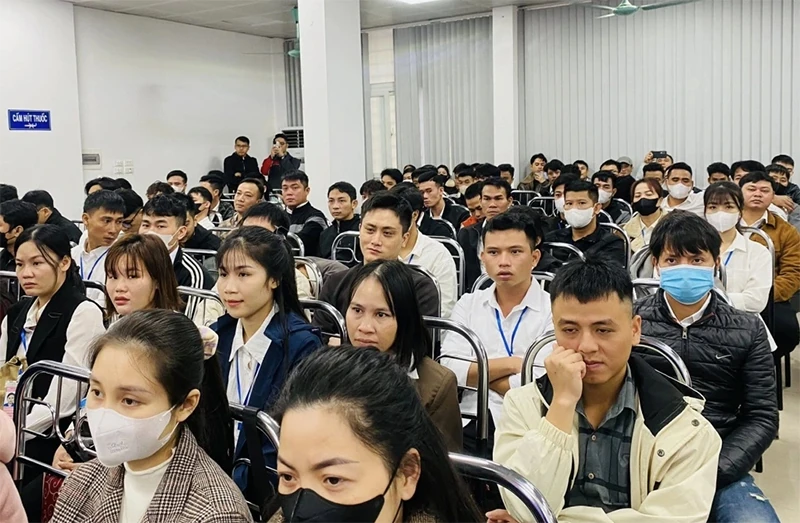
Workers returning from working abroad receive job counseling at the Hanoi Employment Service Center.
Of which, Japan continues to be the largest market receiving Vietnamese workers, with more than 55,000 people. Next is Taiwan (China) with more than 47,000 workers, South Korea with nearly 10,000 workers. In addition, traditional markets and many other markets in the European region such as Germany, Romania, Hungary, Russia... remain stable.
It is estimated that by the end of 2025, the total number of Vietnamese workers working abroad in the 2021-2025 period will reach about 636,000 people, equivalent to 127.3% of the set plan (500,000 people).
Mr. Vu Truong Giang, Acting Director of the Department of Overseas Labor Management ( Ministry of Home Affairs ), assessed that workers working abroad have stable salaries, significantly higher than the income of the same profession and level in the country. Every year, Vietnamese workers abroad send home about 6.5-7 billion USD, making an important contribution to the country's foreign currency resources and improving the economic life of their families. In addition to the results achieved, in the recent period, the field of sending Vietnamese workers to work abroad still has many limitations and difficulties.
Mr. Giang cited that in the Japanese market, the sharp depreciation of the yen has reduced the real income of workers, making it less attractive than before. Although Japan has added a series of policies and opened many new occupations, the complicated recruitment regulations make it difficult for domestic workers who wish to go to Japan to determine which occupation they belong to.
In Korea, the biggest difficulty today is the situation of runaway workers, especially among crew members, because some businesses pay high salaries to attract workers, causing unfair competition.
The Taiwanese market (China) also has a widespread situation of brokers, deeply intervening in the selection and cost stages, causing the cost of going to work to increase. Among the more than 500 businesses in operation, there are still a number of weak-capacity businesses that compete by paying commissions to brokers to win contracts, then charging high fees from workers to compensate.
From the business side, Mr. Nguyen Phong Hai, a recruitment officer at EK Group, also frankly pointed out that many businesses collect fees against regulations, causing workers to have to bear a huge amount of money when exporting labor.
“When you have a large sum of money on your back, you even have to borrow money from everywhere to pay the brokerage company, but when you enter the country, the job is unstable, not as initially advised. This is also the reason why many workers run away hoping to have a higher income, quickly enough to "capitalize".
In the Taiwanese market, workers also have to pay high fees, the amount of money spent to go is much different from the salary received. There are also many people who are eager to leave the country quickly, listen to consultants who do not need to learn the language, and are taken advantage of by brokers, who give widespread advice. On the consultant side, many businesses are willing to pay very high commissions, causing consultants to do whatever it takes to entice workers to register to participate," Mr. Hai said.
Mr. Nguyen Phong Hai said that, to limit the shortcomings in the field of labor export, the state needs to "tighten up" with businesses that violate regulations and collect fees against regulations. In addition, workers also need to choose reputable consulting units as well as be ready to equip themselves with the necessary language and skills to meet the requirements of the labor market, constantly learn and improve their skills to have sustainable jobs.
To overcome the limitations of the labor export market, the Ministry of Home Affairs said that in the coming time, it will deploy many synchronous solutions, first of all, cutting cumbersome administrative procedures, publicizing and making transparent procedures, agreements, and costs so that people can easily access information. The Ministry of Home Affairs will also coordinate with the Ministry of Justice to propose amendments to the Law on Vietnamese Workers Working Abroad and develop a National Strategy on Overseas Labor. The second solution is to step up propaganda about international agreements, procedures, and mechanisms so that people clearly understand the difference between commercial and non-profit contract labor, avoiding being exploited by individuals and brokerage organizations.
In addition, the Ministry of Home Affairs also aims to strengthen education, training, improve vocational skills and behavior so that workers can both develop their skills and comply with the laws of the host country, not becoming a burden for the receiving countries. The Ministry of Home Affairs will also coordinate with the Ministry of Foreign Affairs and consular agencies to protect citizens and promptly handle violations or risks.
In the coming time, the Ministry of Home Affairs will also strengthen digital transformation through the development of national applications such as DOLAB-JICA or job exchanges to give workers more choices.
According to VOV
Source: https://baothanhhoa.vn/nguoi-lao-dong-canh-giac-neu-duoc-tu-van-khong-can-hoc-tieng-khi-di-xkld-270598.htm


![[Photo] Cat Ba - Green island paradise](/_next/image?url=https%3A%2F%2Fvphoto.vietnam.vn%2Fthumb%2F1200x675%2Fvietnam%2Fresource%2FIMAGE%2F2025%2F12%2F04%2F1764821844074_ndo_br_1-dcbthienduongxanh638-jpg.webp&w=3840&q=75)








































![[VIMC 40 days of lightning speed] Da Nang Port: Unity - Lightning speed - Breakthrough to the finish line](https://vphoto.vietnam.vn/thumb/402x226/vietnam/resource/IMAGE/2025/12/04/1764833540882_cdn_4-12-25.jpeg)









































Comment (0)