

This morning, the National Assembly held group discussions on the merger of provinces and a law amending 11 laws related to the field of national defense, including: the Law on National Defense; the Law on Officers of the Vietnam People's Army; the Law on Professional Soldiers, Workers and Civil Servants in National Defense; the Law on Military Service; the Law on Vietnam Border Guard; the Law on People's Air Defense; the Law on Reserve Mobilization Forces; the Law on Civil Defense; the Law on Management and Protection of National Defense Works and Military Zones; the Law on Militia and Self-Defense Forces; and the Law on National Defense and Security Education.
The military has been reorganized in a streamlined, efficient, and effective manner, ensuring compatibility with the two-tiered local government system. Specifically, the district-level military commands have been dissolved, and regional defense commands have been established under the provincial-level military commands. Similarly, the provincial-level Border Guard Command has been dissolved, and a Border Guard Command has been established under the provincial-level military commands.
" In times of peace , we must strive diligently; this land will endure for a thousand years."
General Phan Van Giang, Minister of National Defense, emphasized that the regional defense command is not an administrative level but merely a subordinate unit. The tasks of the district-level military command must be divided among the commune-level military command and the provincial-level military command.
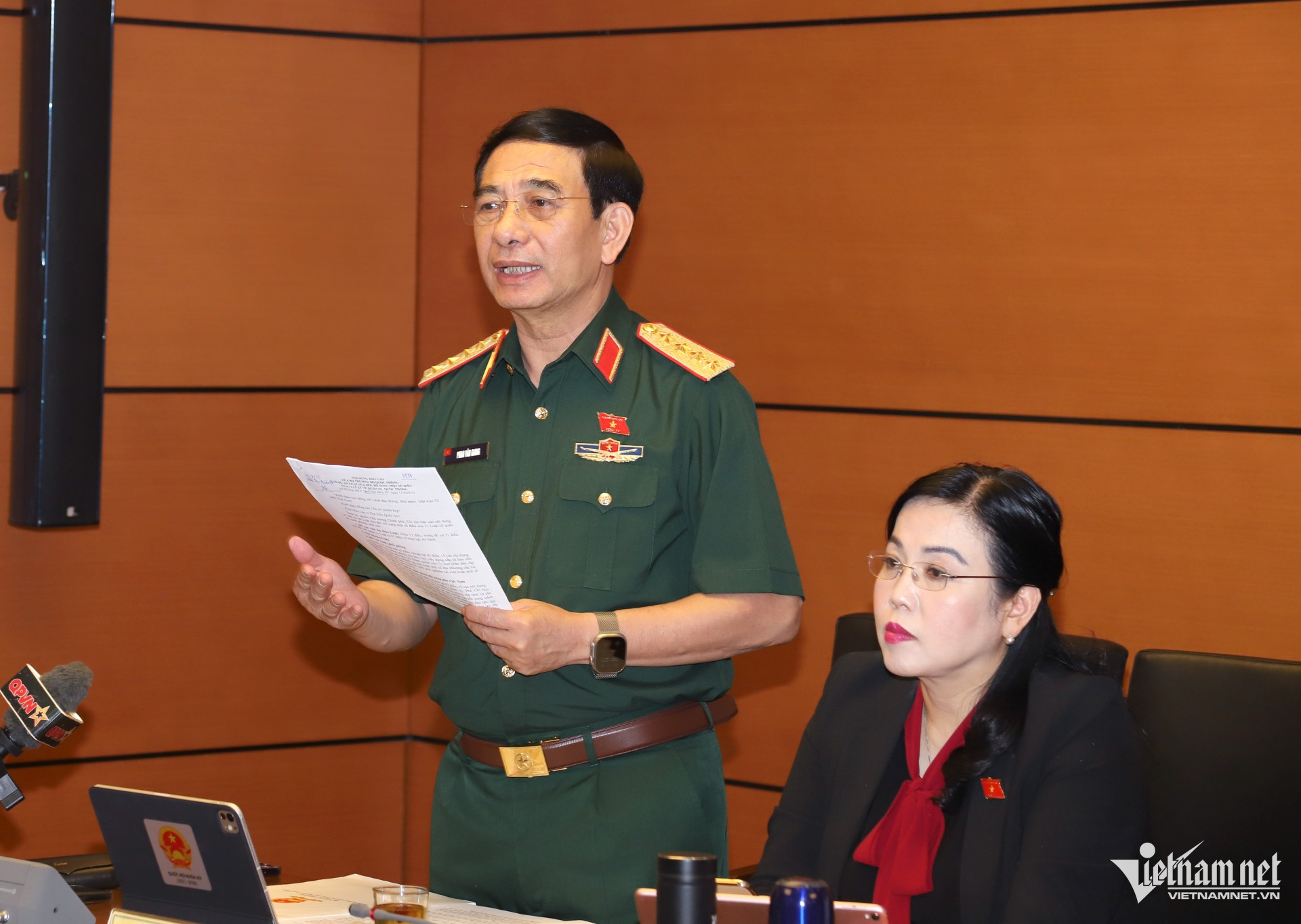
The Minister cited that previously, the authority to call for military service was decided by the district-level military command, but in this revision of the Law on Military Service, it will be transferred to the chairman of the commune People's Committee. "A province can recruit over a thousand soldiers, but now that authority is given to each commune. The number of communes has decreased from 10,035 to 3,321. In some places, 3-4 communes, 2 communes, or 5 communes are merged into one, but on average, there are 3-4 communes, so the responsibility is assigned to the commune chairman," the Minister explained.
Some National Assembly representatives have proposed clarifying the position and authority of the Regional Defense Command to ensure uniformity in position, function, tasks, and authority between the commune-level military command, the regional defense command, and the provincial-level military command.
The Minister of Defense emphasized that the spirit of the law amendment is "to do well in peacetime but to consider what will happen in emergencies... As the old saying goes, 'In times of peace, one should strive hard, for the nation will last for a thousand years.' If we don't prepare, we will be caught off guard, so we must prepare thoroughly, firmly, with many strategies and plans..." From this, General Phan Van Giang stressed the role of the Regional Defense Command when a situation arises.
The Law on Militia and Self-Defense Forces has added air defense and artillery militia platoons to the militia and self-defense force organization. Based on the realities of conflicts and wars around the world, General Phan Van Giang shared that identifying key areas for national defense is not an easy task, while key areas for security can be identified.
The draft law amends the regulations to stipulate that the Commander of the Commune-level Military Command is a civil servant, in order to align with the draft Law on Organization of Local Government and the Law on Cadres and Civil Servants.
The Minister of Defense stated that the officials of the commune-level military command are not yet considered officers, and if necessary, officers from the regional defense command will be sent down to assist the commune in certain tasks. These include training militia and developing plans to designate the commune as a local defense stronghold...
The Minister stated that each commune has approximately 5-7 people in the Military Command Board, and if they were officers, then with over 3,300 communes after the merger, more than 15,000 officers would be needed. The Minister affirmed that this number is not small, so for the time being, the "military stationed in agriculture" system will continue to be applied.
Regarding the provincial merger, some delegates expressed concerns about officials having to relocate to other localities to work, facing difficulties with housing and ensuring a decent life.
The Minister of Defense cited the example of the journey from Dak Nong to Da Lat, Lam Dong, which takes 4 hours by car, while Da Lat is a tourist city with high costs, and officials moving to new workplaces also have to bring their families along.
Therefore, General Phan Van Giang believed that official housing was necessary and that it should be built as quickly as possible to ensure a decent standard of living for officials and civil servants.
Source: https://vietnamnet.vn/bo-truong-quoc-phong-ly-giai-cong-chuc-ban-chi-huy-quan-su-xa-khong-phai-si-quan-2410373.html


![[Photo] Prime Minister Pham Minh Chinh holds a phone call with the CEO of Russia's Rosatom Corporation.](/_next/image?url=https%3A%2F%2Fvphoto.vietnam.vn%2Fthumb%2F1200x675%2Fvietnam%2Fresource%2FIMAGE%2F2025%2F12%2F11%2F1765464552365_dsc-5295-jpg.webp&w=3840&q=75)




























































Comment (0)