

Accelerate the construction of railway lines connecting Vietnam and China .
In his welcoming remarks, Chongqing Mayor Hu Honghua stated that Chongqing and Vietnam have a long-standing historical relationship and close exchanges. Recently, trade and investment cooperation between the two sides has been increasingly strengthened, with vast potential for further collaboration. Several Chongqing enterprises have already invested in Vietnam. Chongqing's automobiles, motorcycles, and electronics products are already present in Vietnam. Meanwhile, many Vietnamese agricultural products are highly favored by consumers in the city of over 30 million people. “We are ready to cooperate with Vietnamese enterprises in all fields to achieve mutual benefit and create a bright future of cooperation between Chongqing and Vietnam,” Mr. Hu Honghua emphasized.
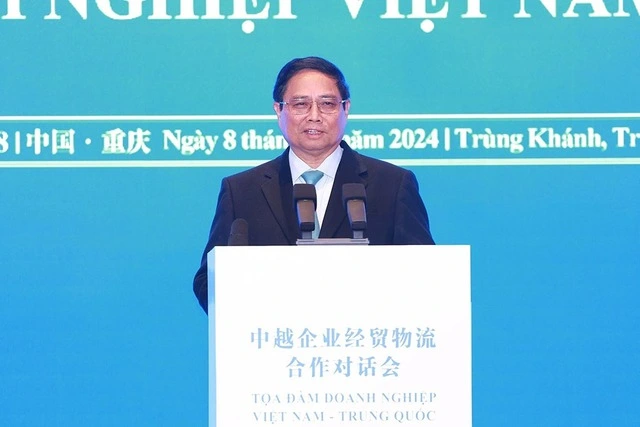
Prime Minister Pham Minh Chinh, speaking at the Vietnam-China business forum, urged businesses from both sides to expand investment cooperation.
At the seminar, businesses from both countries shared potential areas of cooperation and offered specific recommendations and proposals to further promote and expand connectivity between the two economies . Mr. Chu Hong Phi from the Hawei Supply Chain Group in Chongqing stated that while transportation between Vietnam and China is currently convenient, customs clearance procedures need to be improved and simplified to reduce time and costs.
Meanwhile, Mr. Dang Sy Manh, Chairman of the Board of Directors of Vietnam Railways Corporation , pointed out several bottlenecks regarding connecting infrastructure and the lack of warehousing facilities, as well as inconsistent quarantine procedures for agricultural and aquatic products from Vietnam to Chongqing. This has resulted in low production and revenue, long processing times, and high costs compared to capacity and expectations. He suggested that both sides consider recognizing the results of quarantine procedures carried out by the other side to reduce administrative procedures, save time and costs. He also proposed researching the application of a smart border gate model at railway border crossings. Mr. Manh also suggested accelerating cooperation in the deployment of new railway lines connecting the two countries, especially the Lao Cai – Hanoi – Hai Phong railway, so that construction can begin by the end of 2025.
Meanwhile, Le Anh Son, Chairman of the Board of Directors of Vietnam Maritime Corporation, proposed that China expand import ports for agricultural products via both land and sea routes. This would enhance the competitiveness of goods, shorten transit times at border crossings, and streamline customs and quarantine procedures. Reducing transportation time, according to Mr. Son, would also lower logistics costs.
MORE INVESTMENT AND COOPERATION ARE VERY NEEDED
Speaking at the seminar, Prime Minister Pham Minh Chinh emphasized that Vietnam and China have a good traditional friendship, "both comrades and brothers," with a solid political foundation, similar cultural background, favorable legal framework, and open markets. The Prime Minister stated that in recent years, China has invested in Vietnam more than 5,000 projects with a capital of over 30 billion USD. Two-way trade between the two countries reached 173 billion USD in 2023 and 190 billion USD in the first nine months of 2024, an increase of over 14% compared to the same period.
However, the Prime Minister noted that, given the current relationship, trade and investment cooperation between the two countries is still not commensurate. "The potential is enormous, and there are many opportunities. More investment and cooperation are urgently needed," the Prime Minister emphasized.
The Prime Minister also shared that Vietnam pursues an independent and self-reliant foreign and economic policy, in which the economy is identified as the central task, actively integrating and cooperating with the international community in a comprehensive and effective manner. In particular, the Prime Minister emphasized that Vietnam is implementing three strategic breakthroughs: institutions, infrastructure, and human resources, aimed at serving and supporting businesses and investors to reduce costs, increase competitiveness, boost productivity, create new development opportunities, and generate new values and products.
Prime Minister Pham Minh Chinh emphasized the "three interconnected" principles: transparent institutions, seamless infrastructure, and smart governance. He also stressed the importance of the "four together" approach: listening and understanding together; sharing a vision and taking action together; working together, enjoying together, winning together, and developing together; and sharing joy, happiness, and pride together. The guiding principle is harmonious benefits and shared risks; harmonizing the interests of the people, businesses, and the State.
"I very much hope that businesses from both countries will play a connecting role between the two economies," the Prime Minister emphasized, adding that investment and business cooperation between businesses from both countries will benefit the people of both nations. "Together we will develop our countries into strong and prosperous nations," the Prime Minister said. Agreeing with the proposals from businesses of both countries, the Prime Minister affirmed: "Vietnam has been, is, and will do even better to support businesses and investors participating in business and investment in Vietnam."
Research is being conducted on opening more direct flights between Vietnam and Chongqing.
On the morning of November 8th, Prime Minister Pham Minh Chinh met with the Secretary of the Chongqing Municipal Party Committee, Yuan Jiajun, during his working visit to China.
During the meeting, Prime Minister Pham Minh Chinh affirmed that the Vietnamese Government attaches great importance to developing relations with China, supports and is ready to create all favorable conditions for Vietnamese ministries, sectors, and localities to expand and strengthen friendly exchanges and comprehensive cooperation with Chongqing City.
Prime Minister Pham Minh Chinh proposed promoting exchanges of delegations at all levels and in all sectors, further enhancing mutual understanding between Vietnam and Chongqing. The Prime Minister also requested that relevant Chongqing authorities create favorable conditions for Vietnamese businesses to effectively utilize the China-Europe international railway line, enabling the export of Vietnamese goods to third countries and the import of more high-quality Vietnamese products.
In addition, both sides need to expand bilateral trade; further promote cooperation in tourism, culture, education, people-to-people exchanges, and local cooperation. In particular, the Prime Minister suggested actively studying the possibility of opening more direct flights between Chongqing and major localities in Vietnam to facilitate exchanges and travel for people from both sides.
For his part, Mr. Yuan Jiajun affirmed that he would closely coordinate with Vietnamese ministries, departments, and localities to effectively implement the suggestions of Prime Minister Pham Minh Chinh, especially to efficiently utilize the China-Europe international railway line and increase imports of high-quality Vietnamese goods.
The Prime Minister successfully concluded his working visit to China.
On the evening of November 8th, Prime Minister Pham Minh Chinh and the high-level Vietnamese delegation arrived back in Hanoi, concluding their working trip to China to attend the 8th GMS Summit, the 10th ACMECS Summit, the 11th CLMV Summit, and to work in China.
Deputy Minister of Foreign Affairs Pham Thanh Binh said that at the conferences, Prime Minister Pham Minh Chinh had made very insightful and heartfelt assessments and observations, while also suggesting new ways of thinking, approaches, ideas, and practical proposals to create a breakthrough in the development of all three cooperation mechanisms.
The Prime Minister proposed that the GMS focus on developing next-generation economic corridors with innovation at its core; ACMECS define its new mission as building a united, strong, and sustainably developed Mekong community; and the new focus of CLMV is to create breakthroughs based on leveraging internal strengths combined with external forces and solidarity to overcome difficulties.
In addition, the Prime Minister also outlined important principles and guidelines to promote more effective cooperation and better meet the needs of the members. "The delegates were very impressed with the Prime Minister's views on valuing time, valuing intellect, innovation for breakthroughs, creativity for advancement, integration for progress, and unity for greater strength," Mr. Binh said.
According to the Deputy Minister of Foreign Affairs, during the trip, the Prime Minister had 19 bilateral activities. In the talks and exchanges between Prime Minister Pham Minh Chinh and Chinese Prime Minister Li Qiang and leaders of Yunnan, Chongqing, and Guangxi provinces, both sides reached many important common understandings on continuing to implement and concretize high-level common understandings, promoting the relationship between Vietnam and China, including with Chinese localities, to develop increasingly effectively, substantively, and sustainably.
Thanhnien.vn
Source: https://thanhnien.vn/day-manh-hop-tac-dau-tu-doanh-nghiep-viet-nam-trung-quoc-185241108225045158.htm


![[Image] Vietnam's colorful journey of innovation](/_next/image?url=https%3A%2F%2Fvphoto.vietnam.vn%2Fthumb%2F1200x675%2Fvietnam%2Fresource%2FIMAGE%2F2025%2F12%2F14%2F1765703036409_image-1.jpeg&w=3840&q=75)











































![[Image] Vietnam's colorful journey of innovation](https://vphoto.vietnam.vn/thumb/402x226/vietnam/resource/IMAGE/2025/12/14/1765703036409_image-1.jpeg)





















Comment (0)