

.jpg)
Tourists visit the Po Rome Tower in Hau Sanh village, Phuoc Huu commune (Ninh Phuoc district, Ninh Thuan province).
Architectural and sculptural heritage of temples and towers.
Champa temple complexes are built throughout the South Central Coast and Central Highlands provinces. The deities worshipped in these temples include Hindu gods such as Brahma, Vishnu, Shiva, the divine bull Nadin, and the Linga-Yoni symbols. Additionally, there are goddesses, deities, sacred animals, and national heroes who were deified by the Champa people after their death. Regarding religious architecture, there are two major sacred sites: My Son Sanctuary ( Quang Nam ) and Cat Tien Sanctuary (Lam Dong). In Ninh Thuan and Binh Thuan, the Champa people also hold annual ceremonies at the Po Klaong Garay and Po Ramê temples (Ninh Thuan), and the Po Dam and Po Sah Anaih temples (Binh Thuan).
The temples and towers in Ninh Thuan and Binh Thuan provinces are celebrated as living cultural heritage. The Hoa Lai and Po Klaong Garay temples and towers were awarded the title of Special National Monument by the Prime Minister in 2016. These Cham temples and towers possess historical, architectural, and sculptural value, placing them on par with Angkor Wat in Cambodia, Wat Phu in Laos, and Borobudur in Indonesia. To promote the value of Cham cultural heritage, these temples and towers have been selected as destinations to be showcased to domestic and international tourists, contributing to the development of local tourism. Furthermore, these temple and tower sites are attractive cultural and spiritual tourism destinations, creating a bridge and linking the development of cross-national tourism.
Religious and cultural heritage
The Cham people have adopted many religions, forming a unique and diverse cultural identity. These include the Cham Brahman community, the Cham Bani community, and the Cham Muslim community.
According to the 2019 Population and Housing Census, the Cham population is 178,948 people. Of these, 64,547 are Cham followers of the Brahman religion. In Ninh Thuan, the Cham Brahman community lives in 15 palei (equivalent to villages). The main economic activities of the Cham people are rice farming and livestock breeding. In their cultural life, the Cham Brahman people still preserve many traditional festivals and ancestor worship customs. Every year, religious leaders such as Po Adhia (the head priest, abbot of the temple), Pajau (the medium), Kadhar (the kanyi player and hymn singer), and Camanei (the temple caretaker, who manages the ceremonial attire and performs the ritual bathing of the deity statue) open the temple gates for devotees to bring offerings to the deities.
Besides worshipping deities in temples and towers, the Cham Brahman people also practice many religious customs related to agricultural rituals. Among them is the worship of the Rice Goddess, which the Cham people revere as the mother of abundance and happiness. The worship of the rice goddess is not only found in the cultures of ethnic groups in Vietnam, but also in Southeast Asian countries with rice-based agricultural production.
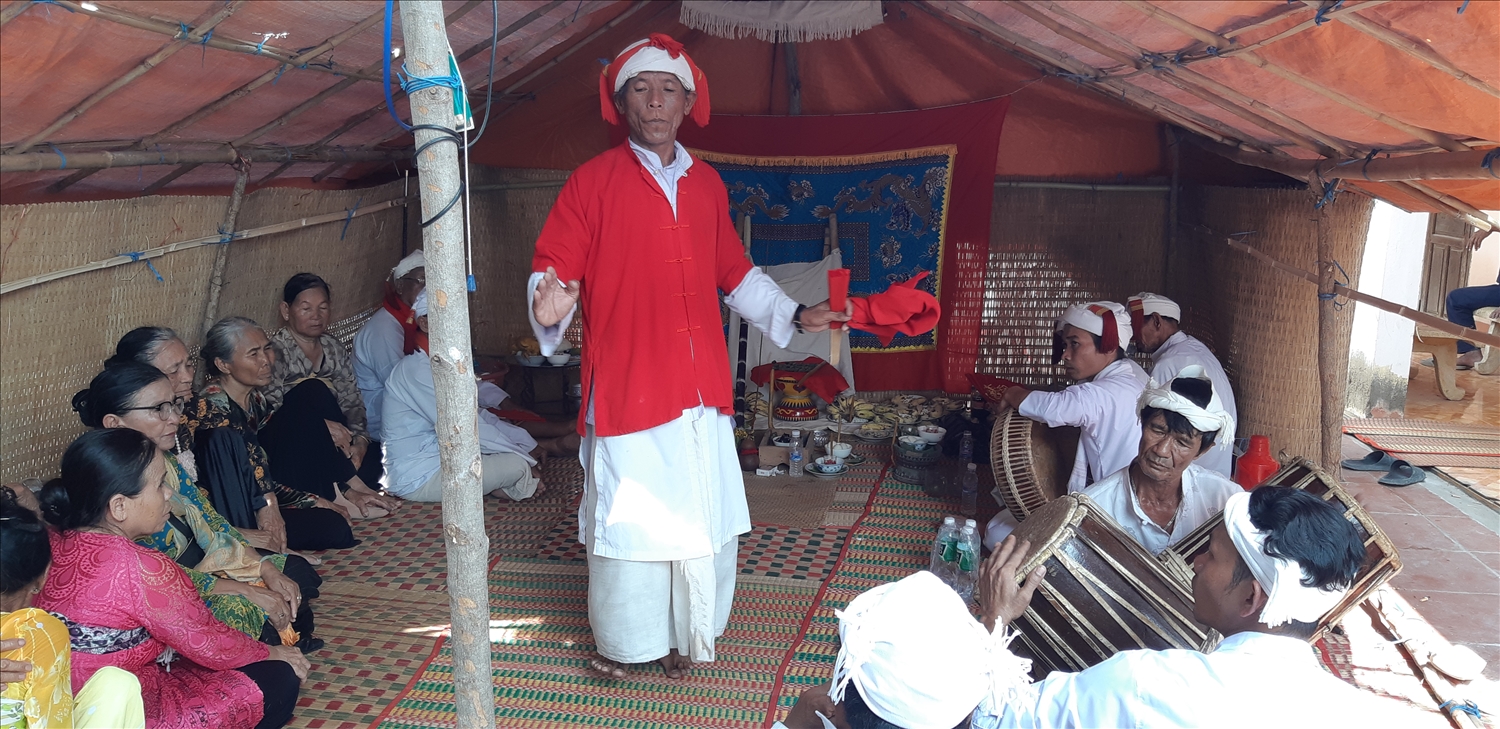
Celebrating dances at the Rija Nagar Festival in Huu Duc village, Phuoc Huu commune, Ninh Phuoc district, Ninh Thuan province.
The Cham Bani community lives in Ninh Thuan and Binh Thuan provinces. Each village builds a mosque (Sang magik) for believers to worship and perform rituals. The main object of worship for the Cham Bani is Allah, pronounced Awluah in the Cham language. Alongside the worship of the supreme being Awluah, the Cham Bani also practice ancestor worship (Éw muk kei) and the Yang deities belonging to the pantheon of gods in the temple towers. This is a unique characteristic still practiced by the Cham Bani in Ninh Thuan and Binh Thuan. Each clan appoints a representative to serve as an Acar (a religious leader) to practice asceticism, learn Arabic through the Quran, participate in mosque rituals, and handle marriage and funeral arrangements for the clan.
The Acar religious hierarchy is divided into several ranks from lowest to highest, including: Acar, Madin, Katip, Imam, and Po Gru, who is the head of the religious hierarchy. Po Gru holds the supreme role in managing and directing all activities related to the beliefs and religion of the Cham Bani people. Each mosque has a Po Gru in charge, and only when a Po Gru dies is another Po Gru appointed to replace them. Besides religious activities at the mosque, the Cham Bani people also organize the New Year festival (Rija Nagar) and dances within the Rija ritual system. Although the Cham Bani community does not identify themselves as Muslim, they still practice the worship of the supreme being Awluah, preserve the Quran written in Arabic, and observe fasting during the month of Ramadan like Muslims worldwide. This identity reflects the unique characteristics of the Cham people in their adaptation of Islamic culture in Southeast Asia.
The Cham Muslim community is concentrated in the provinces of An Giang, Tay Ninh, Ho Chi Minh City, Dong Nai, and Ninh Thuan. In Ninh Thuan, Islam only began to develop in the early 1960s. Currently, Ninh Thuan has four mosques (Masjid), named in order of mosque numbers 101, 102, 103, and 104. Cham Muslims have close ties with the international Islamic community, particularly in the Middle East, Indonesia, and Malaysia.
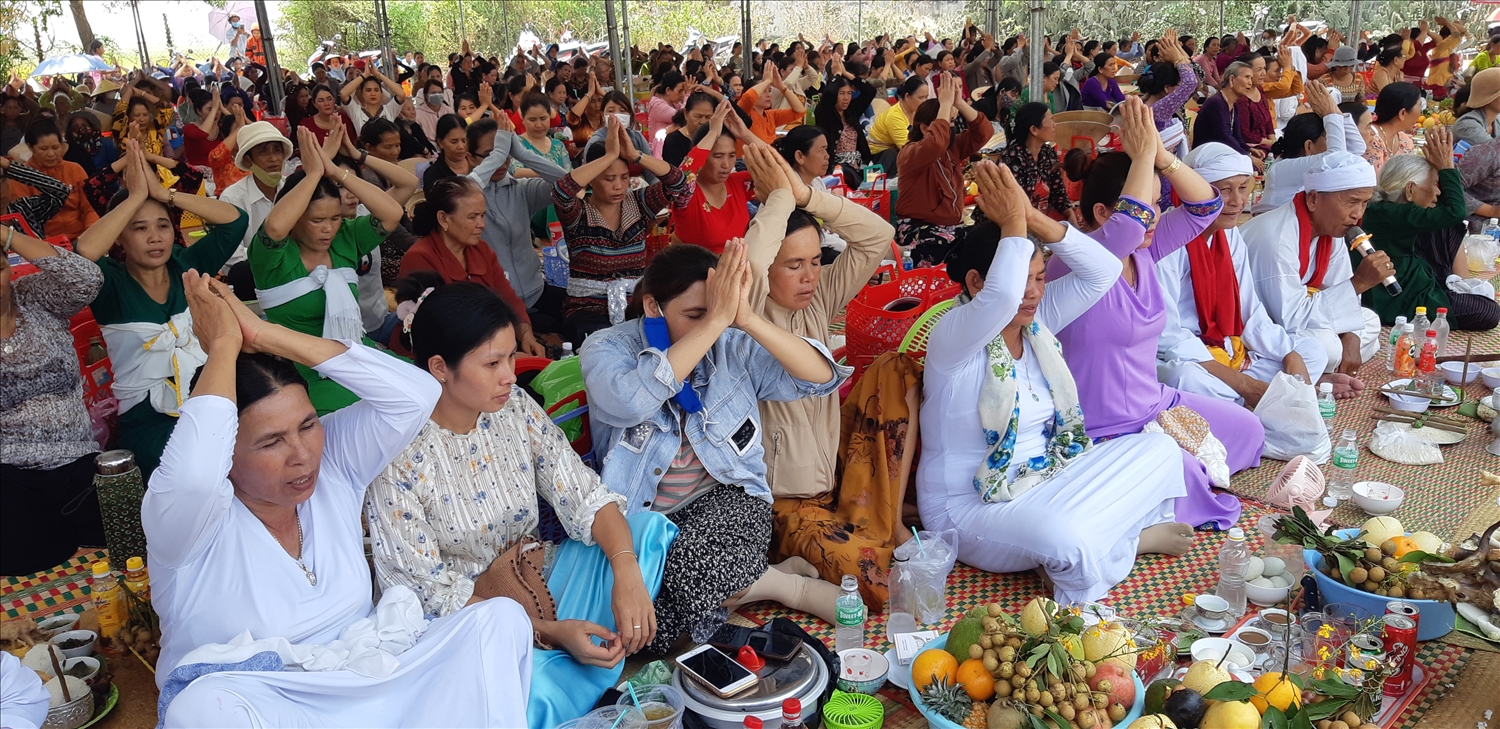
The Cham people bring offerings to the Rija Nagar festival.
The cultural and religious diversity within the Cham community in Vietnam provides a favorable means for economic, cultural, and educational integration with the ASEAN community. Cham Muslims have access to education in Indonesia, Malaysia, and the Arab world through overseas study. After completing their studies, these students have opportunities to find employment in the Middle East, Southeast Asia, or work for foreign companies in Vietnam, or for embassies of countries sharing the same Islamic religion. Therefore, the Islamic community itself connects with the ASEAN community in the economic, cultural, and educational fields. At the same time, the Cham Muslim community in Vietnam serves as a focal point for ASEAN countries to visit, promoting tourism development in the region.
In addition to the aforementioned heritage sites, the Cham people also possess a system of festival heritage at their temples and kinship rituals. The most prominent are the Katê Festival, the Ramâwan Festival, and the Rija Nagar Festival. Exploiting and promoting Cham cultural values as a bridge to connect with the ASEAN community is the shortest and most convenient path to integration and development.
Source: https://baodantoc.vn/di-san-van-hoa-cham-tiem-nang-lon-de-phat-trien-du-lich-1687838691408.htm



![[Photo] Closing Ceremony of the 10th Session of the 15th National Assembly](/_next/image?url=https%3A%2F%2Fvphoto.vietnam.vn%2Fthumb%2F1200x675%2Fvietnam%2Fresource%2FIMAGE%2F2025%2F12%2F11%2F1765448959967_image-1437-jpg.webp&w=3840&q=75)




































![[OFFICIAL] MISA GROUP ANNOUNCES ITS PIONEERING BRAND POSITIONING IN BUILDING AGENTIC AI FOR BUSINESSES, HOUSEHOLDS, AND THE GOVERNMENT](https://vphoto.vietnam.vn/thumb/402x226/vietnam/resource/IMAGE/2025/12/11/1765444754256_agentic-ai_postfb-scaled.png)































Comment (0)