

South Korea announces new National Security Strategy, Finland's Foreign Minister runs for president… these are some of the notable international news stories from the past 24 hours.
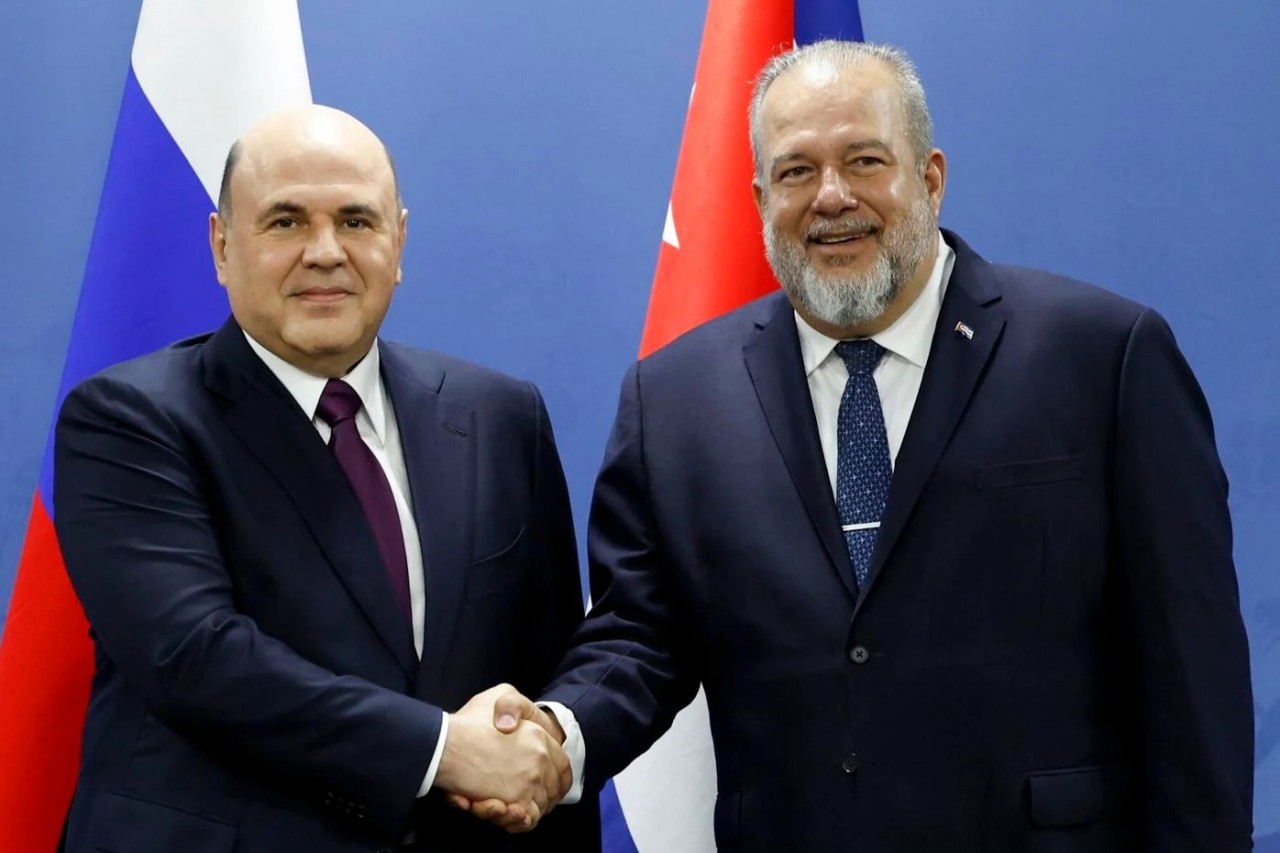 |
| Cuban Prime Minister Manuel Marrero Cruz met with his Russian counterpart Mikhail Mishustin during his visit to Russia from June 6-17. (Source: WVNews) |
The World & Vietnam newspaper highlights some of the day's most prominent international news.
Russia-Ukraine
* Russia accuses Ukraine of destroying the Kakhovka dam at the ICJ: On June 8, speaking at the International Court of Justice (ICJ) of the United Nations regarding the collapse of the Kakhovka dam in southern Ukraine, controlled by Russia, following a "large-scale" shelling, Russian diplomat Alexander Shulgin said: "The Kiev authorities not only carried out large-scale shelling of the Kakhovka dam on the night of June 6, but also deliberately raised the water level of the Kakhovka reservoir to a dangerous level beforehand." (AFP)
* Ukrainian President visits Kherson after Kakhovka dam collapse: On June 8, the Ukrainian leader announced that he had visited the flooded southern part of Kherson following the Kakhovka dam collapse. Posting on Telegram , he wrote: “We discussed many important issues. The actual situation in the disaster area (dam collapse), evacuation of people from flood-prone areas, lifting the state of emergency following the dam collapse, organizing flood relief efforts... prospects for restoring the region's ecosystem and the military situation in the disaster area.”
Meanwhile, speaking on television, Ihor Syrota, General Director of Ukrhydroenergo, the state-owned company overseeing the Kakhovka hydroelectric power plant, said: “The reservoir water is nearing a dangerously low level of 12.7 meters, after which there will be no water for the cooling ponds at the Zaporizhzhia plant or for all the surrounding areas.” However, the Ukrhydroenergo official said the company is ready to repair the hydroelectric plant and the dam as soon as possible, once Russian troops leave the eastern part of Dnipro. This process will take about two months.
Earlier that day, Ukraine's nuclear power company said the situation at the Zaporizhzhia nuclear power plant was "stable and under control."
For its part, the International Red Cross Committee warned of the risk of landmines detonating due to rising floodwaters following the Kakhovka dam collapse. Erik Tollefsen, head of the agency's Mine Action Control Unit, stated: “Previously, we knew where the dangers were. Now we don’t know. All we know is that they are somewhere downstream.” The expert suggested that landmines could still be lying in the riverbed or stuck in the mud, or in fields, gardens, and roads across a wide area.
Meanwhile, Russian-backed sources in the Kherson region believe the landmines could easily be found in flooded towns and villages. (Reuters)
* France, Czech Republic, and Brazil plan aid for Ukraine following Kakhovka dam collapse : On June 7th, writing on Twitter , French President Emmanuel Macron said: “I send to Ukrainian President Volodymyr Zelensky my solidarity with the Ukrainian people following the attack on the Kakhovka dam.” The leader also affirmed: “In the next few hours, we will send aid to meet the immediate needs.”
Meanwhile, the Czech newspaper Lidovky quoted Prime Minister Petr Fiala as saying that Prague “has decided to provide aid to Ukraine” in connection with the dam collapse and that “the (Czech) Ministry of Defence will provide Ukraine with what it currently needs to address the problems related to this disaster.”
According to media reports, the aid will include life vests and life jackets, water pumps, and drinking water supplies. Meanwhile, the country's Foreign Minister Jan Lipavsky said Prague would allocate 10 million Koruny ($430,000) in aid to Ukraine.
Also on June 7, the Brazilian Foreign Ministry announced that the country was ready to provide assistance to mitigate the consequences of the Kakhovka dam collapse in Ukraine. (Sputnik)
* Wagner sets conditions to prevent Ukrainian counterattack: On June 7, Yevgeny Prigozhin, founder of the Wagner private military corporation, stated: “I say I need 200,000 men. Fewer than 200,000 on the Lugansk-Donetsk front line will be insufficient. We are prepared to take full responsibility.” He expressed concern that Ukrainian troops could regain territories currently controlled by Russia.
The head of Wagner Group stated that the corporation is currently the only official military structure possessing all the necessary components for combat operations, including aircraft, helicopters, tanks, and artillery. He argued that the main issue now is the supply of weapons and ammunition to the army. According to him, despite the presence of trained fighters, the most crucial factor for the success of the operation will be the ability to provide the appropriate weapons and ammunition. (VNA)
* Russia : US pressured Ukraine to leave negotiations : On June 8, Russian Security Council Secretary Nikolai Patrushev referred to the March 2022 peace talks in Turkey: “Without US pressure on Ukraine, this situation would not have occurred. The Ukrainian leaders themselves were ready to sign a peace treaty and presented Russia with written proposals which we accepted in principle.”
The senior official also stated: “In the morning, they (members of the Ukrainian delegation) presented us with proposals during the negotiations, and in the evening, they said: 'No, we are abandoning them.' This happened simply because the US pressured them and said there was no need to hold negotiations.” (TASS)
| RELATED NEWS | |
 | Kakhovka Dam Collapse: President Zelensky personally visits the site; Russia accuses Ukraine at the Court of Justice. |
Southeast Asia
* Singapore presidential election gains another candidate : On June 8th, Senior Minister and Chairman of the Monetary Authority of Singapore, Tharman Shanmugaratnam, informed Prime Minister Lee Hsien Loong that he would step down from all current government positions.
This decision stems from the politician's intention to run for President of Singapore in the election scheduled for September 13th. Currently, Tharman Shanmugaratnam serves as the Chairman of the Monetary Authority of Singapore (MAS) and holds other ministerial responsibilities.
For his part, Prime Minister Lee Hsien Loong said he understood the decision and considered it "consistent with the spirit of community service and sense of responsibility that Mr. Tharman has demonstrated over the years." (VNA)
| RELATED NEWS | |
 | World's most expensive cities: Hong Kong (China) drops in ranking, Singapore unexpectedly rises. |
South Asia
* Foreign Minister Jaishankar: India stands firm against pressure : On June 8, speaking at a press conference on foreign policy, Foreign Minister S Jaishankar affirmed that after nine years of Prime Minister Narendra Modi's rule, India remains unshaken by coercion, incitement, and false narratives.
He cited India's approach to the situation along the northern border and its opposition to China's Belt and Road Initiative. Foreign Minister Jaishankar argued that India and China must find a way to withdraw their troops.
In addition, Foreign Minister Jaishankar stated: “The second image of India is that of an economic partner… The world, especially the Southern Hemisphere, sees India as an effective and reliable development partner through practical actions.” He noted that India is creating a significant economic impact and is globally recognized. (VNA)
| RELATED NEWS | |
| Indian Prime Minister makes first visit to Egypt. |
Northeast Asia
* Russia speaks out on Japan's wastewater discharge plan : On June 7, Russian Foreign Ministry spokeswoman Maria Zakharova expressed concern about the plan to discharge wastewater from the Fukushima nuclear power plant and urged Japan to inform its neighbors about its actions to address the potential radiation threat.
The Russian diplomat also emphasized the importance of transparency and demanded access to information and water samples if necessary. She noted that Japan has not yet been open to addressing these concerns, and that Moscow has sent a list of questions to Tokyo requesting clarification on the water release plan.
Previously, Japan asserted that the planned release of radioactive water posed no significant threat to the environment or the health of people in the area. (Xinhua News Agency)
* Japan protests Chinese Navy ships entering its territorial waters : On June 8, Chief Cabinet Secretary Matsuno Hirokazu said Tokyo had expressed “strong concern” and sent a protest note to Beijing after the Chinese Navy entered Japanese waters near Yakushima Island. He also said two Chinese coast guard ships had entered the Diaoyu/Senkaku Islands area and attempted to approach a Japanese fishing vessel. (Reuters)
* South Korea proactively improves relations with Japan: On June 7, Seoul announced its first National Security Strategy under President Yoon Suk Yeol. In the new strategy, the country views Tokyo as an important neighbor and seeks cooperation in areas including national security and the economy. The strategy calls for the two countries to frankly confront the past and build a new future, reiterating the spirit of the 1998 Japan-South Korea Joint Declaration.
The document also marks a shift in President Yoon's stance on North Korea. While the previous administration emphasized a peaceful resolution of differences, the latest strategy identifies Pyongyang's nuclear weapons capability as the "most urgent" threat to Seoul. The document also underscores the importance of South Korea being able to ensure its ability to deter threats, launch preemptive strikes, and retaliate in large-scale attacks when necessary. (Yonhap)
| RELATED NEWS | |
| Russia and China deploy fighter jets for joint patrols; South Korea and Japan voice concerns. |
Central Asia
* Tajikistan will not join the Eurasian Economic Union : On June 7, the country's Foreign Ministry announced that Dushanbe had refused to join the Eurasian Economic Union (EAEU) because it did not see clear benefits for itself within the organization. A representative of the Tajik Foreign Ministry also stated that the possibility of Tajikistan integrating into the EAEU had not been discussed at recent meetings, specifically the June 6 meetings between Foreign Minister Lavrov and the host country's President Emomali Rahmon, and with Tajik Foreign Minister Sirojiddin Muhriddin.
Previously, Russian Foreign Minister Sergei Lavrov had expressed hope that Tajikistan would join the bloc. (VNA)
| RELATED NEWS | |
| French scholar: Where does Kazakhstan stand in Sino-Russian relations? |
Europe
* Russia: Togliatti- Ode pipeline explosion negatively impacts grain deal : On June 8, Kremlin spokesman Dmitry Peskov told reporters, "This is another incident that really complicates the situation regarding the extension of this agreement."
The Togliatti-Odessa pipeline transports fertilizer from Russia to Ukraine. Resuming Russian fertilizer exports via this route is one of the conditions Moscow has set for continuing the Black Sea grain agreement.
However, on June 7, Russia said a group of Ukrainian "saboteurs" had blown up a section of the Togliatti-Odessa pipeline. For their part, Kyiv officials accused Moscow's forces of firing on the 2,500-kilometer pipeline. (AFP)
* Finnish Foreign Minister announces presidential candidacy : On June 8th, Pekka Haavisto announced his intention to run for president in next year's election.
Speaking at a press conference, the Finnish Foreign Minister explained: “Recently, many Finns from different places have contacted me and urged me to run in the presidential election next January.” This would be the third attempt by Mr. Haavisto, a member of the Green Party, to become Finland’s head of state, after finishing second in the 2012 and 2018 elections . (Reuters)
| RELATED NEWS | |
| Newly joined NATO, Finland announces the expulsion of nine Russian diplomats. |
America
* Cuba assesses the US stance on Russia: On June 7, during talks with his Russian counterpart Mikhail Mishustin, Cuban Prime Minister Manuel Marrero Cruz stated that the first stop for the High Representative for Security and Foreign Policy and Vice President of the European Commission, Josep Borrell, during his visit to Havana last May was the US Embassy. Borrell also repeatedly mentioned Russia in his speeches during his trip to Cuba. Prime Minister Marrero Cruz emphasized that following the Russia-Cuba business forum last month in Havana, a smear campaign against both countries is underway in the United States.
The Cuban Prime Minister is currently on an official visit to Russia from June 6-17. He is expected to participate in the meeting of the Eurasian Intergovernmental Council in Sochi, the International Economic Forum in Saint Petersburg, and sign several important agreements with his Russian counterparts.
The traditional alliance was further strengthened last month when both countries agreed to boost Russia's business and financial presence in the Caribbean island nation through tariff exemptions, 30-year land leases, and banking system connections. Agreements reached within the framework of a bilateral business and economic forum held in the Cuban capital also promise to pave the way for Russian investors to participate in several strategic sectors of the Caribbean nation.
In less than six months, Russian Foreign Minister Sergei Lavrov, Chairman of the State Duma Vyacheslav Volodin, Presidential economic advisor Maxim Oreshkin, Secretary of the Security Council Nikolai Patrushev, and Rosneft CEO Ígor Sechin, along with many other Russian officials, have visited Cuba. (VNA)
| RELATED NEWS | |
| The Iranian president is about to travel to three Latin American countries. |
Middle East-Africa
* Iran comments on missile launches: On June 7, Iranian Foreign Ministry spokesman Nasser Kanaani emphasized that the Islamic Republic's missile activities are normal, defensive, and legitimate based on international law.
He rejected claims of interference from some Western countries regarding the Fattah missile. The Iranian diplomat emphasized that these countries, with their long history of violating international commitments on nuclear testing, the nuclear non-proliferation mechanism, atomic missiles, and destructive regional and international involvement, have no right to comment on Iran's legitimate defense capabilities.
Mr. Nasser Kanaani also noted that the signing of the AUKUS agreement by the US, UK, and Australia represents a discriminatory approach by nuclear powers in the transfer of technology and highly enriched uranium, and is contrary to the Nuclear Non-Proliferation Treaty (NPT).
The diplomat also praised the efforts of the Islamic Republic's armed forces in building and strengthening effective deterrence capabilities in the face of foreign threats and protecting national security. (IRNA)
Source
![[Photo] Closing Ceremony of the 10th Session of the 15th National Assembly](/_next/image?url=https%3A%2F%2Fvphoto.vietnam.vn%2Fthumb%2F1200x675%2Fvietnam%2Fresource%2FIMAGE%2F2025%2F12%2F11%2F1765448959967_image-1437-jpg.webp&w=3840&q=75)


































![[OFFICIAL] MISA GROUP ANNOUNCES ITS PIONEERING BRAND POSITIONING IN BUILDING AGENTIC AI FOR BUSINESSES, HOUSEHOLDS, AND THE GOVERNMENT](https://vphoto.vietnam.vn/thumb/402x226/vietnam/resource/IMAGE/2025/12/11/1765444754256_agentic-ai_postfb-scaled.png)





































Comment (0)