

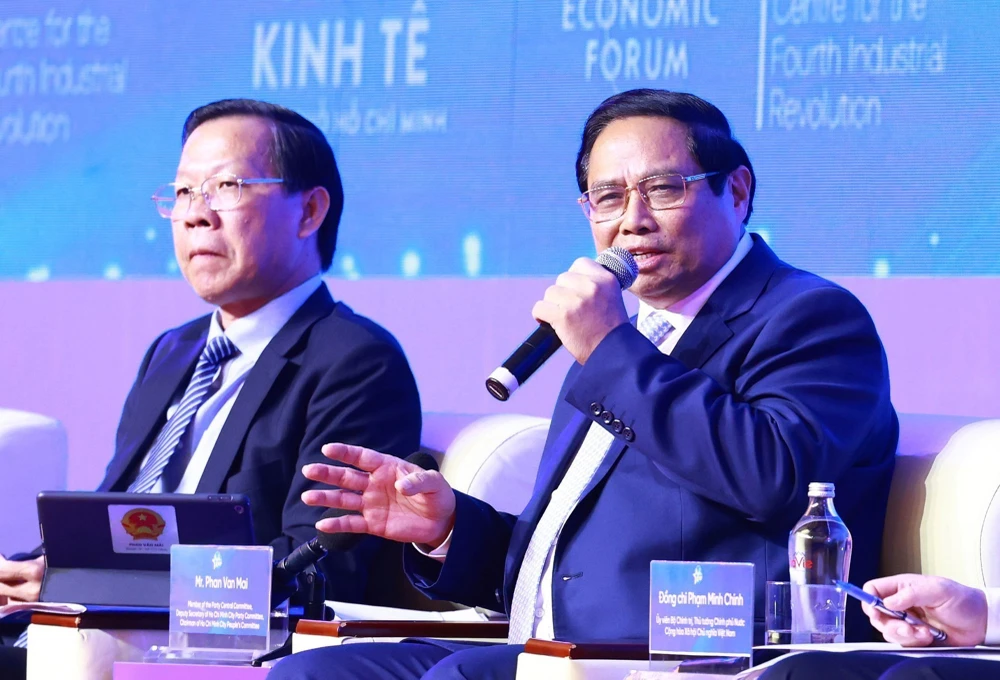
Within the framework of the Ho Chi Minh City Economic Forum 2024, on the afternoon of September 25th, Prime Minister Pham Minh Chinh chaired the policy dialogue session. The message delivered by the Prime Minister reflected the Government's determination to transform the economy to adapt and integrate with global development.
Attending the opening ceremony and plenary session were: Prime Minister Pham Minh Chinh; Secretary of the Ho Chi Minh City Party Committee Nguyen Van Nen; Chairman of the Ho Chi Minh City People's Committee Phan Van Mai; leaders of central ministries, departments, agencies, provinces and cities; representatives from many countries, localities of countries, diplomatic and consular agencies, international organizations; and many experts, businesses, and domestic and international investors.
The green development legislation is complete.
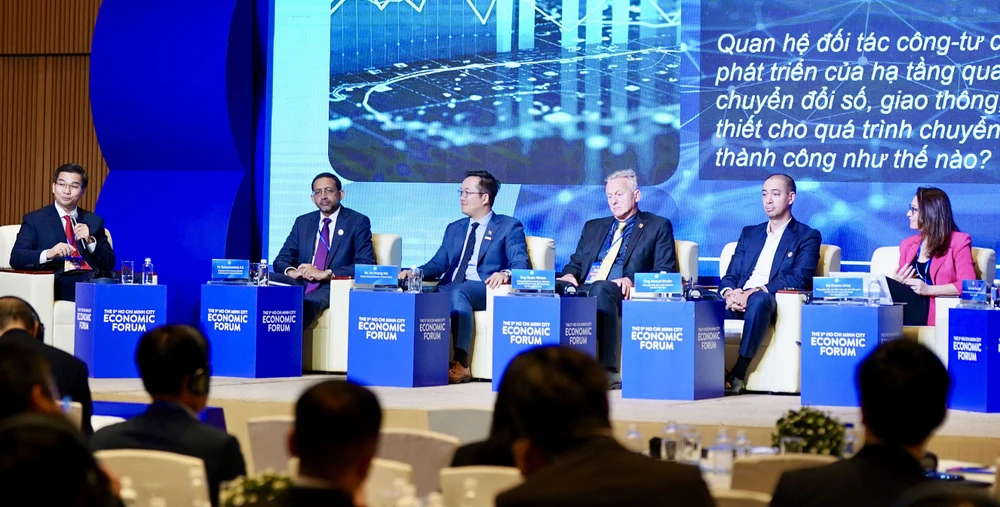
Moderating the dialogue session, Dr. Tran Du Lich raised the following issues: What is the government doing and what will it do to accelerate and complete the ecosystem for industrial transformation? What breakthrough policies will be implemented next to promote the development of the science and technology market? Another issue of concern to many businesses was the legal framework for the development of clean energy and green transportation transformation.
Representatives from various ministries and agencies attending the forum affirmed that bottlenecks would soon be removed through policies issued in the near future. Deputy Minister of Planning and Investment Tran Quoc Phuong stated that regulations, criteria, standards, and norms for identifying green businesses and green projects have been finalized. These provide a solid legal basis to encourage businesses to implement green transformation and digital transformation. In addition, a fund will be established in the near future to support investment in businesses in the fields of innovation, digital transformation, and green transformation.
In the field of science and technology, Deputy Minister of Science and Technology Le Xuan Dinh informed that the Ministry is developing a Law on Science, Technology and Innovation. This draft law focuses on socializing resources to promote the development of science and technology, mainly in the non-state sector, so that businesses have sufficient capacity to absorb technology and innovate. With this legal framework, businesses can establish a science and technology development fund to create conditions for attracting human resources and technology, contributing to increasing the endogenous capacity of businesses.
Deputy Minister Le Xuan Dinh added that the government is currently amending the decree related to the use of research products developed with state budget funds. However, fundamentally, the current mechanism for managing public assets makes it very difficult to invest in the development of these products. Furthermore, the law on civil servant management, which prohibits civil servants from participating in leadership positions or establishing businesses, also significantly hinders labor transformation and participation in scientific and technological development, resulting in some research projects that may be technologically viable but lack market viability.
Regarding the energy and green transportation sectors, according to Deputy Minister of Transport Le Anh Tuan, the ministry is developing two urban transportation development projects for Ho Chi Minh City and Hanoi. Simultaneously, there are policies to encourage people and businesses to switch to green and clean transportation methods by 2030. However, it must be acknowledged that implementing these transportation projects requires significant investment and a clear roadmap.
Adding to the responses from ministries and agencies at the dialogue session, Prime Minister Pham Minh Chinh affirmed that the Government has been developing and amending many laws. At the upcoming National Assembly session in October, many laws will be submitted to the National Assembly for discussion, amendment, and approval. The Government will accelerate the development of decrees and decisions so that laws can be implemented promptly. The Government is also developing policy mechanisms to mobilize resources, contributing to infrastructure development, especially digital infrastructure, transportation, climate change mitigation infrastructure, green development, and social infrastructure, including healthcare, education, and culture. However, localities must be proactive and creative within their own conditions, and have mechanisms to mobilize people and businesses to participate in achieving the Net Zero goal.
A liberal and open investment attraction policy.
During a dialogue on policies to attract foreign direct investment (FDI), Dr. Tran Du Lich cited numerous obstacles that significantly affect the quality of investment attraction, especially in high-tech sectors.
In response, Deputy Minister of Information and Communications Pham Duc Long stated that the revised Telecommunications Law project addresses the development of data centers and cloud computing to attract foreign investment. Foreign investors are not limited in their capital contribution ratio when participating in the construction of data centers; the licensing process also has breakthroughs with the introduction of the principle of post-audit. The State will use the budget to build laboratories for both domestic and foreign businesses to use. The Ministry also submitted to the Government a strategy for the development of digital technology enterprises. "Currently, the Government is urgently finalizing a fund to support investment for projects currently under investment and those planned for the future related to the high-tech industry," the representative from the Ministry of Planning and Investment added.
The Prime Minister expressed confidence that with the unity and support of the people and businesses, and the facilitation of international friends, ministries, and the Government, Ho Chi Minh City will achieve its set goals.
Prime Minister Pham Minh Chinh affirmed that FDI capital is very important and groundbreaking because domestic resources are limited. The Prime Minister urged investors to continue coming to Vietnam, as Vietnam has a transparent policy mechanism, developing infrastructure, and intelligent people and governance. While the current global minimum tax rate may create some limitations, Vietnam will have other supportive policies...
Concluding the dialogue, Prime Minister Pham Minh Chinh expressed his pleasure and pride that Ho Chi Minh City is hosting the Ho Chi Minh City Economic Forum on an increasingly larger and deeper scale, attracting greater attention from international friends. The choice of the theme of industrial transformation is timely and appropriate to the current economic development context. The Prime Minister commended Ho Chi Minh City for always being at the forefront of reforming policies and mechanisms, social welfare, maintaining growth momentum, and contributing to the overall development of the country. Regarding the issue of industrial transformation, the Prime Minister stated that it is necessary to revitalize traditional industries and incorporate new industries, focusing on green transformation, digital transformation, cultural industries, and high technology…
The Prime Minister requested that relevant ministries and agencies prioritize resources, policy mechanisms, and institutional development to create a favorable legal framework for Ho Chi Minh City's development. This includes focusing on solutions for developing infrastructure related to human resources, smart governance, and mobilizing social resources through public-private partnerships. Smooth infrastructure, a transparent institutional framework, and smart governance are fundamental to the city's development. "The State guarantees the legitimate rights and interests of investors and does not criminalize economic relations. Conversely, investors must comply with the law," the Prime Minister affirmed.
Expressing his hopes to foreign investors, Prime Minister Pham Minh Chinh stated that Vietnam needs resources for development. Therefore, it needs investors to provide capital, transfer technology, and participate in human resource training. Regarding digital governance capacity, Vietnam still faces many limitations, so it greatly needs the sharing and support from investors. "Work together, share the benefits, win together, and develop together," the Prime Minister expressed.
Seriously and fully absorbing the Prime Minister's directives at the Forum, Mr. Phan Van Mai emphasized that the Ho Chi Minh City People's Committee will focus on developing a plan to implement the Prime Minister's directives, especially regarding important tasks in industrial transformation, ensuring that Ho Chi Minh City continues to be a model of successful industrial transformation. This will create momentum for transformation throughout the region and spread nationwide, making it a pioneering locality in testing new development policies. At the same time, with the inauguration of C4IR, the Chairman of the Ho Chi Minh City People's Committee, Phan Van Mai, also committed to creating the best conditions for the center to quickly stabilize and operate effectively.
Chairman of the Ho Chi Minh City People's Committee, Phan Van Mai: Applying new technologies to key industries.
In the coming period, Ho Chi Minh City will focus on developing potential industries, encouraging the application of new technologies to key industries, and supporting businesses in enhancing their capacity to participate in global value chains. Ho Chi Minh City will strongly implement a dual transformation, green transformation, and digital transformation; leveraging the combined strength of businesses and citizens, promoting international cooperation, and especially leveraging the role of the newly established C4IR. Industrial transformation is not a new process globally, but it is crucial for Ho Chi Minh City. With a flexible and decisive approach, a well-structured and focused strategy, a receptive and attentive approach, effective governance, a transparent legal framework, and specific policies to support businesses, especially with the determination of Ho Chi Minh City's leaders and the strong support of the Government and the Prime Minister, Ho Chi Minh City will certainly successfully implement its industrial transformation process.
Mr. TRINH HUONG DONG, Vice Mayor of Chongqing City (China): Establishing a distribution hub for goods entering mainland China.
To promote cooperation, the first priority is to jointly improve the overall service level of the new international land and sea trade corridor, building a high-quality and efficient logistics environment. This includes accelerating the construction and connection of railway and highway infrastructure, opening a high-quality China-Vietnam railway line. Next, it involves improving the quality of cross-border e-commerce. This includes promoting the establishment of a new international land and sea trade corridor transit center in Hanoi and Ho Chi Minh City, expanding the scale of imports of high-quality Vietnamese agricultural products such as fruits, seafood, and rice, and promoting Vietnamese specialties such as coffee, durian, and cashew nuts to join the online and offline platform "Luhai Youpin," forming a distribution hub for goods from Chongqing to inland areas of China.
Mr. PHAM HONG DIEP, Chairman of the Board of Directors of Shinec JSC - the investor of Nam Cau Kien Industrial Park (Hai Phong): Ready to cooperate and support Ho Chi Minh City in developing eco-industrial parks.
If an eco-industrial park (IIP) is built, it will be fully occupied within just three years. Ho Chi Minh City was one of the first localities to develop this model. To date, some IIPs are nearing the end of their lease terms, and many businesses have already completed their lease agreements, presenting a great opportunity for Ho Chi Minh City to transform into eco-industrial parks. I propose that Ho Chi Minh City apply the same investment incentives for eco-industrial parks as for economic zones. This would encourage businesses investing in infrastructure to accelerate their efforts and potentially convert simultaneously within the IIPs, as they would be unable to compete without such conversion. We are ready to cooperate and share our experience with Ho Chi Minh City in building eco-industrial parks.
AI VAN - PLUM FLOWER
Source: https://www.sggp.org.vn/dien-dan-kinh-te-tphcm-nam-2024-chuyen-doi-so-phat-trien-xanh-nen-tang-tuong-lai-post760723.html



























![[Video] The craft of making Dong Ho folk paintings has been inscribed by UNESCO on the List of Crafts in Need of Urgent Safeguarding.](https://vphoto.vietnam.vn/thumb/402x226/vietnam/resource/IMAGE/2025/12/10/1765350246533_tranh-dong-ho-734-jpg.webp)










































Comment (0)