

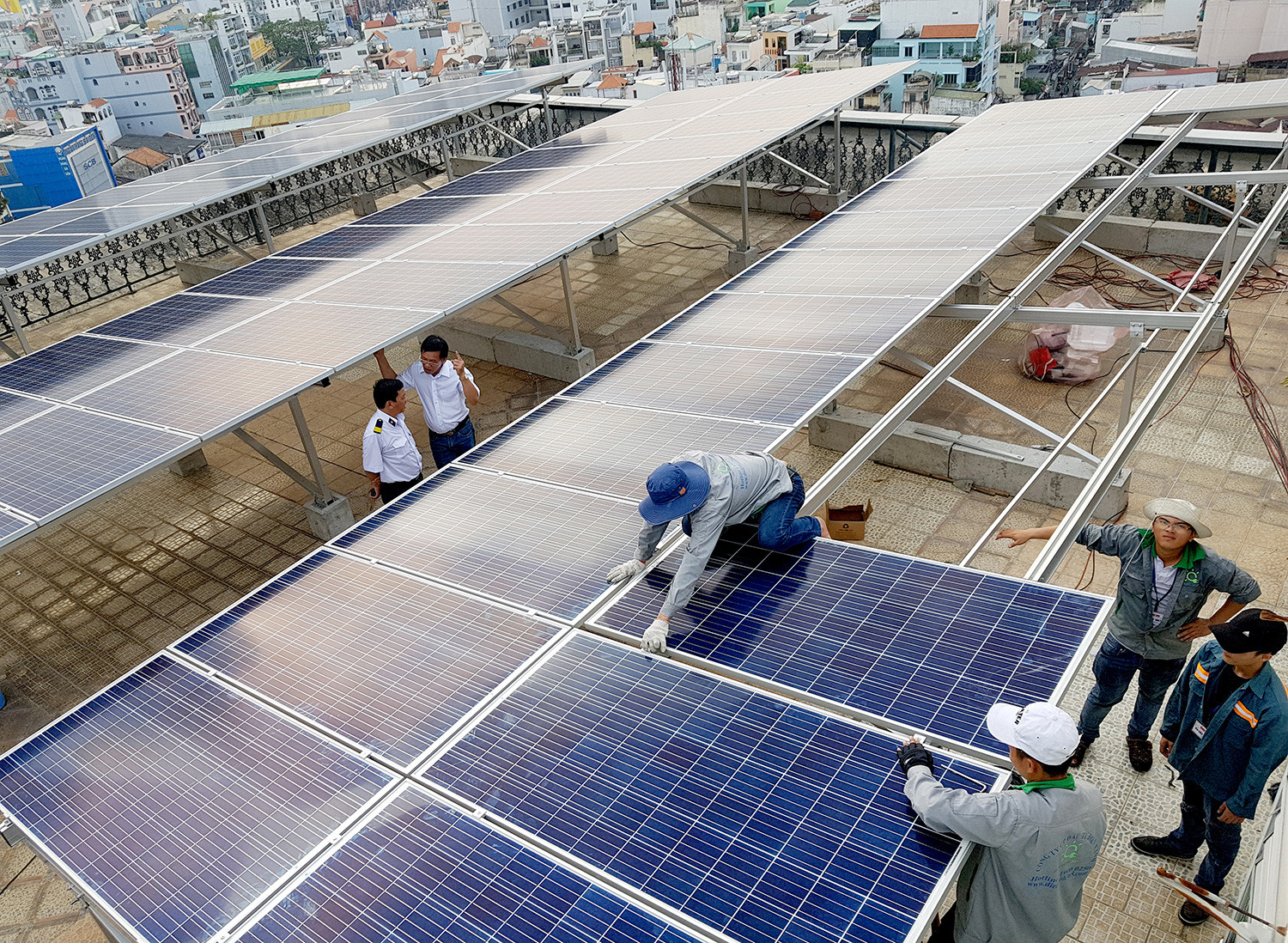
The Ministry of Industry and Trade stated that the development of these regulations is in accordance with the National Power Development Plan for the period 2021-2030, with a vision to 2050 (Power Plan 8), approved by the Prime Minister.
The regulations state: "Priority and encouragement should be given to the development of self-produced and self-consumed wind and solar power (including rooftop solar power of people and buildings, solar power at production and business establishments, consumed on-site, not connected to or sold to the national power grid)."
Meeting self-consumption needs
Therefore, this draft proposes regulations for two types of rooftop solar power development: connected to and not connected to the national power grid. The zero-price policy only applies to surplus "self-produced" rooftop solar power generated and fed into the national grid, with a capacity limit of 2,600 MW.
"The reason why rooftop solar power that generates electricity for self-consumption and feeds it into the national grid will cost 0 VND is because the State wants to encourage individuals and organizations to develop rooftop solar power to meet their own needs, contributing to reducing pressure on the national power system," the Ministry of Industry and Trade emphasized.
According to the ministry, although Vietnam's power grid infrastructure has been invested in, upgraded, and gradually modernized over the years, it cannot fully meet all power needs at various capacity levels.
To meet this demand, it requires storage technology, grid system operation and dispatching technology, and a base power source that can promptly generate electricity when wind and solar power declines.
If the development of self-sufficient rooftop solar power is encouraged and unlimited grid connection is allowed, the Vietnam Electricity Group (EVN) will face many difficulties in grid operation and a very high risk of national power system safety breaches.
This power source depends on solar radiation, but this is an unpredictable factor. Even without solar radiation, the national grid must still ensure sufficient power supply. This leads to rapid fluctuations in the system, making the base-load power source unstable.
Encouragement to prevent policy abuse.
Meanwhile, the current power reserve ratio remains low, and there is no synchronized national-scale power storage solution. Therefore, measures are needed to limit the proportion of grid-connected solar power to ensure the stable operation of the power system and avoid disruptions to the planning.
In addition, Power Development Plan 8 encourages the development of self-sufficient rooftop solar power, but does not permit the sale of electricity. The goal is to focus on using solar power to self-supply energy for households and businesses, promoting energy saving and reducing electricity consumption from the national grid.
Given the current conditions of the transmission and distribution system and the balance of power sources, the Ministry of Industry and Trade affirms that the solution of preventing reverse power generation and the solution of purchasing electricity at zero cost when it is fed into the national grid is necessary and appropriate. This both encourages the self-production and self-consumption of rooftop solar power and prevents the exploitation of the policy.
To encourage this type of project, the draft proposes incentive mechanisms, such as exemption from electricity operation licenses; construction projects with self-generating and self-consuming rooftop solar power systems do not need to adjust or supplement energy land and functional requirements as stipulated by law; and the implementation procedures are simplified…
HA (according to Tuoi Tre newspaper)Source


![[Photo] Prime Minister Pham Minh Chinh holds a phone call with the CEO of Russia's Rosatom Corporation.](/_next/image?url=https%3A%2F%2Fvphoto.vietnam.vn%2Fthumb%2F1200x675%2Fvietnam%2Fresource%2FIMAGE%2F2025%2F12%2F11%2F1765464552365_dsc-5295-jpg.webp&w=3840&q=75)































































Comment (0)