

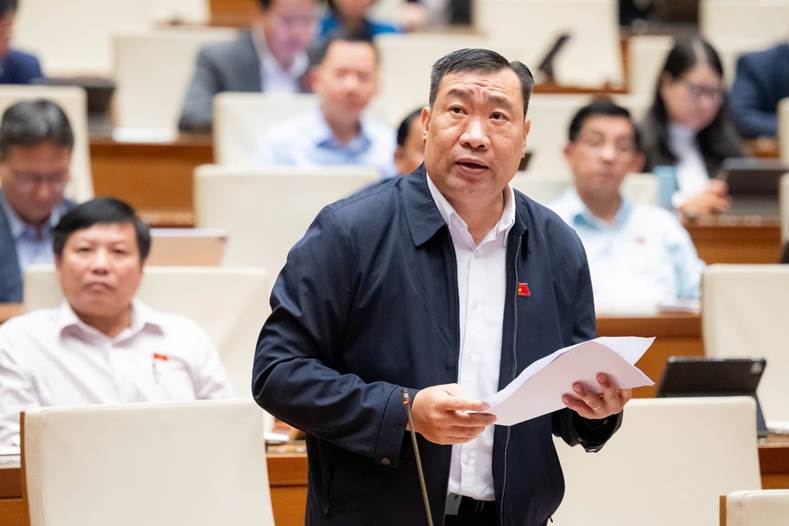
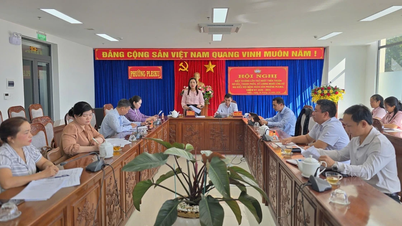
On the morning of December 5, participating in the discussion at the hall on the investment policy of the National Target Program (NTP) on new rural areas (NTM), sustainable poverty reduction, socio -economic development in ethnic minority and mountainous areas until 2035, delegate Thach Phuoc Binh - Provincial Party Committee member, Deputy Head of the National Assembly Delegation of Vinh Long province emphasized the need to adjust the target and increase the central budget to ensure the effectiveness of this Program.
|
Delegate Thach Phuoc Binh - Member of the Provincial Party Committee, Deputy Head of the National Assembly Delegation of Vinh Long province discussed at the Hall on the morning of December 5, 2025 (Photo: media.quochoi.vn) |
First, about specific goals
Delegates said that the Program aims to increase rural income by 2.5 to 3 times by 2030 compared to 2020; reduce the multidimensional poverty rate in ethnic minority areas to below 10%; strive for 65% of communes to meet NTM standards, of which 10% will meet modern NTM standards; and aim for 100% of poor communes to escape poverty. By 2035, the goal is to continue to increase rural income by at least 1.6 times, reaching 85% of NTM communes, of which 30% will be modern NTM, and reduce the number of disadvantaged communes - villages - hamlets in ethnic minority and mountainous areas by 50%.
However, at present, the poverty rate in the Northwest is still over 20%, the Northeast is about 9-10%, the Central Highlands is about 7-8% and many particularly difficult communes still have over 30% of poor households; therefore, the goal of "100% of poor communes escaping poverty by 2030" is very difficult to achieve without particularly large resources. Similarly, the expectation that 80% of ethnic minority households will produce agricultural and forestry commodities is not close to reality, when the current rate of commodity production in many localities is only 30-40% and depends heavily on the market, infrastructure and production organization capacity.
In addition, some important areas do not have clear quantified targets, such as: (1) Rural digital transformation, although currently only about 40-50% of households have stable Internet access in difficult areas; (2) Reducing re-poverty, while the re-poverty rate in ethnic minority areas still fluctuates at 0.8-1%/year; (3) Developing enterprises and cooperatives, when many mountainous communes do not have effectively operating cooperatives; (4) Essential infrastructure, while only about 65-70% of domestic water in ethnic minority areas meets standards, and only 50-60% of village roads are paved.
Therefore, delegates proposed adjusting some targets to be closer to the regional situation, and adding quantifiable targets such as: The re-poverty rate remains below 0.5%/year by 2030; 70% of communes provide level 4 online public services; 90% of rural households have broadband internet; Each commune has at least one effectively operating cooperative; 50% of OCOP products participate in the linked value chain; 100% of schools and health stations in ethnic minority areas meet minimum standards of facilities; 80% of village roads are paved by 2030.
Second, on the scope, time and cost of implementation
The delegate said that the Program is determined to be implemented nationwide, with priority given to ethnic minority and mountainous areas. This is an approach that is consistent with the characteristics of the integrated program, ensuring policy consistency while providing clear direction for disadvantaged areas where there are still large gaps in income, infrastructure and access to basic social services. On the other hand, the program is designed in a 10-year cycle, divided into two phases 2026-2030 and 2031-2035. This arrangement allows for mid-term evaluation, appropriate policy and resource adjustments, and ensures continuity in implementation.
However, the biggest problem now lies in the funding structure. With a total capital of 500,000 billion VND for the 2026-2030 period, of which the central budget is only 100,000 billion VND and the local budget is up to 400,000 billion VND, delegates said that this structure does not accurately reflect the financial capacity of each region. Currently, most provinces in ethnic minority and mountainous areas have low budget revenue; many provinces in the Northwest only reach 2,000-5,000 billion VND per year, the Central Highlands and the Southwest also mainly rely on the central government's balanced support. Therefore, requiring localities to contribute 80% of the total capital is very difficult to achieve. In addition, the draft Resolution has not clarified the capital allocation mechanism according to the level of difficulty, and has not clearly stipulated the capital ratio for essential infrastructure, digital transformation, or enterprise and cooperative development, while these are key contents to achieve the goal of modern new rural areas and sustainable poverty reduction.
Therefore, the delegates proposed: First, increase the proportion of the central budget to 180,000 to 200,000 billion VND to help reduce pressure on localities. Second, apply capital allocation according to 3 levels of difficulty to avoid average and spread allocation; ensure capital "flows" to the poorest and most difficult places; increase investment efficiency, reduce regional differences; help localities proactively design plans suitable to their capacity and needs.
Specifically: Group 1 - Extremely difficult areas (highest priority) include extremely difficult communes, remote villages, border areas, and very small ethnic groups. Support level: 150-180% of the general standard. Priority capital for: essential infrastructure, domestic water, transportation, livelihood conversion, schools and stations.
Group 2 - Medium difficulty areas include: communes in region II and region III that have escaped the extremely difficult situation but still lack infrastructure. Support level: 100% of the general norm. Capital priority for: completing infrastructure, producing goods, digital transformation. Group 3 - Less difficult areas include: communes in region I and communes that have met the NTM standards but still need to upgrade. Support level: 70-80% of the general norm. Capital priority for: improving service quality, advanced NTM, modern NTM. Third, supplement the mechanism for mobilizing non-budgetary capital, striving to reach 25-30% of total resources. Fourth, clearly define the capital ratio for digital transformation, essential infrastructure and livelihood development. Delegates said that these adjustments will also ensure that the program has sufficient resources, is implemented closely to reality and achieves sustainable goals for the 2026 - 2035 period.
BUILDING THE NATION (recorded)
Source: https://baovinhlong.com.vn/kinh-te/202512/dieu-chinh-muc-tieu-tang-ngan-sach-trung-uong-de-bao-dam-hieu-qua-chuong-trinh-muc-tieu-quoc-gia-2026-2035-6a71907/




![[Photo] 60th Anniversary of the Founding of the Vietnam Association of Photographic Artists](/_next/image?url=https%3A%2F%2Fvphoto.vietnam.vn%2Fthumb%2F1200x675%2Fvietnam%2Fresource%2FIMAGE%2F2025%2F12%2F05%2F1764935864512_a1-bnd-0841-9740-jpg.webp&w=3840&q=75)
![[Photo] National Assembly Chairman Tran Thanh Man attends the VinFuture 2025 Award Ceremony](/_next/image?url=https%3A%2F%2Fvphoto.vietnam.vn%2Fthumb%2F1200x675%2Fvietnam%2Fresource%2FIMAGE%2F2025%2F12%2F05%2F1764951162416_2628509768338816493-6995-jpg.webp&w=3840&q=75)












































































Comment (0)