

| Textile and garment industry: Enhancing productivity and alleviating labor cost pressures; Developing niche markets for the textile and garment industry: A game for the "big players" |
According to information from the Vietnam Textile and Garment Association, the Association, as the organizing unit, has sent a delegation to attend the Sourcing at Magic 2024 trade fair in Las Vegas, USA, combining it with market research and assessment. The fair will conclude on August 29, 2024.
Starting in 2017, with the goal of strengthening and promoting its presence in the US market, the largest export market for Vietnam's textile and garment industry, the Vietnam Textile and Garment Association invested in building a uniquely designed Vietnamese pavilion with strong Vietnamese identity and high recognition. The pavilion features stylized details such as a wooden gate and prominent decorations with a Vietnamese nameplate, showcasing the innovation and potential of Vietnam's textile and garment industry. This year, the Vietnamese pavilion is strategically located very close to the main stage, along the main road, with a total of 16 booths.
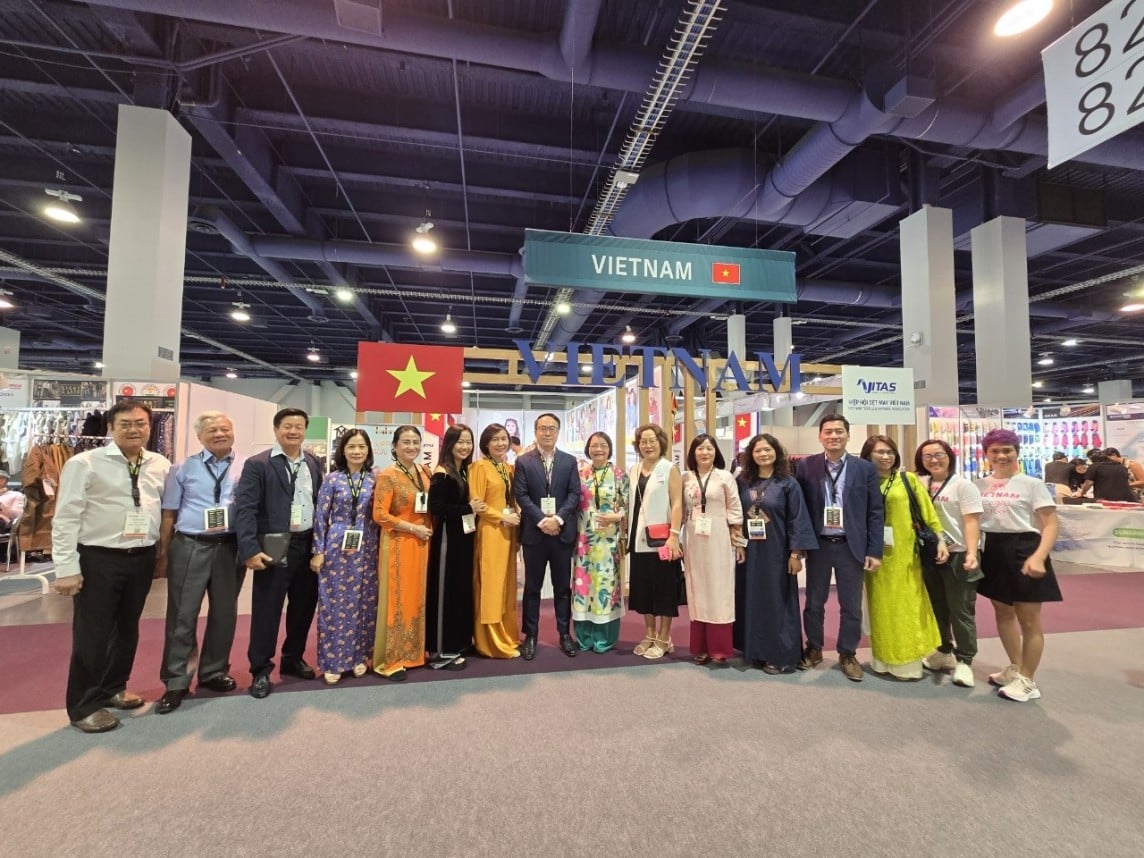 |
| The Vietnamese business delegation and the Vietnamese Trade Office in the US at the Sourcing at Magic 2024 trade fair. Photo: Vitas |
The Vietnamese pavilion, with its diverse range of products, materials, and designs that meet market trends, and its eye-catching booth decorations, attracted considerable attention from visitors and those working with Vietnamese businesses.
On the first day alone, following the booth setup, the number of visitors to the Vietnamese booths reached nearly 200. On average, each business met with more than 10 customers that day.
According to the assessment of businesses participating in the Sourcing at Magic 2024 trade fair, Vietnam's location was better than the previous year, with a prominent design that attracted a large number of visitors. The customers visiting the Vietnamese booth were of high quality, and some businesses received orders for sample products. Businesses conducting market research, although without booths, brought their products to showcase and introduce them. These are truly encouraging signs for businesses.
The US is a traditional export market and accounts for a large share of Vietnam's textile and garment exports. In the first six months of the year, the US imported $7.2 billion worth of Vietnamese textiles and garments. Vietnamese products in this sector hold a 7.2% market share in the US, second only to China.
According to the Vietnam Textile and Garment Association, with many new and stringent regulations, exporting textiles and garments to the US market is becoming increasingly difficult, especially with regard to supply chain control. Citing information from the US Department of Homeland Security, the Vietnam Textile and Garment Association stated that reports from the garment industry indicate that over 95% of US textile and garment companies have actively strengthened their supply chain due diligence efforts by using technology and verification tools.
With its new textile enforcement plan, the U.S. Department of Homeland Security is expanding its enforcement efforts to minimize the risk of cotton originating from the Xinjiang Uygur Autonomous Region in shipments and to protect the textile industry's investment in clean supply chains under free trade agreements.
Because the U.S. Department of Homeland Security is focusing enforcement on apparel and cotton products, importers have shifted their supply chains away from China to mitigate risks. The Xinjiang Uygur Autonomous Region produces 10% of the world's polyvinyl chloride, much of which is used in the manufacture of vinyl flooring.
U.S. imports of polyvinyl chloride products have fallen 48 percent over the past 12 months as importers shift away from suppliers using polyvinyl chloride sourced from the Xinjiang Uygur Autonomous Region in some flooring products. The U.S. Department of Homeland Security said industry reports acknowledge these shifts away from the Chinese supply chain and have led to expanded flooring production capacity in the U.S., Mexico, India, and Vietnam.
Source: https://congthuong.vn/doanh-nghiep-det-may-tim-co-hoi-tai-thi-truong-my-340671.html























































































Comment (0)