

The research project "Developing a highly reliable gigabit data transmission system intelligently combining laser and radio waves for areas with complex terrain and harsh weather conditions," funded by the National Foundation for Science and Technology Development (NAFOSTED), was carried out by Assoc. Prof. Dr. Nguyen Tan Hung, University of Da Nang, and his colleagues.
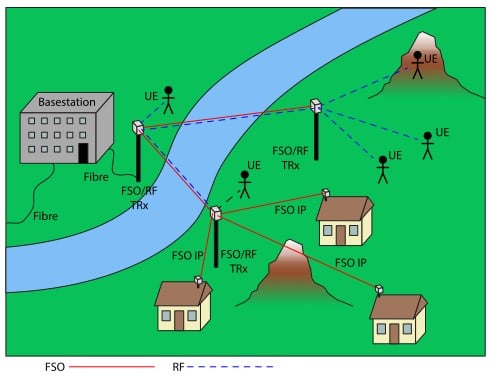
General simulation of a coupling system between FSO and radio waves for areas with rugged terrain and harsh weather conditions.
According to Dr. Nguyen Tan Hung, wireless communication using laser light is a high-speed information transmission technology that can be installed quickly and at a much lower cost than fiber optic cable technology, especially in areas with complex terrain such as hills, mountains, rivers, or urban areas with high density of tall buildings.
In areas frequently affected by natural disasters such as storms and floods, building a network system using cables is very difficult. Natural disasters can completely destroy cable systems, and restoration can take months or even years. Meanwhile, wireless transmission using lasers can be restored within days, or even hours, after a disaster. Therefore, this technology is considered the most suitable high-speed communication technology for rural areas, remote regions, and mountainous areas with difficult terrain and prone to natural disasters in Vietnam.
However, FSO also faces significant challenges, such as high sensitivity to fog, smoke, rain, and atmospheric aerosols, which degrade signals and disrupt connections. Improving reliability becomes a key factor for this technology to be widely adopted.
Based on that practical need, the project led by Assoc. Prof. Dr. Nguyen Tan Hung focuses on developing a wireless communication system using high-speed lasers (Gigabits per second) with flexible configuration and real-time processing to meet various weather conditions.
To achieve this, the project proposes using encoding techniques with high spectral efficiency and energy efficiency, such as multi-band phase and amplitude modulation (CAP) or orthogonal frequency division multiplexing (OFDM), combined with advanced channel equalization techniques to improve transmission quality. Advanced pulse filtering techniques such as Xia and SRRC pulse formats are also used to enhance system efficiency. The system is implemented in real time on a system-on-a-chip (SoC) platform using FPGA technology.
Furthermore, to avoid connection interruptions due to bad weather and ensure channel reliability, this project proposes a soft-switching solution for high-speed laser wireless communication and RF radio communication systems through an automatic power control mechanism based on weather conditions. This is a novel and effective method because it allows the system to automatically control itself according to weather fluctuations. Based on this, resources are optimally distributed between the laser and radio channels to ensure system continuity at the highest transmission speed.
The proposed solutions and techniques of this project have been recognized through a granted patent, two publications in prestigious international journals, and contributions to the training of postgraduate students. The project was implemented in international collaboration with Northumbria University, UK, a world- leading research institution in laser-based wireless communication.

The experimental system for this research project is located at Northumbria University, UK.
Representing the research team, Associate Professor Dr. Nguyen Tan Hung shared that the team expects the developed methods and technical structures to overcome the limitations of traditional FSOs, bringing gigabit data transmission technology closer to practical applications in Vietnam. When connected to high-speed internet, this solution can bring economic , educational, and social value to millions of people living in remote areas and regions frequently affected by natural disasters – where the need for a sustainable communication system is always urgent.
Source: https://mst.gov.vn/dot-pha-he-thong-truyen-thong-gigabit-ket-hop-laser-va-song-vo-tuyen-trong-dieu-kien-thoi-tiet-khac-nghiet-197251212001734068.htm
![[Photo] Prime Minister Pham Minh Chinh holds a phone call with the CEO of Russia's Rosatom Corporation.](/_next/image?url=https%3A%2F%2Fvphoto.vietnam.vn%2Fthumb%2F1200x675%2Fvietnam%2Fresource%2FIMAGE%2F2025%2F12%2F11%2F1765464552365_dsc-5295-jpg.webp&w=3840&q=75)



![[Photo] Closing Ceremony of the 10th Session of the 15th National Assembly](/_next/image?url=https%3A%2F%2Fvphoto.vietnam.vn%2Fthumb%2F1200x675%2Fvietnam%2Fresource%2FIMAGE%2F2025%2F12%2F11%2F1765448959967_image-1437-jpg.webp&w=3840&q=75)

































































Comment (0)