

The science and technology project "Research, design, and fabrication of a biological propulsion system for the swimming locomotion mechanism of fish using longitudinal caudal fins for a guided underwater robot for marine research applications" is led by Dr. Duong Van Tu and is part of the Physics Development Program for the period 2021-2025.
According to the report, the team successfully simulated the characteristic locomotion mechanism of fish using their tail fins through biomimicry and built an underwater robot using this propulsion system for testing in real-world deep-water conditions.
The outstanding results of the mission are demonstrated in the complete scientific product system, including a 3D model simulating fish movement, a motion control and 3D trajectory simulation program, design documentation and operating and maintenance manuals for the equipment, and a report on the results of practical testing of the underwater robot.
All products met the requirements regarding quantity, volume, and quality as classified by the evaluation committee.
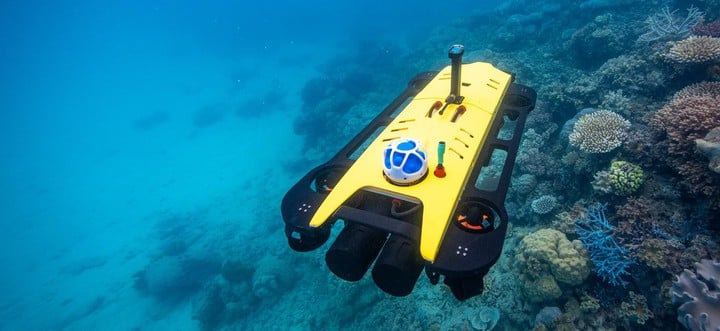
Illustration.
Notably, the team developed a control algorithm suite encompassing motion control, depth control, orientation control, and trajectory tracking, combined with CFD simulation and hydrodynamic kinematic modeling. This algorithmic system enables the underwater robot to operate stably and flexibly in real water environments, meeting the requirements for movement, deep diving, and efficient payload carrying.
The topic of biomimetic underwater robots mimicking fish species offers many practical benefits for socio-economic development, especially in the context of the increasing need for exploitation, protection, and management of marine resources.
First and foremost, mastering domestic underwater robot technology significantly reduces dependence on imported equipment, which is often very expensive, difficult to maintain, and limited in customization. The ability to design and manufacture high-performance, low-noise, and flexible underwater robot models opens up opportunities for commercialization for marine research units, training institutions, hydrological survey businesses, or water management organizations.
From a societal perspective, robots can assist in many crucial tasks such as environmental monitoring, water quality assessment, watershed surveillance, inspection of underground structures, reservoirs, and coastal infrastructure without requiring direct human intervention in hazardous environments. This contributes to workplace safety and reduces risks in manual diving operations.
Furthermore, this project helps train high-quality human resources in the fields of underwater robotics, mechatronics, and automatic control, thereby promoting domestic scientific and technological capabilities. The development of biomimetic robots also lays the groundwork for expanding the marine technology ecosystem, supporting a sustainable marine economic development strategy.
Source: https://mst.gov.vn/hoan-thien-robot-ngam-phong-sinh-hoc-mo-phong-chuyen-dong-ca-bang-vay-than-doc-duoi-197251211230237573.htm



























































Comment (0)