

Recently, the Quality of Higher Education (QILT) survey site in Australia has released the Graduate Employment Report 2024 (GOS) for international students. QILT is a program funded by the Australian Government, conducting nationwide surveys to evaluate and improve the quality of higher education , from learning experience to employment after graduation. The report is based on an online survey of 30,491 international students, of which about 1,250 are Vietnamese.

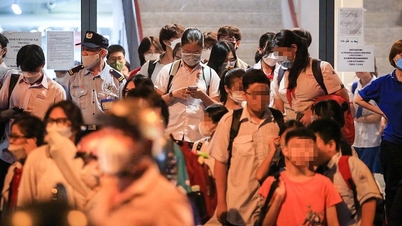
Vietnamese students studying in Australia (Photo: QT).
According to GOS 2024, only 51.6% of Vietnamese university graduates in Australia have full-time jobs, down 7.3% compared to 2023 (58.9%). At the postgraduate level (masters, doctorates), the employment rate of Vietnamese international students is 63.4%, lower than the previous year's 68.2%. In the research-oriented postgraduate group, this rate decreased slightly by 0.2%.
In terms of monthly income, Vietnamese undergraduate students have an average salary of 63,700 AUD, lower than international students (68,000 AUD) and local students (75,000 AUD). At the postgraduate level, Vietnamese students receive an average of 71,300 AUD, while international students are 70,000 AUD and local students are 100,000 AUD. In the research postgraduate group, Vietnamese students are paid 97,800 AUD, higher than the international average (95,600 AUD) but still lower than local students (104,400 AUD).
In general, international students in Australia have lower rates of full-time employment than domestic students, the difference is most obvious at undergraduate and postgraduate levels. Their income is also often lower than domestic students at all levels. The countries with the largest numbers of international students in Australia include China, India and Nepal. Popular fields of study for international students include Business - Management, Information Technology and Information Systems, Engineering, Science - Mathematics...
Another reason why international students have difficulty finding jobs and low income is the tendency to continue studying full-time after graduation. This rate is almost double that of domestic students. More than 1/3 of international undergraduate students choose to continue studying, while domestic students often go to work first, accumulate experience and thus have better job opportunities and higher income when studying for postgraduate programs.
Source: https://dantri.com.vn/giao-duc/du-hoc-sinh-viet-o-australia-ngay-cang-kho-kiem-viec-20251201134632347.htm

![[Photo] Parade to celebrate the 50th anniversary of Laos' National Day](/_next/image?url=https%3A%2F%2Fvphoto.vietnam.vn%2Fthumb%2F1200x675%2Fvietnam%2Fresource%2FIMAGE%2F2025%2F12%2F02%2F1764691918289_ndo_br_0-jpg.webp&w=3840&q=75)


![[Photo] Worshiping the Tuyet Son statue - a nearly 400-year-old treasure at Keo Pagoda](/_next/image?url=https%3A%2F%2Fvphoto.vietnam.vn%2Fthumb%2F1200x675%2Fvietnam%2Fresource%2FIMAGE%2F2025%2F12%2F02%2F1764679323086_ndo_br_tempimageomw0hi-4884-jpg.webp&w=3840&q=75)




























![[Video] Protecting World Heritage from Extreme Climate Change](https://vphoto.vietnam.vn/thumb/402x226/vietnam/resource/IMAGE/2025/12/03/1764721929017_dung00-57-35-42982still012-jpg.webp)
























































Comment (0)